AI Customer Support Chatbot Development for Ecommerce Websites
Running an ecommerce business involves more than displaying products and accepting online orders.
Customers often need assistance before and after making a purchase.
They may want to compare products, understand delivery options, check stock availability, track orders, request returns, or contact the support team.
When these questions arrive through different communication channels, customer support teams may spend significant time answering repeated enquiries.
This is one reason online store owners are exploring AI customer support chatbot development for ecommerce websites.
An AI chatbot can help shoppers find relevant information, navigate product categories, submit support requests, and access verified order details through secure integrations.
For ecommerce businesses using Shopify, WooCommerce, or custom ecommerce platforms, a properly developed chatbot may support customer service workflows and reduce some repetitive administrative tasks.
However, a chatbot must provide accurate information, protect customer data, and know when to transfer a conversation to a human employee.
In this guide, we explain how ecommerce AI chatbots work, which features are useful, how integrations are developed, what security controls are needed, and how businesses can plan a chatbot project.
What Is an AI Customer Support Chatbot for Ecommerce?
An ecommerce AI customer support chatbot is a conversational software application that helps online shoppers access information and complete supported customer service activities.
Depending on the implementation, the chatbot may use artificial intelligence to interpret customer questions and provide responses based on approved business information.
Examples include:
- Product information assistance
- Order tracking support
- Shipping policy explanations
- Returns and refund information
- Product category guidance
- Customer support ticket creation
- Human support routing
The chatbot should not invent product specifications, delivery commitments, refund decisions, or order information.
How Does an Ecommerce AI Chatbot Work?
A typical ecommerce chatbot connects a website chat interface with approved business information and selected ecommerce systems.
The process may include:
- A customer opens the chatbot.
- The customer asks a question.
- The chatbot identifies the request.
- The system retrieves relevant approved information.
- The AI prepares an appropriate response.
- The system validates the response or required action.
- The chatbot responds or escalates the request to a human employee.
A simplified workflow is:
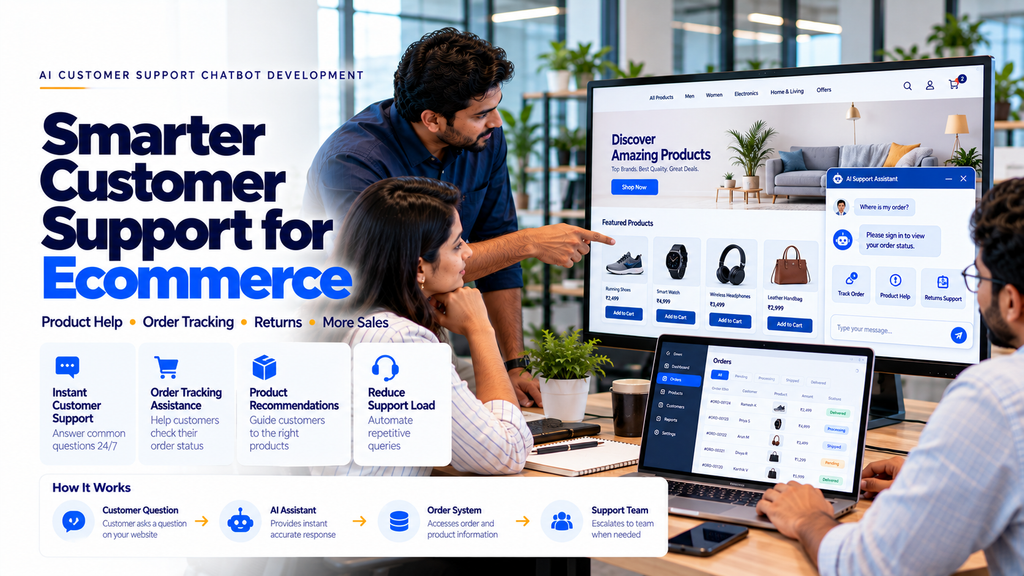
Customer Question → AI Chatbot → Product or Order System → Verified Response → Customer
Customer-specific information must only be accessed after suitable authentication and authorization.
Why Ecommerce Websites Need Better Customer Support
Online shoppers may have questions at different stages of the purchasing journey.
Before purchasing, they may ask about:
- Product specifications
- Available sizes or variants
- Delivery options
- Payment methods
- Return policies
After purchasing, they may ask about:
- Order confirmation
- Shipment status
- Delivery delays
- Returns
- Refund progress
- Product support
A chatbot can help organize suitable enquiries and provide access to relevant information when connected systems support the required functionality.
1. AI Product Information Assistance
Customers often need more information before selecting a product.
An AI chatbot may help shoppers find relevant details from an approved product catalogue.
For example:
Customer: Is this product available in different sizes?
Chatbot: I can check the available variants for this product.
The response should be based on actual product information.
2. AI Product Recommendation Chatbots
Product recommendation chatbots can help customers explore suitable products based on stated preferences.
For example, a customer may ask:
Customer: I need a laptop bag for daily office use.
The chatbot may ask about preferred size, features, and budget before presenting relevant products from the store catalogue.
Recommendations should use accurate product attributes and avoid fabricated claims.
3. AI Chatbots for Order Tracking
Order tracking is a common ecommerce support requirement.
A chatbot may help authenticated customers access order status information through an approved ecommerce integration.
A possible workflow is:
Customer Authentication → Order Lookup → Verified Order Status → Customer Response
Important security requirements include:
- Customer authentication
- Order ownership verification
- Secure API access
- Limited data exposure
- Appropriate session management
A chatbot should never reveal order information based only on an unverified order number.
4. Shipping and Delivery Support
Customers may want to understand delivery options and shipping policies.
A chatbot can help explain approved information such as:
- Shipping methods
- Delivery coverage
- Shipping charges
- Estimated delivery policies
- Shipment tracking procedures
Real-time delivery information should come from connected shipping or order systems.
5. Returns and Refund Support
Returns and refunds often require careful handling.
An AI chatbot may help customers:
- Find return policy information
- Understand the return request process
- Submit a support request
- Check verified request status
- Contact the support team
Refund eligibility and payment decisions should follow approved store policies and authorized business workflows.
6. AI Chatbots for Frequently Asked Questions
Many ecommerce customers ask similar questions.
Examples include:
- What payment methods are accepted?
- How can I track my order?
- What is the return policy?
- How do I contact support?
- Do you deliver to my location?
- How can I change my account details?
A chatbot can provide answers based on approved and regularly updated store information.
7. AI Chatbots for Customer Support Ticket Creation
Some customer issues require human assistance.
A chatbot can help collect relevant details and create a support ticket.
A possible workflow is:
Customer Request → Issue Classification → Support Ticket → Assigned Agent → Resolution
Potential features include:
- Ticket creation
- Issue categorization
- Priority routing
- Agent assignment
- Status tracking
- Conversation history
8. Human Handoff in Ecommerce Chatbots
A chatbot should provide a practical way to reach a human support agent.
Human escalation may be necessary when:
- The chatbot cannot answer confidently
- A customer reports a complicated order problem
- A refund requires review
- A complaint needs personal attention
- Sensitive account information is involved
Human handoff helps prevent customers from becoming trapped in an automated conversation.
9. AI Chatbots for Shopify Stores
Shopify stores may integrate AI chatbots through supported applications or custom development.
Possible features include:
- Product information assistance
- Product catalogue search
- Customer support enquiries
- Authenticated order tracking
- Shipping policy information
- Support ticket integration
Implementation should respect Shopify permissions, API limits, customer privacy, and storefront performance.
10. AI Chatbots for WooCommerce Websites
WooCommerce websites may integrate AI chatbots using suitable plugins, APIs, or custom software.
Potential applications include:
- Product search
- Product variation information
- Customer support
- Order status assistance
- Returns enquiry collection
- Customer service routing
Customer-specific order information should only be provided after appropriate identity verification.
11. AI Chatbots for Custom Ecommerce Platforms
Custom ecommerce websites may require a dedicated chatbot interface and backend integration.
A typical architecture may include:
Website Chat Widget → Secure Backend → AI Service → Ecommerce APIs → Verified Response
Important development considerations include:
- Authentication
- API permissions
- Product data access
- Order system integration
- Conversation logging
- Error handling
- Human escalation
12. AI Chatbot Integration With CRM Software
CRM integration may help ecommerce businesses organize customer enquiries.
Potential features include:
- Customer enquiry records
- Support history
- Lead categorization
- Staff assignment
- Follow-up tasks
- Customer service reporting
Integration should respect customer privacy and role-based permissions.
13. AI Chatbot Integration With Helpdesk Software
Helpdesk integration can help support teams manage requests that require human assistance.
A chatbot may create a ticket, summarize the issue, and route it to the appropriate team.
AI-generated summaries should be checked for accuracy when they affect customer support decisions.
14. WhatsApp Integration for Ecommerce Customer Support
Some ecommerce businesses may want to connect website chatbot workflows with approved WhatsApp Business communication.
Possible uses include:
- Customer enquiry routing
- Approved order notifications
- Support request follow-ups
- CRM updates
WhatsApp Business Platform integrations must follow applicable platform policies, messaging requirements, and customer consent rules.
15. Multilingual Ecommerce AI Chatbots
Ecommerce stores may serve customers who prefer different languages.
Depending on the selected AI model and implementation, chatbot support may include Tamil and English.
Multilingual chatbots should be tested for:
- Product terminology
- Customer intent
- Mixed-language questions
- Policy accuracy
- Human escalation
Businesses should not assume all translations or responses will be correct without evaluation.
16. AI Chatbot Knowledge Base Development
A chatbot knowledge base contains approved information that can support customer responses.
For ecommerce businesses, this may include:
- Product descriptions
- Shipping policies
- Returns policies
- Payment information
- Customer support procedures
- Frequently asked questions
Knowledge base information should be reviewed and updated when store policies or product details change.
17. Retrieval-Augmented Generation for Ecommerce
Retrieval-Augmented Generation, or RAG, is an approach that retrieves relevant information from approved sources and supplies it to an AI model when generating a response.
For example:
Customer Question → Retrieve Relevant Product or Policy Information → Generate Response → Apply Validation
RAG can help ground answers in store information, but it does not eliminate incorrect responses.
18. AI Chatbot vs Traditional Live Chat
| Traditional Live Chat | AI Customer Support Chatbot |
|---|---|
| Typically requires an available human agent | Can handle selected routine enquiries automatically |
| Human agents interpret customer requests | AI interprets questions with possible errors |
| Suitable for complex support conversations | Useful for common information requests |
| Response availability depends on staffing | Can provide automated assistance when systems are available |
| Human judgment is directly involved | Requires safeguards and human escalation |
Many ecommerce businesses may benefit from combining automated assistance with human support.
19. Essential Features of an Ecommerce AI Chatbot
| Feature | Business Purpose |
|---|---|
| Product Knowledge | Answer approved product questions |
| Catalogue Search | Help customers find relevant products |
| Order Tracking | Retrieve verified order status |
| Returns Support | Explain policies and collect requests |
| Helpdesk Integration | Create and route support tickets |
| Human Handoff | Escalate complex enquiries |
| Mobile-Friendly Interface | Support customers on smartphones |
| Security Controls | Protect customer information |
20. Ecommerce AI Chatbot UI/UX Design
The chatbot should feel like a natural part of the ecommerce website.
Useful design practices include:
- Clearly visible chatbot launcher
- Readable message bubbles
- Mobile-responsive chat panel
- Accessible controls
- Simple quick-action options
- Visible close and minimize controls
- Clear human support option
- Minimal interference with shopping navigation
The chatbot should not block checkout buttons, product options, or important store content.
21. Mobile-Friendly AI Chatbots
Many ecommerce customers browse stores using smartphones.
A mobile chatbot should:
- Fit smaller screens
- Support touch interaction
- Keep text readable
- Avoid covering essential shopping controls
- Load efficiently
- Provide an easy way to close the conversation
22. AI Chatbot Performance and Website Speed
Adding a chatbot introduces additional scripts and network requests.
Developers should evaluate the impact on website performance.
Useful practices include:
- Loading nonessential chatbot resources when needed
- Reducing unnecessary JavaScript
- Optimizing chatbot assets
- Monitoring loading performance
- Testing mobile devices
- Reviewing accessibility
A chatbot should not significantly reduce the usability of the ecommerce store.
23. AI Chatbot Security for Ecommerce Websites
Ecommerce chatbots may process customer information and connect to private order systems.
Important safeguards include:
- Secure authentication
- Order ownership verification
- Role-based permissions
- Protected API credentials
- Input validation
- Appropriate encryption
- Conversation retention controls
- Prompt injection defenses
- Logging and monitoring
Payment card details and other highly sensitive information should not be unnecessarily collected through chatbot conversations.
24. Customer Data Privacy
Businesses should clearly understand what information the chatbot collects, stores, and sends to external services.
Important considerations include:
- Customer consent
- Purpose of data collection
- Data minimization
- Retention periods
- Vendor data handling
- Access permissions
- Applicable privacy requirements
25. Preventing Incorrect AI Responses
AI chatbots may occasionally generate inaccurate information.
To reduce risk, businesses should:
- Use verified product information
- Connect order queries to reliable systems
- Restrict unsupported claims
- Validate important responses
- Test common customer questions
- Monitor incorrect answers
- Provide human escalation
- Update the knowledge base
26. Can AI Chatbots Process Refunds Automatically?
Refund processing may involve financial decisions, customer identity verification, and store policy requirements.
A chatbot can help explain the process and collect relevant support information.
Automatic refund actions should only be implemented when supported by secure, approved workflows with appropriate authorization, transaction limits, and audit controls.
27. Can AI Chatbots Change Customer Orders?
Order modifications may be possible through authorized integrations.
However, the system must verify the customer’s identity, confirm the requested change, and enforce store rules.
Important order changes may require human review.
28. AI Chatbot Development Process for Ecommerce
- Requirement Analysis: Identify customer support goals and store requirements.
- Platform Assessment: Review Shopify, WooCommerce, or custom ecommerce capabilities.
- Knowledge Preparation: Organize product and policy information.
- Conversation Design: Define customer support journeys.
- UI/UX Development: Build a suitable chat interface.
- AI Integration: Configure the selected AI service.
- Ecommerce Integration: Connect approved product, order, and support APIs.
- Security Testing: Verify authentication, permissions, and data protection.
- Response Testing: Evaluate accuracy and failure scenarios.
- Deployment: Integrate the chatbot into the live store.
- Monitoring: Review performance, errors, and customer feedback.
29. How to Measure Ecommerce Chatbot Performance
Businesses should define measurable outcomes before deployment.
Possible indicators include:
- Customer support enquiries handled
- Correct answer rate
- Human escalation rate
- Support ticket creation rate
- Customer satisfaction feedback
- Order tracking query completion
- Average support handling time
- Chatbot-related technical errors
Chatbot conversation volume alone does not demonstrate customer satisfaction or increased sales.
30. Benefits of AI Customer Support Chatbots
Support for Routine Enquiries
Chatbots can help customers find approved information without requiring an employee for every simple question.
Better Product Information Access
Customers can ask questions using natural language.
Organized Support Requests
Chatbots can help classify and route customer issues.
Support for Order Tracking
Authenticated customers may access verified order information through suitable integrations.
Reduced Repetitive Support Work
Employees may spend less time answering the same routine questions.
Improved Support Visibility
Connected helpdesk systems can help teams monitor unresolved requests.
Actual benefits depend on chatbot accuracy, system integration, and customer adoption.
31. Limitations of Ecommerce AI Chatbots
AI chatbots also have limitations.
Possible challenges include:
- Incorrect responses
- Outdated product information
- Integration failures
- Customer authentication requirements
- AI API usage costs
- Privacy concerns
- Multilingual accuracy limitations
- Need for human support
- Ongoing monitoring and maintenance
32. AI Chatbot Development Cost for Ecommerce Websites
The development cost depends on the required features and technical complexity.
Factors include:
- Shopify, WooCommerce, or custom platform integration
- Chatbot UI customization
- Product catalogue integration
- Order tracking integration
- Helpdesk integration
- AI model usage
- Knowledge base development
- Multilingual support
- Security requirements
- Hosting and maintenance
A basic product FAQ chatbot and a fully integrated ecommerce customer support assistant require different development efforts.
Businesses should request a quotation that separates one-time development costs from recurring service and API charges.
33. How Long Does Ecommerce Chatbot Development Take?
The timeline depends on the ecommerce platform, chatbot requirements, integration availability, and testing scope.
Important factors include:
- Product catalogue complexity
- Order system integration
- Authentication requirements
- Knowledge base preparation
- Custom UI design
- Security testing
- Store approval processes
34. How to Choose an Ecommerce AI Chatbot Development Company
Before choosing a development partner, consider:
- Ecommerce development capabilities
- Shopify or WooCommerce integration experience
- Understanding of customer support workflows
- AI knowledge base approach
- Security and privacy practices
- Authentication and authorization design
- Testing procedures
- Human escalation features
- Maintenance and support arrangements
35. Ecommerce AI Chatbot Development in Erode and Tamil Nadu
Online stores operated by businesses in Erode, Coimbatore, Tiruppur, Salem, Chennai, and other Tamil Nadu locations may explore AI chatbot integration based on their customer support requirements.
Relevant ecommerce business categories include:
- Fashion and apparel stores
- Textile ecommerce businesses
- Electronics stores
- Home and furniture stores
- Beauty and personal care stores
- Grocery ecommerce businesses
- Industrial product suppliers
- B2B wholesale ecommerce platforms
The right chatbot functionality depends on the store’s product catalogue, order system, customer support process, and technical infrastructure.
36. Common Ecommerce AI Chatbot Mistakes
- Using inaccurate product information
- Providing order details without verifying customer identity
- Inventing delivery commitments
- Allowing unapproved refund actions
- Failing to provide human support
- Ignoring mobile usability
- Adding scripts that slow the store
- Exposing API credentials
- Ignoring customer privacy
- Failing to update the knowledge base
- Launching without realistic testing
- Assuming AI automatically increases conversions
37. Ecommerce AI Chatbot Development Checklist
- Define customer support goals.
- Identify common customer questions.
- Review ecommerce platform capabilities.
- Prepare accurate product information.
- Review shipping and returns policies.
- Define chatbot conversation flows.
- Plan customer authentication.
- Identify order and product APIs.
- Design a mobile-friendly interface.
- Configure human escalation.
- Implement access controls.
- Test product information accuracy.
- Test order tracking permissions.
- Evaluate chatbot response quality.
- Monitor website performance.
- Review recurring AI costs.
- Train customer support employees.
- Maintain and improve the chatbot.
38. How Greap Technologies Can Help
Greap Technologies can help ecommerce businesses discuss AI chatbot requirements as part of website development, ecommerce integration, and custom software projects.
Depending on the agreed project scope, development work may include:
- Ecommerce chatbot requirement analysis
- Custom chatbot UI development
- AI model integration
- Product knowledge base integration
- Shopify chatbot integration
- WooCommerce chatbot integration
- Custom ecommerce API integration
- Authenticated order tracking
- Support ticket workflows
- CRM integration
- Human support escalation
- Security testing
- Deployment and maintenance
Explore Greap Technologies for ecommerce development, custom software, and AI integration solutions.
Conclusion
AI customer support chatbot development for ecommerce websites can help online stores organize customer enquiries, provide access to product information, and support selected customer service activities.
Potential applications include product assistance, authenticated order tracking, shipping information, returns support, ticket creation, and human support routing.
However, successful chatbot development requires accurate store information, secure integrations, customer authentication, responsive design, realistic testing, and ongoing maintenance.
A practical implementation approach is:
Identify Support Needs → Prepare Store Knowledge → Design Chatbot → Integrate Ecommerce Systems → Test → Deploy → Monitor
For ecommerce businesses in Erode, Tamil Nadu, and across India, a well-designed AI chatbot can become a useful part of a broader customer support strategy.
Need an AI Customer Support Chatbot for Your Online Store?
Greap Technologies can help you discuss Shopify, WooCommerce, or custom ecommerce chatbot integration requirements.
Frequently Asked Questions
1. What is an ecommerce AI customer support chatbot?
It is a conversational software application that uses AI to help online shoppers access approved product, order, policy, and customer support information.
2. Can an AI chatbot be integrated into Shopify?
Yes. Shopify stores may integrate chatbots through supported applications or custom development, subject to platform permissions and technical requirements.
3. Can WooCommerce websites use AI chatbots?
Yes. WooCommerce stores can use suitable plugins, APIs, or custom chatbot integrations.
4. Can an AI chatbot track customer orders?
Order tracking may be supported through secure ecommerce integrations after appropriate customer authentication and authorization.
5. Can AI chatbots recommend products?
Yes. Chatbots may help customers discover relevant products using approved catalogue information and stated preferences.
6. Can AI chatbots handle returns and refunds?
They can explain approved policies and collect requests. Financial actions require secure workflows and appropriate authorization.
7. Can an ecommerce chatbot support Tamil and English?
Multilingual support may be possible depending on the selected AI model, implementation, and testing results.
8. Can AI chatbots replace human customer support?
They can assist with routine enquiries, but human employees remain important for complex, sensitive, and unusual situations.
9. Is an ecommerce AI chatbot secure?
Security depends on authentication, access controls, data handling, integrations, testing, and maintenance.
10. Does an AI chatbot improve ecommerce conversion rates?
A chatbot may help some shoppers find information, but conversion improvements are not guaranteed and should be measured using real store data.
11. How much does ecommerce AI chatbot development cost?
Cost depends on the ecommerce platform, chatbot features, AI usage, integrations, security requirements, and maintenance.
12. Does Greap Technologies develop AI chatbots for ecommerce websites?
Greap Technologies can help assess ecommerce chatbot requirements and develop suitable AI integration solutions according to the agreed project scope.