CRM Software for Textile and Manufacturing Businesses in Erode
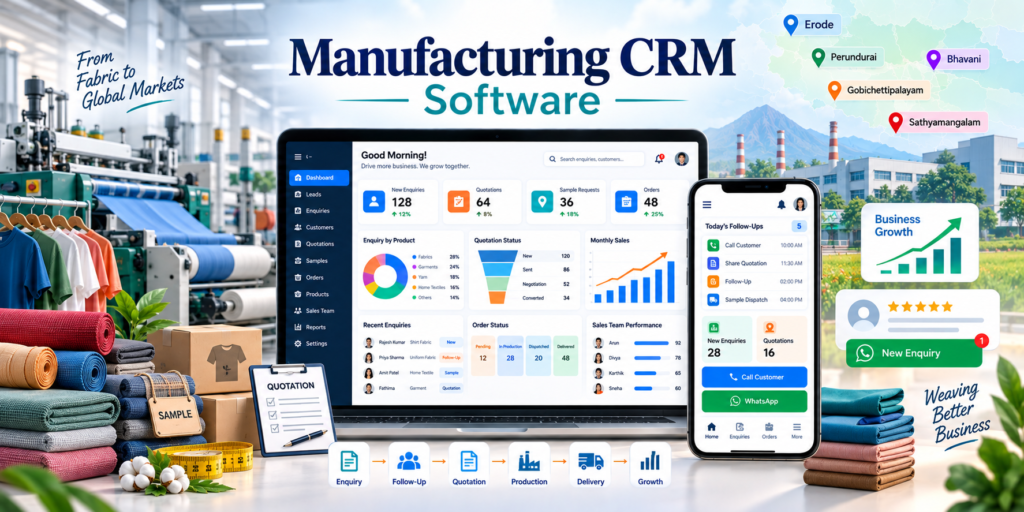
CRM software for textile and manufacturing businesses in Erode helps textile manufacturers, garment companies, fabric suppliers, home textile businesses, non-woven bag manufacturers, industrial suppliers, machinery companies and B2B manufacturers manage enquiries, quotations, samples, follow-ups, orders and customer communication in one organized system.
Textile and manufacturing sales usually involve multiple stages. A buyer may first request product details, then ask for specifications, samples, pricing, minimum quantity, customization, delivery timelines, payment terms or a formal quotation before confirming an order.
When enquiries are handled through spreadsheets, notebooks, individual WhatsApp chats and separate sales staff, important follow-ups can be delayed or missed.
At Greap Technologies, we provide CRM software for textile and manufacturing businesses in Erode, helping B2B businesses organize their sales process, improve follow-up discipline and track customer enquiries more clearly.
Quick Answer: What Is Textile and Manufacturing CRM Software?
Textile and manufacturing CRM software is a customer, enquiry and sales management system designed to track B2B leads from the first enquiry through quotation, sample approval, negotiation, order confirmation and follow-up.
A custom manufacturing CRM can include:
- Lead and enquiry management
- Customer and company management
- Product enquiry tracking
- RFQ management
- Quotation management
- Sample request tracking
- Follow-up reminders
- Sales pipeline
- Dealer and distributor enquiries
- Order-status tracking
- Payment follow-up
- WhatsApp communication support
- Staff assignment
- Role-based permissions
- Lead-source tracking
- Reports and dashboards
- Website enquiry integration
- Catalogue website integration
- Data import/export
- Mobile-responsive access
The CRM should match the company’s actual enquiry-to-order workflow instead of forcing the sales team to follow a generic sales process.
Textile and Manufacturing CRM Software in Erode: Service Overview
| Detail | Information |
|---|---|
| Service | CRM Software for Textile and Manufacturing Businesses |
| Company | Greap Technologies |
| Location | Erode, Tamil Nadu |
| Main Audience | Textile businesses, manufacturers, suppliers, exporters and B2B companies |
| Main Goal | Manage enquiries, RFQs, quotations, follow-ups and customer relationships |
| Core Features | Lead tracking, quotation management, samples, pipeline, orders and reports |
| Best For | Textiles, garments, home textiles, packaging, non-woven bags, machinery and industrial manufacturing |
| Service Area | Erode District and nearby industrial areas |
Why Textile and Manufacturing Businesses in Erode Need CRM Software
Manufacturing companies can receive enquiries from websites, catalogue websites, trade contacts, WhatsApp, calls, exhibitions, Google Ads, Meta Ads, referrals, dealers, distributors and existing customers.
Without CRM software, it can become difficult to know:
- Who submitted the enquiry?
- Which company do they represent?
- Which product did they ask about?
- What quantity do they need?
- What specifications were requested?
- Was a sample requested?
- Was the quotation shared?
- Was the quotation revised?
- When is the next follow-up?
- Which salesperson owns the enquiry?
- Was the enquiry converted into an order?
- Which source generated the enquiry?
A manufacturing CRM centralizes this information so the sales team and management can follow each opportunity more systematically.
Which Textile and Manufacturing Businesses Can Use CRM Software?
1. Textile Manufacturers
Textile manufacturers can manage fabric enquiries, buyer requirements, samples, quotations, custom specifications and repeat orders.
2. Fabric Suppliers
Fabric suppliers can track enquiries for cotton, polyester, knitted, woven and blended fabrics along with GSM, width, colour and quantity requirements.
3. Garment Manufacturers
Garment manufacturers can manage:
- Bulk order enquiries
- Style requirements
- Size specifications
- Fabric requirements
- Sample approval
- Quotation follow-up
4. Home Textile Businesses
Home textile companies can manage enquiries for bedsheets, towels, curtains, pillow covers, blankets, hotel linen and export requirements.
5. Non-Woven Bag Manufacturers
Non-woven bag businesses can track:
- Bag type
- Dimensions
- GSM
- Colour
- Printing requirement
- Quantity
- Sample approval
- Quotation
- Delivery requirement
6. Packaging Manufacturers
Packaging companies can manage enquiries for boxes, labels, pouches, bags, printed packaging and custom-size requirements.
7. Machinery and Equipment Suppliers
Machinery businesses can track technical enquiries, product demos, quotations, installation requirements and service follow-ups.
8. Industrial Manufacturers
Industrial companies can manage specification-heavy B2B enquiries, technical discussions, approvals and quotations.
9. Export Businesses
Exporters can use CRM software for international buyer enquiries, samples, quotations, export documentation follow-ups and shipment communication.
10. Wholesale and Distribution Businesses
Wholesale companies can manage dealer leads, bulk requirements, repeat buyers, pricing discussions and order follow-ups.
Benefits of CRM Software for Textile and Manufacturing Businesses
1. Better Lead and Enquiry Management
Every enquiry can be recorded with important B2B information.
Fields can include:
- Customer name
- Company name
- Phone number
- Location
- Business type
- Product requirement
- Quantity
- Enquiry source
- Assigned sales staff
- Status
- Next follow-up
- Notes
2. Reduce Missed Follow-Ups
The CRM can show:
- Today’s follow-ups
- Overdue follow-ups
- Upcoming activities
- Quotation follow-ups
- Sample follow-ups
- Payment follow-ups
- Priority enquiries
- Staff-wise pending tasks
This can improve sales consistency, although actual order conversion still depends on pricing, quality, buyer requirement, competition, delivery capability and sales execution.
3. Better Quotation Tracking
A quotation workflow can record:
- RFQ date
- Quotation number
- Quotation shared date
- Products quoted
- Quantity
- Price
- Tax details
- Delivery terms
- Payment terms
- Revision history
- Quotation status
- Next follow-up
4. Better Sample Request Tracking
Sample requests can be tracked with:
- Product requested
- Sample quantity
- Dispatch date
- Courier details
- Sample cost where applicable
- Customer feedback
- Approval status
- Next action
5. Better Sales Pipeline Visibility
A manufacturing sales pipeline can look like:
New Enquiry → Contacted → Product Details Shared → Sample Requested → Sample Approved → Quotation Shared → Negotiation → Order Confirmed → Production / Fulfilment → Dispatch → Closed
This makes it easier for management to see where sales opportunities are currently positioned.
6. Better Customer History
Authorized sales staff can review:
- Past enquiries
- Quotation history
- Products discussed
- Sample history
- Previous orders
- Communication notes
- Payment-related follow-up notes
7. Better Sales Team Accountability
Management can monitor:
- Lead assignments
- Pending follow-ups
- Completed activities
- Quotations shared
- Samples dispatched
- Orders converted
- Source-wise enquiries
- Staff-wise performance
Important Features of Textile and Manufacturing CRM Software
1. Lead and Enquiry Management
The core CRM module can include:
- Create enquiry
- Edit enquiry
- Assign salesperson
- Product requirement
- Quantity
- Source
- Status
- Priority
- Follow-up date
- Notes
- Activity history
2. Product Requirement Tracking
Product enquiry fields can include:
- Product category
- Product name
- Material
- Dimensions
- Colour
- GSM or technical specification
- Quantity
- Customization requirement
- Packaging
- Delivery location
- Expected timeline
3. RFQ Management
For B2B sales, a Request for Quote workflow can help organize formal buyer requests.
RFQ details can include:
- RFQ number
- Buyer
- Products requested
- Specifications
- Quantity
- Delivery location
- Required date
- Assigned salesperson
- Status
4. Quotation Management
The quotation module can support:
- Create quotation
- Quotation number
- Customer information
- Product line items
- Quantity
- Rate
- Taxes
- Terms
- Validity
- Revision tracking
- Approval status
5. Sample Request Management
The CRM can record sample requests, dispatch status, courier information, feedback and approval.
6. Follow-Up Reminder System
Follow-ups can be categorized as:
- General enquiry follow-up
- Quotation follow-up
- Sample follow-up
- Negotiation follow-up
- Order follow-up
- Payment follow-up
7. Customer and Company Management
Customer/company profiles can include:
- Company name
- Contact person
- Phone
- Billing location
- Delivery locations
- Business type
- Product interests
- Past enquiries
- Past quotations
- Order history
8. Dealer and Distributor Management
Dealer-related fields can include:
- Business name
- Location
- Product interest
- Monthly requirement
- Pricing discussion
- Approval status
- Follow-up history
9. WhatsApp Communication Support
Depending on the implementation, the CRM can support:
- Click-to-chat
- Product-detail sharing
- Quotation follow-up messages
- Sample dispatch updates
- General order updates
- Catalogue sharing
Hi, thank you for your enquiry. Our team will share the requested product details and quotation information with you.
Automated WhatsApp communication may require an approved WhatsApp Business Platform provider, approved templates and separate provider charges.
10. Sales Pipeline
A pipeline or Kanban view can show:
- New Enquiry
- Contacted
- RFQ Received
- Sample Stage
- Quotation Stage
- Negotiation
- Order Confirmed
- Closed Won
- Closed Lost
11. Order Status Tracking
Where required, the CRM can track high-level sales-order progress such as:
- Order confirmed
- Advance received
- Production in progress
- Quality check
- Packing
- Ready for dispatch
- Dispatched
- Delivered
For detailed production planning, inventory, material requirements, shop-floor scheduling or accounting, an ERP or manufacturing management system may be more suitable.
12. Reports and Dashboard
The dashboard can show:
- Total enquiries
- New enquiries
- Today’s follow-ups
- Overdue follow-ups
- RFQs received
- Quotations shared
- Samples pending
- Orders confirmed
- Product-wise enquiries
- Source-wise leads
- Staff-wise activity
CRM vs ERP for Manufacturing Businesses
| Feature | Manufacturing CRM | ERP / Manufacturing Software |
|---|---|---|
| Main Purpose | Leads, customers, RFQs, quotations and follow-ups | Operational and production management |
| Enquiry Tracking | Core focus | May be limited |
| Quotation Follow-Up | Core focus | May be included |
| Sales Pipeline | Important | Usually not primary focus |
| Production Planning | Not primary function | Core function |
| Inventory | Basic or integrated | Core function |
| Purchase Management | Usually not core | Core function |
| Accounting | Usually not core | May be included |
| Best Use | Sales and customer relationship management | Manufacturing and operational control |
For many manufacturers, CRM and ERP can work together. CRM handles the enquiry-to-order sales process, while ERP handles inventory, production, procurement and operational processes.
Best CRM Structure for Textile and Manufacturing Businesses
General Manufacturing CRM
- Dashboard
- Leads
- Customers
- Products
- RFQs
- Quotations
- Samples
- Follow-Ups
- Sales Pipeline
- Orders
- Dealers
- Staff
- Reports
- Settings
Textile CRM
- Fabric Enquiries
- Buyer Management
- Sample Requests
- Specifications
- Quotation Follow-Ups
- Bulk Orders
- Dispatch Follow-Ups
- Reports
Packaging CRM
- Customer Enquiries
- Product Specifications
- Custom Printing Requirements
- Samples
- Quotations
- Order Follow-Up
- Reports
Export CRM
- International Enquiries
- Buyer Profiles
- Product Requirements
- Sample Tracking
- Quotation Management
- Buyer Follow-Up
- Shipment Communication
- Reports
CRM Software Design for Manufacturing Sales Teams
| User Type | Primary CRM Requirement |
|---|---|
| Business Owner | Dashboard, pipeline and reports |
| Sales Manager | Team activity and quotation tracking |
| Sales Executive | Assigned enquiries, follow-ups and notes |
| Production Coordinator | Confirmed-order requirement visibility |
| Admin Team | Customer records and documents |
| Marketing Team | Lead-source and campaign reports |
Useful interface principles include:
- Simple dashboard
- Fast enquiry entry
- Product filters
- Quick follow-up creation
- Clear quotation status
- Mobile-responsive access
- Role-based dashboards
- Fast search
Connecting CRM with Website, Catalogue and Digital Marketing
CRM software for textile and manufacturing businesses in Erode becomes more useful when website and campaign enquiries enter a structured sales workflow.
A connected system can include:
- Company website
- Product catalogue website
- Request Quote forms
- Landing pages
- Google Ads
- Meta Ads
- WhatsApp enquiries
- CRM lead capture
- Sales assignment
- Quotation tracking
- Follow-up reminders
- Reports
Example workflow:
Google / Ads / Website → Product Enquiry → CRM → Sales Assignment → RFQ / Sample → Quotation → Follow-Up → Order
Automated capture from advertising platforms depends on the APIs, permissions and integration methods currently supported by those platforms.
Related Greap services include website development, ecommerce development, SEO services and digital marketing services.
Lead Sources to Track in Manufacturing CRM
- Website
- Catalogue website
- RFQ form
- Landing page
- Google Ads
- Meta Ads
- Direct call
- Referral
- Existing customer
- Dealer network
- Trade exhibition
- Social media
- Google Business Profile
- Offline campaign
Admin Panel Features for Textile and Manufacturing CRM
| Module | Purpose |
|---|---|
| Dashboard | View overall sales activity |
| Leads | Manage enquiries |
| Customers | Manage buyer and company records |
| Products | Manage product references |
| RFQs | Track quotation requests |
| Quotations | Manage quotation workflow |
| Samples | Track sample requests and approvals |
| Follow-Ups | Manage sales reminders |
| Pipeline | Track sales stages |
| Orders | Track confirmed order progress |
| Dealers | Manage dealer enquiries |
| Staff | Manage CRM users |
| Roles | Control access permissions |
| Lead Sources | Track marketing sources |
| Reports | Analyze enquiries and sales activity |
Advanced Features for Textile and Manufacturing CRM Software
- Automatic lead assignment
- RFQ workflow
- Quotation PDF generation
- Quotation revision history
- Multi-product quotations
- Sample dispatch tracking
- Courier tracking fields
- Dealer management
- Buyer-wise order history
- Product-wise enquiry reports
- WhatsApp integration
- Email notifications
- Sales activity reminders
- Document uploads
- Google Sheet import/export
- Website integration
- Catalogue website integration
- ERP integration
- Accounting software integration
- API integrations
- Analytics dashboard
- Mobile application
Advanced features should be introduced when they solve genuine operational or sales problems rather than making the CRM unnecessarily complex.
CRM Software Development Process
Step 1: Requirement Analysis
Important questions include:
- What products do you manufacture or sell?
- Do you sell B2B, wholesale, retail or export?
- How many sales employees handle enquiries?
- Do you receive RFQs?
- Do you send formal quotations?
- Do buyers request samples?
- Do you need dealer management?
- Do you need order-status tracking?
- Do you already use ERP or accounting software?
- Do you need website integration?
- What reports does management need?
Step 2: Sales Workflow Planning
Example workflow:
New Enquiry → Qualification → Product Requirement → Sample / RFQ → Quotation → Negotiation → Order Confirmed → Fulfilment Follow-Up → Closed
Step 3: UI/UX Design
Common activities should remain simple:
- Create enquiry
- Assign salesperson
- Record product requirement
- Create follow-up
- Generate quotation
- Update sample status
- Move pipeline stage
Step 4: CRM Development
Development can include:
- Lead management
- Customer management
- Products
- RFQs
- Quotations
- Samples
- Follow-ups
- Pipeline
- Dealers
- Staff permissions
- Reports
Step 5: Existing Data Migration
Existing data can be prepared for migration where appropriate.
Examples:
- Customer records
- Old enquiries
- Product information
- Quotation history
- Dealer details
- Staff information
- Lead sources
Data should be reviewed and cleaned before import to reduce duplicates and incorrect records.
Step 6: Testing and Training
Testing should include:
- Enquiry creation
- Lead assignment
- Product requirements
- RFQ workflow
- Quotation generation
- Quotation revision
- Sample tracking
- Follow-up reminders
- Pipeline movement
- Permissions
- Reports
- Mobile responsiveness
Sales team training is important because CRM reports depend on consistent and accurate system usage.
Step 7: Launch and Improvement
After launch, reports, workflows, filters and integrations can be refined based on real sales-team feedback.
Textile and Manufacturing CRM Features Checklist
| Feature | Recommendation |
|---|---|
| Admin Dashboard | Required |
| Lead Management | Required |
| Customer Management | Required |
| Product Enquiry Tracking | Required |
| Follow-Up Reminders | Required |
| RFQ Management | Recommended for B2B |
| Quotation Management | Required |
| Sample Tracking | Recommended |
| Sales Pipeline | Required |
| Dealer Management | Based on business model |
| Order Status Tracking | Recommended |
| Staff Login | Required |
| Role-Based Permissions | Recommended |
| WhatsApp Support | Recommended |
| Lead-Source Tracking | Required |
| Reports | Required |
| Mobile Responsive Access | Required |
| Website Integration | Recommended |
| Catalogue Website Integration | Recommended |
| ERP Integration | Based on requirement |
Common Manufacturing CRM Mistakes to Avoid
1. Managing High Enquiry Volume Only in Spreadsheets
Spreadsheets can become difficult when multiple sales users need assignments, reminders and activity history.
2. No Follow-Up Reminders
Every active enquiry should have a clear next action.
3. No Quotation Status Tracking
The sales team should know whether a quotation is draft, sent, revised, under negotiation, approved or lost.
4. No Sample Tracking
Sample-based enquiries should not disappear after dispatch.
5. No Product Requirement History
Customer specifications should be recorded clearly so repeated discussions are reduced.
6. No Lead Ownership
Each enquiry should have a responsible salesperson or team.
7. No Lead-Source Tracking
Marketing reports become unreliable when enquiry sources are not recorded consistently.
8. Trying to Use CRM as a Complete ERP
Production, inventory, procurement and accounting may require dedicated ERP functionality or integrations.
9. Complicated CRM Interface
Everyday sales activities should remain quick and practical.
10. No Staff Training
A CRM only becomes useful when users update enquiries and follow-ups consistently.
Erode District Textile and Manufacturing CRM Strategy
Greap Technologies supports textile and manufacturing businesses across:
Erode, Perundurai, Bhavani, Anthiyur, Gobichettipalayam, Sathyamangalam, Modakkurichi, Kodumudi, Nambiyur, Chennimalai, Kavindapadi, Ammapettai, Arachalur, Sivagiri, Punjai Puliampatti, Solar, Surampatti, Veerappanchatram, Nasiyanur and nearby areas.
Location-specific SEO pages should only be created for genuine service areas and should contain useful, unique information rather than simply replacing location names.
How Greap Technologies Helps Textile and Manufacturing Businesses
Greap Technologies can develop custom CRM systems around the real enquiry and sales workflow of textile and manufacturing businesses.
Our CRM development services can include:
- CRM requirement planning
- Lead management
- Customer management
- Product enquiry tracking
- RFQ management
- Quotation management
- Sample request tracking
- Follow-up reminders
- Sales pipeline
- Dealer management
- Order-status tracking
- Staff management
- Role-based permissions
- WhatsApp support
- Lead-source tracking
- Dashboards and reports
- Website integration
- Catalogue website integration
- Data import support
- ERP/API integration
- Mobile-responsive CRM
- Testing and training
- Maintenance support
Explore related Greap services:
- Custom Software Development
- Website Development Services
- Ecommerce Development
- SEO Services
- Digital Marketing Services
- API Integration Services
Why Choose Greap Technologies?
Manufacturing-Focused CRM Planning
We can structure the CRM around enquiries, RFQs, samples, quotations, negotiation and order confirmation.
Custom CRM Development
The software can match your company’s workflow instead of forcing sales staff into a fixed generic process.
Quotation and Follow-Up Focus
RFQs, quotations, sample follow-ups and sales reminders can be treated as core CRM functions.
Website and Catalogue Integration
Enquiries from websites, catalogue pages and landing pages can be connected where suitable integration methods are available.
CRM + ERP Integration Support
Where required, CRM data can be connected with suitable ERP, inventory, accounting or other business systems through supported integrations.
Complete Digital Support
Greap Technologies can also support websites, catalogue websites, SEO, digital marketing, mobile applications and custom software development.
Conclusion
CRM software for textile and manufacturing businesses in Erode can help manufacturers, suppliers and B2B companies organize enquiries, track quotations, manage samples, improve follow-ups and maintain clearer customer histories.
A practical manufacturing CRM should include lead management, product requirements, RFQs, quotation tracking, sample requests, sales pipeline, staff assignment, lead-source tracking and useful reports.
For companies with complex production, inventory and procurement requirements, CRM can also work alongside ERP or other operational systems.
Greap Technologies helps textile manufacturers, industrial companies, packaging businesses, suppliers and exporters in Erode build custom CRM systems around their actual sales process.
Need CRM Software for Your Textile or Manufacturing Business in Erode?
Greap Technologies can help you build a custom CRM with lead management, RFQ and quotation tracking, sample management, follow-up reminders, sales pipeline, WhatsApp support and reports.
Frequently Asked Questions
1. What is CRM software for textile and manufacturing businesses?
Manufacturing CRM software is a system for managing B2B leads, customer enquiries, product requirements, quotations, samples, follow-ups, sales stages and customer communication.
2. Why do textile and manufacturing businesses in Erode need CRM software?
CRM software can help businesses organize enquiries, reduce missed follow-ups, track quotations and samples, assign leads to sales staff and improve sales visibility.
3. What should manufacturing CRM software include?
A manufacturing CRM can include lead management, customer profiles, product enquiries, RFQs, quotation management, sample tracking, follow-up reminders, sales pipeline and reports.
4. Can CRM software track quotations?
Yes. CRM software can track quotation numbers, products, quantities, pricing, revision history, status and follow-up dates.
5. Can CRM software track sample requests?
Yes. Sample requests can be recorded with product details, dispatch date, courier information, feedback and approval status.
6. Can textile and manufacturing CRM connect with WhatsApp?
Yes. Depending on implementation, the CRM can support click-to-chat, product sharing, quotation follow-up messages and advanced WhatsApp integrations through suitable providers.
7. Can CRM track enquiries from websites and advertising?
Yes. Lead sources can be recorded, and automated integration may be possible depending on the APIs, permissions and connectors available.
8. Can Greap Technologies build custom manufacturing CRM software?
Yes. Greap Technologies can develop custom CRM software around the company’s enquiry, RFQ, quotation, sample and sales workflow.
9. Is CRM software the same as manufacturing ERP?
No. CRM primarily focuses on sales enquiries, customers and follow-ups, while manufacturing ERP usually manages production, inventory, purchasing and broader operations.
10. Can CRM software help improve manufacturing sales?
CRM software can improve follow-up discipline, quotation visibility and customer management. Actual sales results still depend on product quality, pricing, demand, delivery capability and sales execution.