ERP Software for Textile Manufacturing Companies in Erode
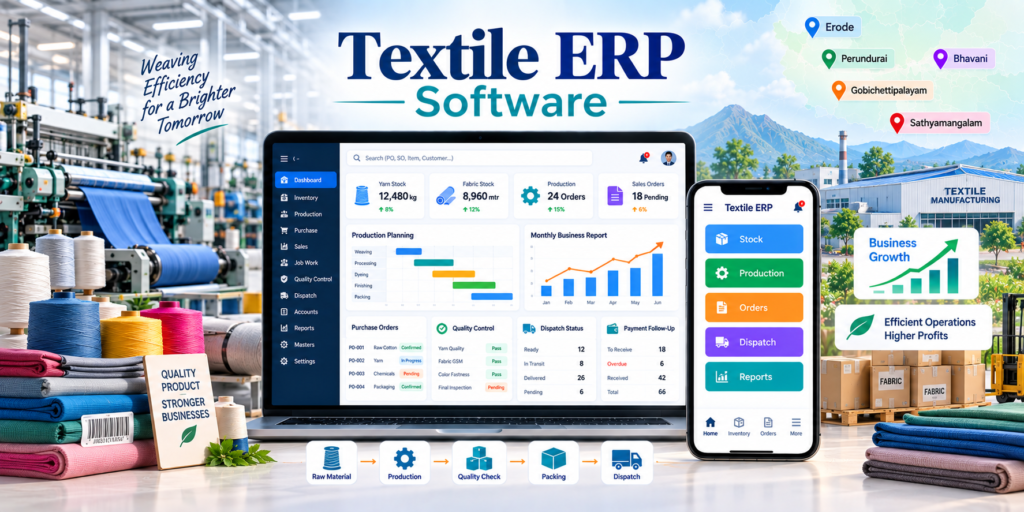
ERP software for textile manufacturing companies in Erode helps textile manufacturers, fabric units, garment manufacturers, home textile businesses, yarn traders, weaving units, knitting units, dyeing units, non-woven bag manufacturers and textile exporters manage inventory, purchase, production, job work, quality, dispatch, sales and business reports in one connected system.
Textile manufacturing involves many interdependent processes. Raw materials must be purchased and received, yarn and fabric stocks must be tracked, customer orders must be planned for production, outside job work may need monitoring, quality checks must be completed and finished goods must be packed and dispatched on time.
When these activities are managed using notebooks, disconnected Excel sheets or different software systems, management may struggle to get a clear view of stock, work-in-progress, production, pending orders and dispatch status.
At Greap Technologies, we provide ERP software for textile manufacturing companies in Erode, helping textile businesses build custom ERP systems around their actual products, production processes and operational requirements.
Quick Answer: What Is Textile Manufacturing ERP Software?
Textile ERP software is a business-management platform that connects important operational functions such as inventory, purchase, production, job work, quality control, sales orders, dispatch and reporting.
A custom textile ERP can include:
- Dashboard
- Raw-material inventory
- Yarn stock management
- Fabric and roll tracking
- Purchase management
- Supplier management
- Sales-order management
- Material Requirement Planning
- Production planning
- Work-in-progress tracking
- Dyeing and processing tracking
- Weaving or knitting tracking
- Garment production
- Job-work management
- Quality control
- Finished-goods inventory
- Packing and dispatch
- Customer management
- Payment follow-up
- Role-based staff access
- Reports and analytics
The ERP should be configured around the actual manufacturing workflow instead of forcing every textile business to follow the same fixed process.
ERP Software for Textile Manufacturing Companies in Erode: Service Overview
| Detail | Information |
|---|---|
| Service | ERP Software for Textile Manufacturing Companies |
| Company | Greap Technologies |
| Location | Erode, Tamil Nadu |
| Main Audience | Textile manufacturers, fabric units, garment units, processing units and exporters |
| Main Goal | Connect production, stock, purchase, job work, quality, sales and dispatch |
| Core Modules | Inventory, purchase, MRP, production, job work, quality, dispatch and reports |
| Best For | Fabric, garments, home textiles, yarn, weaving, knitting, dyeing and non-woven manufacturing |
| Service Area | Erode District and nearby textile clusters |
Why Textile Manufacturing Companies in Erode Need ERP Software
Textile manufacturing companies handle many moving parts every day. A single customer order can involve material planning, purchasing, production scheduling, job work, quality checks, packing and dispatch.
Without an integrated ERP, it can become difficult to know:
- How much raw material is available?
- What is the current yarn stock?
- Which fabric rolls are available?
- Which purchase orders are pending?
- Which customer orders are in production?
- What stage is each order currently in?
- Which materials are with job workers?
- How much work-in-progress is available?
- What quantities were rejected or reworked?
- Which orders are ready for dispatch?
- Which payments are pending?
- Which department updated each transaction?
ERP software provides one central operating system where these activities can be recorded and monitored.
Which Textile Businesses Can Use ERP Software?
1. Textile Manufacturing Units
Textile manufacturers can manage material purchases, inventory, production, customer orders, quality and dispatch in one system.
2. Fabric Manufacturers
Fabric manufacturers can track:
- Yarn purchase
- Yarn issue
- Weaving or knitting
- Fabric production
- Dyeing
- Finishing
- Roll-wise stock
- Batch details
3. Garment Manufacturing Units
Garment manufacturers can manage:
- Buyer orders
- Styles
- Sizes
- Material requirements
- Cutting
- Stitching
- Finishing
- Checking
- Packing
- Dispatch
4. Home Textile Manufacturers
Home textile businesses can manage production and stock for products such as bedsheets, towels, curtains, pillow covers, blankets and hotel linen.
5. Weaving Units
Weaving businesses can track yarn issue, loom production, fabric output, wastage and order-wise production.
6. Knitting Units
Knitting companies can manage yarn consumption, machine production, fabric output and roll-wise inventory.
7. Dyeing and Processing Units
Processing businesses can track fabric inward, batch creation, colour, process stages, quality checks, rework and outward delivery.
8. Textile Export Businesses
Exporters can connect buyer orders with production, quality, packing, shipment and documentation follow-up.
9. Non-Woven Bag Manufacturers
Non-woven bag units can track:
- Raw material
- GSM
- Bag dimensions
- Printing requirement
- Production
- Packing
- Bulk orders
- Dispatch
10. Textile Businesses Combining Manufacturing and Wholesale
Businesses handling both manufacturing and wholesale can manage production alongside finished stock, bulk sales and dispatch.
Benefits of ERP Software for Textile Manufacturing Companies
1. Connect Multiple Departments
A textile ERP can connect:
- Purchase
- Stores
- Inventory
- Production
- Job Work
- Quality
- Sales
- Dispatch
- Management
This reduces reliance on separate files maintained by each department.
2. Improve Inventory Visibility
Inventory modules can track:
- Raw materials
- Yarn
- Fabric
- Accessories
- Packing materials
- Work-in-progress
- Finished goods
- Stock transfers
- Stock adjustments
- Low-stock levels
Accurate inventory depends on disciplined inward, issue, production and dispatch entries by users.
3. Better Production Planning
Production teams can plan work based on:
- Confirmed orders
- Required delivery dates
- Material availability
- Machine capacity
- Production stages
- Pending workload
4. Material Requirement Planning
Material Requirement Planning can help estimate which materials are needed for confirmed production.
Depending on the business, MRP can consider:
- Order quantity
- Bill of materials
- Available stock
- Existing purchase orders
- Existing work-in-progress
- Expected wastage
This can support purchasing and production planning when master data is maintained accurately.
5. Order-Wise Production Tracking
Each sales order can be connected with:
- Customer
- Product
- Quantity
- Colour
- Size
- Specification
- Target date
- Production status
- Quality status
- Dispatch status
6. Better Job-Work Control
Textile businesses often send material outside for processing.
ERP can track:
- Job worker
- Material issued
- Issue quantity
- Issue date
- Expected return
- Received quantity
- Pending quantity
- Wastage
- Charges
- Quality remarks
7. Better Quality Tracking
Quality records can include:
- Inspection stage
- Accepted quantity
- Rejected quantity
- Defect reason
- Rework quantity
- Batch or lot
- Inspector remarks
8. Better Dispatch Coordination
Dispatch staff can view:
- Orders ready to pack
- Pending packing
- Invoice reference
- Transporter
- LR/reference number
- Dispatch date
- Delivery destination
9. Better Management Reporting
Owners can review reports for:
- Inventory
- Purchase
- Production
- WIP
- Job work
- Quality
- Sales orders
- Dispatch
- Pending payments
Important Modules in Textile ERP Software
1. ERP Dashboard
The dashboard can show:
- Total active orders
- Pending production
- Orders due soon
- Low-stock alerts
- Pending purchase orders
- Work-in-progress
- Pending job work
- Pending quality checks
- Pending dispatch
2. Inventory Management
The inventory module can manage:
- Item master
- Raw materials
- Yarn
- Fabric
- Accessories
- Packing materials
- Finished goods
- Warehouse/location
- Stock inward
- Stock issue
- Stock transfer
- Stock adjustment
3. Yarn and Fabric Tracking
Textile-specific fields can include:
- Yarn count
- Lot number
- Batch number
- Shade/colour
- GSM
- Fabric width
- Roll number
- Roll weight
- Meterage
4. Purchase Management
Purchase functionality can include:
- Supplier master
- Purchase request
- Purchase order
- Approval workflow
- Material receipt
- Purchase return
- Supplier rates
- Pending PO report
5. Sales Order Management
Sales-order management can include:
- Customer master
- Quotation reference
- Sales order
- Product specification
- Quantity
- Rate
- Delivery date
- Order priority
- Order status
6. Bill of Materials
Where appropriate, a Bill of Materials can define the expected materials needed for a product or production style.
This is useful for repeatable manufacturing processes such as garments, home textiles, non-woven bags and packaged textile products.
7. Production Planning
Production planning can include:
- Production order
- Order priority
- Planned quantity
- Target date
- Material requirement
- Machine allocation
- Department allocation
8. Work-In-Progress Tracking
WIP tracking can show where material currently exists within the production cycle.
Examples:
- Waiting for weaving
- In dyeing
- In cutting
- In stitching
- In finishing
- Awaiting quality check
9. Weaving / Knitting Module
Depending on the company, this module can track:
- Machine or loom
- Yarn issued
- Production date
- Output
- Wastage
- Roll generation
10. Dyeing and Processing Module
The processing module can include:
- Batch creation
- Material inward
- Colour/shade
- Process stage
- Machine
- Process start/end
- Quality status
- Rework
- Outward
11. Garment Production Module
Garment units can manage:
- Buyer order
- Style number
- Size breakdown
- Cutting
- Stitching
- Finishing
- Checking
- Packing
- Completed quantity
- Rejected quantity
12. Job Work Management
ERP can track material sent to outside processors and returned quantities.
13. Quality Control
Quality control can be connected with production batches, purchase receipts and finished products.
14. Packing and Dispatch
The module can manage packing lists, dispatch entries, transporter information and delivery status.
15. Payment Follow-Up
Basic payment tracking can include:
- Invoice reference
- Invoice amount
- Advance received
- Balance amount
- Due date
- Payment status
- Follow-up notes
For statutory accounting and financial reporting, integration with appropriate accounting software may be preferable depending on the business.
Textile ERP Workflow Example
A general textile manufacturing workflow can be:
Sales Order → Material Check → Purchase Requirement → Material Receipt → Production Planning → Material Issue → Production → Quality Check → Finished Stock → Packing → Dispatch → Payment Follow-Up
Job Work Workflow
Production Requirement → Material Issue to Job Worker → Processing → Material Return → Quantity Verification → Quality Check → Next Process
Garment Workflow
Buyer Order → BOM / Material Planning → Cutting → Stitching → Finishing → Quality Checking → Packing → Dispatch
The exact stages should be customized to match the company’s actual manufacturing process.
ERP Software vs CRM Software for Textile Businesses
| Feature | CRM Software | ERP Software |
|---|---|---|
| Main Purpose | Manage enquiries, customers and sales follow-ups | Manage broader business operations |
| Lead Management | Core focus | May be included or integrated |
| Quotation Follow-Up | Strong focus | Can be included |
| Inventory | Limited | Core focus |
| Purchase | Limited | Core focus |
| Production | Not main purpose | Core focus |
| MRP | Not main purpose | Can be included |
| Job Work | Limited | Strong focus |
| Quality | Limited | Can be included |
| Best For | Sales and customer-management teams | Owners, stores, purchase, production and operations |
Many growing textile businesses can use CRM and ERP together: CRM manages the enquiry-to-order sales journey, while ERP manages the confirmed order through inventory, production and dispatch.
ERP Software vs Billing Software
| Feature | Billing Software | ERP Software |
|---|---|---|
| Main Purpose | Billing and invoice creation | Integrated business operations |
| Inventory | Basic to moderate | Detailed and process-connected |
| Purchase | Basic | Structured workflow |
| Production | Usually not available | Core manufacturing module |
| MRP | Not normally available | Can be included |
| Job Work | Usually limited | Can be fully tracked |
| Quality Control | Usually unavailable | Can be included |
| Best For | Simple billing requirements | Manufacturing and growing operations |
ERP Software Design for Textile Manufacturing Companies
Textile ERP interfaces should prioritize daily operational usability.
| User Type | Primary ERP Need |
|---|---|
| Business Owner | Dashboard, stock, production and management reports |
| Production Manager | Planning, WIP and order status |
| Stores Team | Material inward, issue and stock balance |
| Purchase Team | Purchase requests, POs and supplier tracking |
| Sales Team | Orders, delivery dates and dispatch status |
| Quality Team | Inspection, rejection and rework records |
| Dispatch Team | Packing, transporter and dispatch entries |
| Admin | Users, permissions and settings |
Useful interface principles include:
- Clean dashboards
- Simple forms
- Barcode-friendly entry
- Fast item search
- Order-wise filters
- Clear status indicators
- Role-based screens
- Mobile-responsive access where suitable
Textile ERP Costing and Wastage Tracking
For businesses that need better production-cost visibility, ERP software can be designed to capture relevant cost components.
Depending on the workflow, costing can include:
- Raw-material cost
- Job-work charges
- Process charges
- Packing cost
- Transport cost
- Production wastage
- Rejected quantity
- Rework quantity
Accurate costing depends on reliable transaction data and clearly defined costing rules.
Barcode and QR Tracking for Textile ERP
Businesses with larger inventories can use barcode or QR workflows for faster identification and traceability.
Possible use cases include:
- Yarn lots
- Fabric rolls
- Production batches
- Finished products
- Packing boxes
- Warehouse locations
Barcode or QR implementation should be planned according to the physical material movement inside the factory.
ERP Integrations for Textile Manufacturing Businesses
ERP software for textile manufacturing companies in Erode can be integrated with other business systems where supported and required.
Possible integrations include:
- CRM software
- Company website
- Catalogue website
- Accounting software
- Barcode/QR printers and scanners
- WhatsApp communication workflows
- Email notifications
- Google Sheet import/export
- Customer portal
- Dealer portal
- Mobile applications
- API-based third-party systems
Explore API integration services for custom integration requirements.
Admin Panel Features for Textile ERP Software
| Module | Purpose |
|---|---|
| Dashboard | Operational overview |
| Item Master | Manage materials and products |
| Inventory | Manage stock movement |
| Purchase | Manage procurement |
| Suppliers | Manage vendor information |
| Customers | Manage buyer information |
| Sales Orders | Manage confirmed customer orders |
| BOM / MRP | Plan material requirements |
| Production | Manage production orders and output |
| Job Work | Track outside processing |
| Quality | Manage inspection records |
| Dispatch | Manage delivery activity |
| Payments | Track payment follow-ups |
| Users & Roles | Control staff access |
| Reports | Analyze operations |
Advanced Features for Textile ERP Software
- Barcode stock tracking
- QR roll tracking
- Lot and batch tracking
- Shade tracking
- Machine-wise production
- Loom-wise production
- Worker-wise production
- BOM management
- Material Requirement Planning
- Production costing
- Wastage analysis
- Rework tracking
- Purchase approval workflow
- Multi-store inventory
- Multi-branch ERP
- Job-worker ledger
- Customer portal
- Dealer portal
- Document management
- Export-order tracking
- Role-based permissions
- Audit logs
- Analytics dashboard
- Mobile application
Advanced modules should be introduced according to the company’s actual operational needs and implementation readiness.
Textile ERP Software Development Process
Step 1: Requirement and Workflow Study
Important questions include:
- What textile products are manufactured?
- Which raw materials are used?
- Do you handle yarn, fabric or garments?
- What production stages exist?
- Is job work used?
- How is inventory currently maintained?
- Do you need batch, lot or roll tracking?
- Do you need MRP?
- Do you need quality control?
- Do you need costing?
- Do you need accounting integration?
- How many employees will use ERP?
Step 2: ERP Workflow Mapping
Document the real operational flow before development.
Example:
Purchase → Receipt → Inventory → Production Planning → Material Issue → Production → QC → Finished Stock → Packing → Dispatch
Step 3: Module and Permission Planning
Define:
- Required modules
- User roles
- Approval levels
- Reports
- Data access
- Integrations
Step 4: UI/UX Design
The ERP should make frequent daily activities simple for production, stores and administration teams.
Step 5: ERP Development
Modules can be developed in phases according to business priority.
Step 6: Existing Data Migration
Existing data may include:
- Item master
- Opening stock
- Customers
- Suppliers
- Job workers
- Open sales orders
- Pending purchase orders
- User accounts
Existing data should be cleaned and validated before migration.
Step 7: Testing
Testing should cover:
- Stock inward/outward
- Purchase flow
- Sales orders
- BOM/MRP
- Production
- Job work
- Quality
- Finished goods
- Dispatch
- User permissions
- Reports
Step 8: Staff Training
Separate training may be useful for stores, production, sales, purchase, quality and admin teams.
Step 9: Go-Live and Improvement
After launch, reports, workflows and automation can be refined based on actual ERP usage.
Textile ERP Software Features Checklist
| Feature | Recommendation |
|---|---|
| Admin Dashboard | Required |
| Inventory Management | Required |
| Raw Material Tracking | Required |
| Yarn / Fabric Tracking | Required where applicable |
| Purchase Management | Required |
| Supplier Management | Required |
| Customer Management | Required |
| Sales Orders | Required |
| BOM | Recommended for structured products |
| MRP | Recommended for production planning |
| Production Planning | Required |
| Work-In-Progress | Recommended |
| Job Work | Based on workflow |
| Quality Control | Recommended |
| Finished Goods | Required |
| Packing / Dispatch | Required |
| Payment Follow-Up | Recommended |
| Role-Based Access | Recommended |
| Reports | Required |
| Barcode / QR | Based on requirement |
| CRM Integration | Based on requirement |
| Accounting Integration | Based on requirement |
Common Textile ERP Mistakes to Avoid
1. Digitizing a Bad Process Without Reviewing It
ERP should improve the workflow, not simply copy every manual step into software.
2. Poor Item Master Data
Duplicate product names, inconsistent units and incomplete specifications can make inventory reports unreliable.
3. No Stock Discipline
ERP cannot show accurate inventory when material movement is not entered consistently.
4. No Order-Wise Production Tracking
Confirmed orders should be connected with production and target delivery dates.
5. No Job-Work Reconciliation
Material issued and returned by outside processors should be reconciled properly.
6. No Wastage Tracking
Wastage information can be useful for costing and production analysis.
7. No Role-Based Permissions
Users should only be able to view or change information required for their roles.
8. Overloading the ERP in Phase One
Trying to implement every possible feature at once can make adoption difficult. Core modules can be prioritized first.
9. No Training
Staff must understand how and when to make entries for ERP reports to remain useful.
10. No Management Review
ERP implementation should include regular review of stock accuracy, pending orders, production status and user adoption.
Erode District Textile ERP Strategy
Greap Technologies supports textile businesses across:
Erode, Perundurai, Bhavani, Anthiyur, Gobichettipalayam, Sathyamangalam, Modakkurichi, Kodumudi, Nambiyur, Chennimalai, Kavindapadi, Ammapettai, Arachalur, Sivagiri, Punjai Puliampatti, Solar, Surampatti, Veerappanchatram, Nasiyanur and nearby areas.
Location-specific SEO pages should only be created for genuine service locations and should contain useful, unique information instead of simply replacing city names.
How Greap Technologies Helps Textile Manufacturers
Greap Technologies can develop custom ERP software around the actual operational workflow of textile manufacturers.
Our textile ERP development services can include:
- ERP requirement analysis
- Workflow mapping
- Inventory management
- Yarn and fabric tracking
- Purchase management
- Supplier management
- Customer management
- Sales-order management
- BOM and MRP
- Production planning
- Work-in-progress tracking
- Job-work management
- Quality control
- Finished-goods inventory
- Packing and dispatch
- Payment follow-up
- Barcode or QR workflows
- Role-based permissions
- Dashboards and reports
- CRM integration
- Accounting/API integration
- Data migration
- Testing and staff training
- ERP maintenance
Explore related Greap services:
- Custom Software Development
- API Integration Services
- Website Development Services
- Ecommerce Development
- SEO Services
Why Choose Greap Technologies?
Textile Workflow-Based ERP Planning
ERP can be structured around real textile processes such as inventory, weaving, dyeing, production, job work, quality and dispatch.
Custom ERP Development
The software can match your operational workflow instead of forcing the company into a fixed generic ERP structure.
Modular Implementation
Businesses can prioritize inventory, orders and production first and add advanced modules according to requirements.
Management Reporting
Dashboards and reports can be designed around the operational information owners and managers actually need.
Integration Support
CRM, accounting systems, websites and other supported applications can be connected through suitable integration methods.
Complete Digital Support
Greap Technologies can also support CRM software, websites, catalogue websites, ecommerce, mobile apps, SEO and digital marketing.
Conclusion
ERP software for textile manufacturing companies in Erode can help businesses connect inventory, purchase, production, job work, quality, finished goods and dispatch in one structured system.
A practical textile ERP should be designed around the company’s actual manufacturing flow and should provide reliable information for stock, production progress, pending orders, material requirements and management reporting.
For growing textile companies, ERP can replace fragmented manual tracking with a more organized workflow, provided employees maintain accurate and timely system entries.
Greap Technologies helps textile manufacturers in Erode develop custom ERP software based on their products, departments, production processes and growth requirements.
Need ERP Software for Your Textile Manufacturing Company in Erode?
Greap Technologies can help you build a custom textile ERP with inventory, yarn and fabric tracking, purchase, MRP, production, job work, quality control, dispatch and management reports.
Frequently Asked Questions
1. What is ERP software for textile manufacturing companies?
Textile ERP software is a business-management system that connects inventory, purchase, production, job work, quality, sales orders, dispatch and reporting.
2. Why do textile manufacturing companies in Erode need ERP software?
ERP software can help textile manufacturers improve stock visibility, track production, manage job work, coordinate dispatch and reduce fragmented manual tracking.
3. What modules should textile ERP software include?
A textile ERP can include inventory, purchase, suppliers, customers, sales orders, BOM, MRP, production, job work, quality control, finished goods, dispatch and reports.
4. Can ERP software track yarn and fabric stock?
Yes. ERP software can track yarn lots, fabric rolls, batches, inward, issues, production receipts and stock balances depending on the configured workflow.
5. Can ERP software manage job work?
Yes. ERP can track material issued to job workers, quantities received back, pending quantities, wastage, charges and quality status.
6. Can textile ERP track production status?
Yes. Production orders, material issues, work-in-progress, completed quantities, rejections and pending stages can be tracked.
7. Can Greap Technologies build custom textile ERP software?
Yes. Greap Technologies can develop custom ERP software based on the textile company’s inventory, production, job-work, quality, dispatch and reporting requirements.
8. Is ERP useful for small textile manufacturers?
Yes. Smaller manufacturers can begin with essential modules such as inventory, purchase, orders and production, then expand the ERP as operations grow.
9. Is textile ERP the same as CRM software?
No. CRM primarily focuses on sales enquiries and customer follow-ups, while ERP focuses on broader operational processes such as inventory, purchase, production and dispatch.
10. Can ERP software improve textile manufacturing operations?
ERP software can improve operational visibility and coordination when workflows are designed properly and staff maintain accurate data. Actual improvements depend on implementation quality, user adoption and business processes.