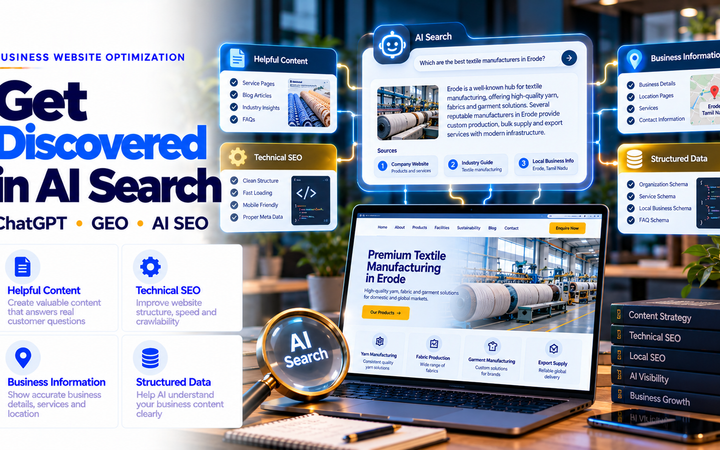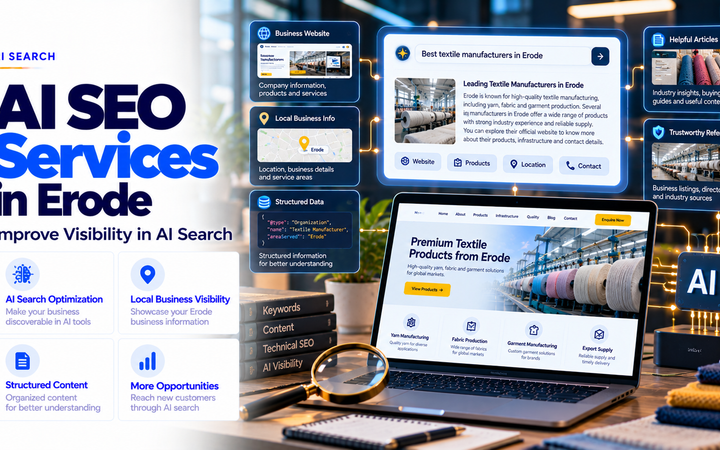
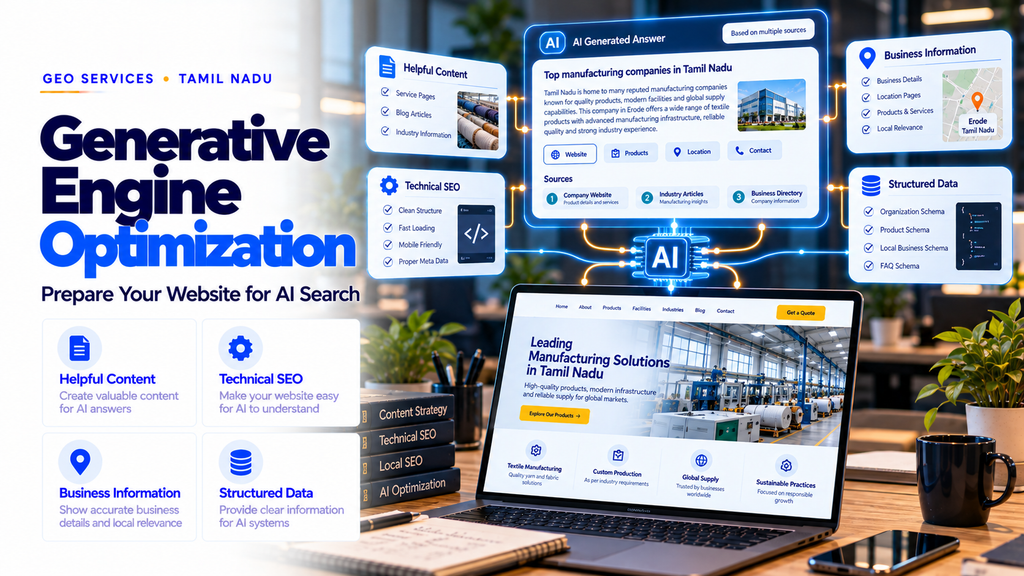
Generative Engine Optimization (GEO) for Business Websites in Tamil Nadu
Online search is changing. Customers no longer rely only on traditional search result pages to research businesses, products and services.
Some people now use AI-powered search experiences to ask detailed questions, compare options and receive summarized answers.
For example, a customer may ask an AI search service to explain how to choose a textile manufacturer in Erode, compare ecommerce development platforms or identify important features in a business management system.
These experiences create new questions for businesses: Is the website easy for search systems to access? Does it explain services clearly? Is its business information accurate? Does it provide useful answers to customer questions?
Generative Engine Optimization (GEO) for business websites in Tamil Nadu focuses on improving the clarity, accessibility, usefulness and credibility of online information that may be encountered by AI-powered search systems.
GEO builds on traditional search engine optimization. It is not a replacement for technical SEO, helpful content, local SEO or a well-developed website.
It is also important to understand that no legitimate optimization method can guarantee inclusion in every AI-generated answer or recommendation.
This guide explains GEO, how it differs from SEO and AEO, the role of AI search platforms, website optimization techniques, content strategies, structured data, local business visibility, measurement and practical implementation for Tamil Nadu businesses.
What Is Generative Engine Optimization?
Generative Engine Optimization, commonly called GEO, is an industry term for practices intended to improve how online information is discovered, understood, referenced or used in AI-generated search responses.
GEO generally involves:
- Clear website information
- Useful and accurate content
- Technical search accessibility
- Consistent business details
- Relevant supporting evidence
- Structured website content
- Ongoing content maintenance
Different AI search systems use different technologies and information sources, so GEO should not be treated as one universal ranking formula.
Why GEO Matters for Tamil Nadu Businesses
Tamil Nadu has businesses across manufacturing, textiles, ecommerce, education, healthcare, logistics, technology and professional services.
Customers researching these businesses may use traditional search engines, business directories, social platforms and AI-powered search tools.
GEO planning encourages businesses to publish information that explains their capabilities and helps customers make informed decisions.
Potential benefits include:
- Clearer service communication
- Improved website content quality
- Better technical discoverability
- More useful customer information
- Consistent business identity
- Stronger foundations for organic search
Actual AI search visibility varies by platform, query and available sources.
1. How Generative AI Search Works
Some AI-powered search systems retrieve information from web sources and use language models to generate responses.
Depending on the system, responses may include:
- Summaries
- Comparisons
- Explanations
- Source links
- Follow-up information
Not every AI response involves live web retrieval, and not every referenced source is selected through the same process.
2. GEO vs Traditional SEO
Traditional SEO focuses on improving a website’s organic search discoverability.
GEO considers how website information may be used within AI-generated search experiences.
| Factor | Traditional SEO | GEO |
|---|---|---|
| Primary Focus | Organic search visibility | AI-generated search visibility |
| Core Activities | Technical SEO, content and links | Useful source content, clarity and discoverability |
| Common Measurement | Impressions, clicks and conversions | Observed citations, mentions, referrals and conversions |
| Guarantees | No guaranteed rankings | No guaranteed AI recommendations |
Both approaches share important technical and content foundations.
3. GEO vs Answer Engine Optimization
Answer Engine Optimization, or AEO, focuses on making information useful for systems that answer questions.
GEO has a broader emphasis on how content may be retrieved, interpreted and referenced within generative search experiences.
In practice, the terms overlap, and many optimization activities support both.
4. SEO, GEO and AEO Together
A practical digital visibility strategy can combine:
- SEO: Help search engines discover relevant webpages.
- GEO: Improve the usefulness and accessibility of information for generative search.
- AEO: Answer customer questions clearly.
Businesses should prioritize website quality rather than creating separate low-value content for each term.
5. GEO for ChatGPT Search
Some ChatGPT experiences can search the web and provide responses with links to sources.
Businesses seeking discoverability should publish accurate, useful public information and review relevant crawler controls.
Allowing access to website content does not guarantee that ChatGPT will cite or recommend a business.
6. GEO for Google AI Overviews
Google AI Overviews may display AI-generated summaries for eligible searches.
Google recommends following established Search best practices, including creating helpful content and ensuring important pages can be accessed and indexed.
There is no special GEO markup that guarantees inclusion in Google AI Overviews.
7. GEO for Perplexity Search
Perplexity is an AI-powered search and answer service that can reference online sources.
Businesses can focus on publishing useful content, maintaining accurate public information and following appropriate technical accessibility practices.
Source selection depends on the service and query.
8. GEO for Other AI Search Experiences
Other AI-powered search experiences may use different retrieval methods, web indexes and response-generation systems.
Businesses should avoid assuming that one platform’s optimization approach works identically across all AI products.
9. GEO Starts with Technical SEO
A website should have a reliable technical foundation before investing heavily in GEO-specific activities.
Important areas include:
- Crawlability
- Indexability
- Canonical URLs
- XML sitemaps
- Internal linking
- Server reliability
- Mobile usability
- Content rendering
10. Website Crawlability
Crawlability refers to whether relevant automated systems can access website content.
Website owners should review robots.txt rules, server responses and access restrictions.
Different AI services may use different crawlers and respect different access controls.
11. Website Indexability
Indexability refers to whether search engines are permitted and able to include webpages in their indexes.
Important checks include:
- Noindex directives
- Canonical tags
- Duplicate content
- Server errors
- Redirect chains
- JavaScript-rendered content
Indexability supports search discoverability but does not guarantee inclusion in AI-generated responses.
12. XML Sitemap Optimization
XML sitemaps help search engines discover important URLs.
A well-maintained sitemap should generally include canonical, indexable pages and avoid unnecessary error URLs.
Sitemap submission is not a guarantee of indexing.
13. Structured Data for GEO
Structured data can provide machine-readable descriptions of eligible webpage content.
Relevant Schema.org types may include:
- Organization
- LocalBusiness
- Service
- Product
- Article
- BreadcrumbList
Structured data should match the visible page content and comply with the requirements of relevant search features.
Adding structured data does not guarantee AI citations or recommendations.
14. Organization Schema
Organization structured data can describe an organization and its relevant public details.
Potential information includes:
- Official organization name
- Website
- Logo where appropriate
- Contact information
- Relevant official profiles
Business information should be accurate and consistent.
15. LocalBusiness Schema
LocalBusiness structured data may be appropriate for eligible local business websites.
Potential properties include:
- Business name
- Address
- Contact number
- Opening hours
- Business category
- Website URL
Do not create fictional office addresses or misleading service locations.
16. Service Schema
Service structured data can describe relevant services when appropriate.
For example, a technology business may publish detailed pages for website development, ecommerce development, software solutions and SEO services.
Useful visible content remains more important than adding markup alone.
17. Helpful Content for GEO
GEO content should help real people understand a topic or make a decision.
Useful content may include:
- Clear explanations
- Practical examples
- Accurate technical information
- Relevant comparisons
- Limitations and considerations
- Original business insights
Repetitive content created only to target keyword variations may offer limited value.
18. Answer Customer Questions Directly
Customers often ask detailed questions when researching services.
Examples include:
- What is the difference between WordPress and a custom website?
- How much does ecommerce development cost?
- Which software is suitable for textile inventory management?
- How does local SEO work?
Pages should answer these questions clearly before providing additional context.
19. Question-Based Content Strategy
Businesses can identify useful topics through:
- Customer enquiries
- Sales conversations
- Support questions
- Search Console queries
- Keyword research
- Industry-specific questions
Content should reflect real customer information needs.
20. FAQ Optimization for GEO
Frequently asked questions can make important information easier to locate.
Good FAQs should:
- Answer genuine questions
- Use accurate information
- Remain concise
- Match the main page content
- Avoid keyword stuffing
FAQ sections do not automatically produce rich results or AI-generated citations.
21. Content Structure and Headings
Clear headings help readers understand a page’s organization.
Businesses should use:
- Descriptive page titles
- Logical H1, H2 and H3 structure
- Short, meaningful sections
- Readable paragraphs
- Appropriate lists and tables
Structure should improve readability rather than simply increase keyword frequency.
22. Topic Clusters for GEO
Topic clusters organize related content around a broader subject.
For example, a website development business may publish:
- Business website development
- WordPress development
- Laravel development
- Ecommerce development
- Website security
- Website maintenance
- Technical SEO
Related articles should connect naturally through internal links.
23. Internal Linking Strategy
Internal links help users and crawlers discover related pages.
Useful practices include:
- Descriptive anchor text
- Links to relevant services
- Links between related guides
- Clear website navigation
- Avoiding unnecessary repeated links
24. Original Research and First-Hand Information
Original information can make business content more distinctive.
Potential examples include:
- Documented project processes
- Real implementation examples
- Original comparisons
- Industry observations
- Customer questions answered from experience
Businesses should not fabricate project results, customer testimonials or research data.
25. Content Accuracy and Source Quality
Information should be accurate, current and appropriate for the subject.
Technical, legal, financial and healthcare content may require additional expert review.
Where external claims matter, businesses should reference trustworthy sources.
26. E-E-A-T and GEO
Experience, Expertise, Authoritativeness and Trustworthiness are concepts discussed in Google’s Search Quality Rater Guidelines.
These concepts can help content creators think about quality and credibility.
E-E-A-T is not a single measurable GEO ranking score.
27. Business Identity and Credibility
A business website should explain who operates it and what services it provides.
Useful information includes:
- Company name
- About page
- Service descriptions
- Contact information
- Relevant experience
- Official public profiles
28. Google Business Profile and GEO
Eligible local businesses can maintain a Google Business Profile to manage information appearing in Google Search and Maps.
Important information may include:
- Business name
- Category
- Address or service area
- Contact number
- Website
- Operating hours
- Services
Profiles should follow Google’s guidelines and represent real business operations.
29. Business Listings and Citations
Relevant public business listings can help customers find accurate company information.
Businesses should prioritize trustworthy, industry-relevant sources and maintain consistent details.
Mass-producing low-quality listings is not a reliable GEO strategy.
30. Genuine Customer Reviews
Authentic reviews can help prospective customers evaluate a business.
Businesses should encourage honest feedback and avoid fabricated reviews.
Reviews do not guarantee AI search recommendations.
31. External References and Brand Mentions
Independent references can provide additional public information about a business.
Examples include:
- Industry publications
- Relevant directories
- Professional associations
- Legitimate partner websites
- Authentic project coverage
References should be earned through genuine business activity rather than misleading promotion.
32. Website Performance and GEO
Website performance affects usability and technical reliability.
Potential improvements include:
- Image optimization
- Efficient caching
- Reduced unnecessary scripts
- Appropriate hosting
- Server performance
Performance optimization alone does not guarantee AI search visibility.
33. Mobile-Friendly GEO Websites
Business websites should provide a consistent experience across devices.
Important considerations include:
- Responsive layouts
- Readable content
- Clear navigation
- Accessible buttons
- Usable forms
- Fast loading
34. GEO for Tamil and English Websites
Businesses serving Tamil Nadu may benefit from publishing useful content in Tamil and English.
Multilingual planning may include:
- Accurate translation
- Language-specific URLs
- Correct language metadata
- Unicode-compatible content
- Localized customer information
Language selection should be based on audience needs.
35. GEO for Textile Businesses
Textile manufacturers, garment businesses and yarn traders may benefit from clear product and manufacturing information.
Useful website content includes:
- Fabric categories
- Product specifications
- Manufacturing capabilities
- Applications
- Business enquiry information
Technical claims should be accurate and verifiable.
36. GEO for Manufacturing Companies
Manufacturers can provide detailed information about their capabilities and products.
Potential content includes:
- Manufacturing processes
- Product specifications
- Industries served
- Quality procedures
- Supply capabilities
- Enquiry details
37. GEO for Ecommerce Businesses
Ecommerce businesses should maintain accurate product and purchasing information.
Important areas include:
- Product descriptions
- Specifications
- Pricing where applicable
- Availability
- Delivery information
- Return policies
38. GEO for Healthcare Websites
Healthcare content should prioritize accuracy, professional review and clear patient information.
Useful content may include:
- Services offered
- Doctor qualifications
- Appointment information
- Location and contact details
- Patient guidance
Medical information should not make unsupported claims.
39. GEO for Educational Institutions
Educational websites can provide clear information about courses, admissions and student services.
Potential content includes:
- Course descriptions
- Eligibility
- Admissions process
- Facilities
- Fees where applicable
- Contact details
40. GEO for Real Estate Websites
Real estate businesses may publish accurate property and project information.
Potential content includes:
- Property descriptions
- Location information
- Facilities
- Project details
- Enquiry options
41. GEO for Local Service Businesses
Local service businesses should explain what they offer, where they operate and how customers can contact them.
Potential content includes:
- Service descriptions
- Service areas
- Booking information
- Common customer questions
- Support details
42. GEO for B2B Business Websites
B2B websites can help buyers understand products, capabilities and procurement processes.
Useful information includes:
- Product catalogues
- Technical specifications
- Industries served
- Company capabilities
- Quotation processes
- Contact information
43. GEO for Software Development Companies
Software companies can explain their solutions using clear, practical information.
Potential topics include:
- Business software features
- Implementation processes
- Technology choices
- Integration requirements
- Maintenance considerations
- Industry-specific workflows
44. Location-Based GEO in Tamil Nadu
Businesses serving multiple locations should publish accurate information about genuine service coverage.
Location-specific pages should provide meaningful differences, such as local service details, customer needs or operational information.
Creating near-duplicate pages for every location keyword can reduce content quality.
45. GEO Services in Erode District
Businesses across Erode district may serve customers in:
- Erode
- Perundurai
- Bhavani
- Anthiyur
- Gobichettipalayam
- Sathyamangalam
- Modakkurichi
- Kodumudi
- Nambiyur
- Chennimalai
- Kavindapadi
- Ammapettai
- Arachalur
- Sivagiri
- Punjai Puliampatti
- Thalavadi
- Solar
- Surampatti
- Veerappanchatram
- Nasiyanur
Service-area claims should match actual business operations.
46. GEO Across Tamil Nadu
Businesses operating across Tamil Nadu may target relevant customers in:
- Coimbatore
- Tiruppur
- Salem
- Karur
- Namakkal
- Chennai
- Madurai
- Tiruchirappalli
- Hosur
- Vellore
- Thanjavur
- Tirunelveli
- Thoothukudi
Regional content should reflect genuine service capabilities and audience needs.
47. GEO Audit Services
A GEO audit can review whether a website provides useful, accessible and trustworthy business information.
Potential audit areas include:
- Technical SEO
- Crawlability
- Indexability
- Content quality
- Service page clarity
- Structured data
- Internal linking
- Business information consistency
- Mobile usability
- Observed AI search visibility
An audit should clearly separate verified findings from experimental observations.
48. Measuring GEO Performance
GEO performance can be challenging to measure because AI-generated answers vary by system, query and context.
Potential measurements include:
- Observed brand mentions
- Source citations where available
- Relevant query coverage
- Identifiable referral traffic
- Organic search performance
- Qualified enquiries
- Conversions
Businesses should avoid presenting occasional AI mentions as stable or guaranteed rankings.
49. Google Search Console for GEO
Google Search Console provides useful information about search indexing and performance.
Potential metrics include:
- Impressions
- Clicks
- Queries
- Page indexing
- Technical search issues
Search Console does not provide a complete separate report for all AI search platforms.
50. GEO Implementation Cost in Tamil Nadu
GEO implementation costs depend on the website’s condition, content requirements, competition and optimization scope.
Potential cost factors include:
- Technical SEO audit
- Content research
- Service page optimization
- Structured data
- Local SEO
- Content creation
- Website improvements
- Monitoring and reporting
Businesses should request transparent deliverables rather than paying for guaranteed AI recommendations.
51. GEO Budget Planning
| Component | Typical Scope | Cost Consideration |
|---|---|---|
| Website Audit | Technical and content assessment | Website size |
| Technical SEO | Crawlability and indexing fixes | Issue complexity |
| Content Optimization | Service pages and articles | Content volume |
| Local SEO | Business information and relevant listings | Service coverage |
| Structured Data | Relevant schema implementation | Website architecture |
| Monitoring | Search and AI visibility observations | Reporting scope |
52. GEO Implementation Process
- Business Analysis: Understand products, services and customers.
- Technical Audit: Review website accessibility and indexing.
- Query Research: Identify relevant customer questions.
- Content Planning: Map topics to services.
- Technical Improvements: Resolve important website issues.
- Content Optimization: Improve usefulness and accuracy.
- Structured Data: Add relevant markup.
- Local SEO: Maintain accurate business information.
- Internal Linking: Connect relevant pages.
- Monitoring: Review performance and observed visibility.
- Refinement: Update content and technical implementation.
53. Common GEO Mistakes
- Expecting guaranteed AI citations
- Ignoring traditional SEO
- Publishing repetitive AI-generated content
- Using inaccurate business information
- Creating near-duplicate location pages
- Adding misleading structured data
- Ignoring indexing problems
- Inventing customer reviews
- Fabricating case studies
- Overusing keywords
- Ignoring mobile usability
- Confusing AI mentions with permanent rankings
54. GEO Checklist for Tamil Nadu Businesses
- Maintain accurate company information.
- Check website crawlability.
- Review indexing status.
- Maintain canonical URLs.
- Update XML sitemaps.
- Create useful service pages.
- Answer customer questions clearly.
- Use logical heading structures.
- Improve internal linking.
- Publish accurate about and contact information.
- Add appropriate structured data.
- Improve mobile usability.
- Optimize website performance.
- Maintain relevant public business profiles.
- Encourage genuine reviews.
- Publish original information.
- Review outdated content.
- Monitor search performance.
- Observe relevant AI search responses.
- Track enquiries and conversions.
55. How to Choose a GEO Service Provider
Before choosing a provider, consider:
- Technical SEO experience
- Content strategy knowledge
- Local SEO capabilities
- Structured data understanding
- Transparent reporting
- Realistic expectations
- Clear project scope
- Responsible content practices
Providers should explain the limitations of AI search optimization and avoid guaranteed placement claims.
56. How Greap Technologies Can Help
Greap Technologies helps businesses explore website development, SEO and digital growth requirements.
For businesses interested in GEO, potential optimization work may include:
- GEO readiness assessments
- Technical SEO audits
- Website indexing reviews
- Local SEO improvements
- Service page optimization
- Structured data implementation
- Content strategy planning
- Internal linking improvements
- SEO-friendly website development
- Website performance optimization
- AI search visibility observations
Specific deliverables should be agreed during project planning.
Explore Greap Technologies for website development, SEO, ecommerce solutions and software services.
Conclusion
Generative Engine Optimization for business websites in Tamil Nadu helps organizations prepare their online information for evolving AI-powered search experiences.
GEO builds on the foundations of traditional SEO: technical accessibility, useful content, accurate business information, structured data and clear website organization.
Businesses should focus on helping real customers understand their products and services rather than pursuing guaranteed AI recommendations.
A practical GEO strategy combines technical SEO, local business optimization, trustworthy content and ongoing measurement.
Want to Prepare Your Business Website for AI Search?
Greap Technologies can help you discuss GEO readiness, technical SEO, content optimization and local search visibility requirements.
Frequently Asked Questions
1. What is Generative Engine Optimization?
GEO is an industry term for practices intended to improve how online information is discovered, interpreted or referenced in AI-generated search experiences.
2. Is GEO different from SEO?
GEO considers generative search experiences, while traditional SEO focuses on organic search visibility. Both share important technical and content foundations.
3. What is the difference between GEO and AEO?
GEO considers discoverability in generative search, while AEO focuses on presenting information that answers user questions clearly.
4. Can GEO help a business appear in ChatGPT Search?
Useful public information and technical accessibility may support discoverability, but inclusion in ChatGPT responses is not guaranteed.
5. Does GEO help with Google AI Overviews?
Established SEO best practices support search discoverability, but there is no special markup or method that guarantees inclusion in Google AI Overviews.
6. How much do GEO services cost in Tamil Nadu?
Cost depends on website condition, technical requirements, content development, local SEO scope and ongoing monitoring.
7. Is structured data important for GEO?
Structured data can clarify eligible webpage information, but it does not guarantee AI citations or recommendations.
8. Can small businesses benefit from GEO?
Small businesses can benefit from clearer website information, technical SEO improvements and useful content, although AI visibility outcomes vary.
9. Can Tamil-language websites benefit from GEO?
Useful Tamil-language content may support relevant Tamil-speaking audiences, depending on the capabilities of the search system.
10. How is GEO performance measured?
Businesses may monitor observed AI citations, brand mentions, identifiable referrals, organic search performance and qualified enquiries.
11. Does GEO replace traditional SEO?
No. GEO builds on technical SEO, useful content, local optimization and website quality.
12. Does Greap Technologies provide GEO services in Tamil Nadu?
Greap Technologies can discuss GEO readiness, technical SEO, local optimization and content improvement requirements according to an agreed project scope.