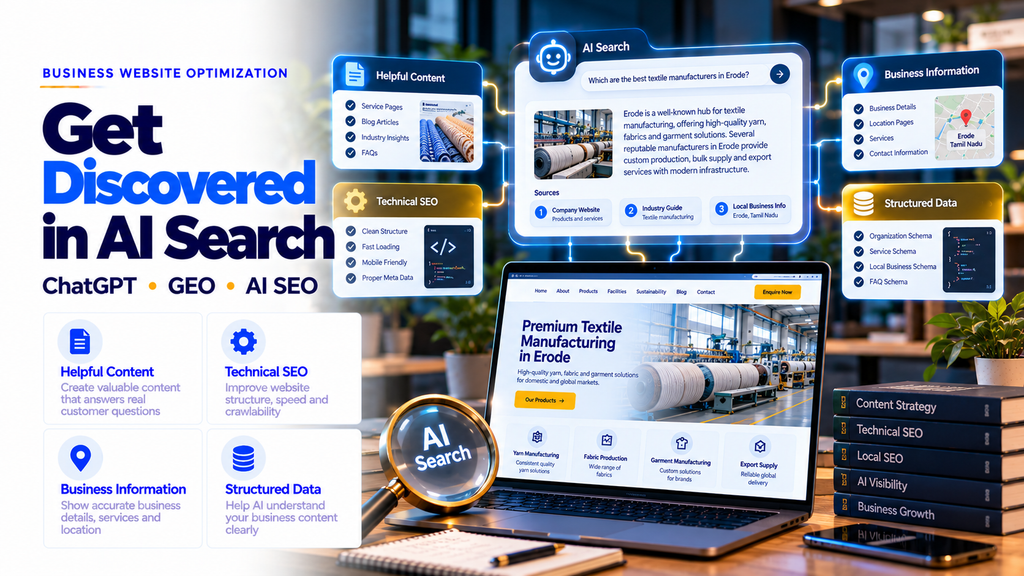
How to Get Your Business Website Discovered by ChatGPT and AI Search
Imagine a customer asking an AI-powered search tool, “Which website development companies serve businesses in Erode?” Another customer might ask, “What should I look for when choosing a textile manufacturer in Tamil Nadu?”
Instead of opening several websites immediately, these customers may first read an AI-generated answer that summarizes information and, in some cases, links to supporting sources.
This creates an important opportunity for businesses: make their website information accurate, useful and technically accessible so customers can discover it through both traditional and AI-powered search experiences.
If you want to understand how to get your website discovered by ChatGPT, the starting point is not a secret AI ranking trick. It is a combination of technical SEO, helpful content, clear business information, relevant online references and ongoing improvement.
There is no legitimate method that guarantees a business will appear in every ChatGPT answer, Google AI Overview or other AI-generated recommendation.
This guide explains practical steps businesses in Erode and across Tamil Nadu can take to improve their website’s readiness for AI search.
What Does It Mean to Be Discovered by ChatGPT and AI Search?
AI search discovery can involve several different outcomes:
- Your website appears as a linked source in an AI search response.
- Your webpage is surfaced among relevant search results.
- Your business information is referenced in a generated explanation.
- A visitor reaches your website through an identifiable AI search referral.
These outcomes are not interchangeable. A business name appearing in an AI-generated answer does not necessarily mean its website was retrieved or cited for that response.
Different AI products also use different sources, search systems and retrieval methods.
1. Understand How AI Search Works
Some AI search experiences combine information retrieval with language models to generate responses to user questions.
Depending on the platform and query, a system may use:
- Web search indexes
- Publicly accessible webpages
- Retrieved documents
- Relevant external sources
- Previously available model knowledge
Not every AI response uses live web search, and a platform’s selection of sources may change over time.
2. Make Your Website Accessible to Search Crawlers
A business website should allow the intended search systems to access important public content.
Review the following:
- Robots.txt rules
- Meta robots directives
- Server response codes
- Login restrictions
- Firewall and bot protection settings
- JavaScript rendering
Search crawlers cannot reliably use content they are blocked from accessing.
Website owners should review the official documentation of relevant search platforms before changing crawler permissions.
3. Understand OpenAI’s Web Crawlers
OpenAI documents different crawlers and user agents for different purposes.
For example, OAI-SearchBot is associated with surfacing websites in ChatGPT search features, while GPTBot relates to model training-related crawling.
These controls serve different purposes. A website owner should not assume that allowing or blocking one crawler has exactly the same effect as controlling another.
Review OpenAI’s current crawler documentation before making changes.
4. Check Your Robots.txt File
A robots.txt file communicates crawling instructions to compatible automated agents.
Businesses should check whether important website paths are unintentionally blocked.
For example, blocking the entire website from a relevant search crawler may prevent that crawler from accessing public pages.
Robots.txt is not a security mechanism. Sensitive information should be protected through proper authentication and access controls.
5. Ensure Important Pages Can Be Indexed
Traditional search indexing remains important for website discoverability.
Check that important pages do not have accidental noindex directives.
Review:
- Homepage
- Service pages
- Product pages
- Relevant location pages
- Helpful blog articles
- About and contact pages
Indexing does not guarantee that a page will appear in AI-generated answers.
6. Maintain an XML Sitemap
An XML sitemap helps search engines discover important website URLs.
A sitemap should generally contain relevant canonical URLs and avoid unnecessary broken, redirected or intentionally excluded pages.
Submitting a sitemap is useful for search discovery, but it does not guarantee indexing or AI citations.
7. Use Clear Website Navigation
Website navigation should help customers and crawlers find important content.
A practical business website structure may include:
- Home
- About Us
- Services
- Industries
- Portfolio or Projects
- Blog or Resources
- Contact
Use descriptive navigation labels and logical internal links.
8. Create Dedicated Pages for Important Services
A single general services page may not answer every customer question.
Businesses can create useful individual pages for distinct offerings.
For a technology company, examples might include:
- Website development
- Ecommerce development
- Custom software development
- Mobile app development
- SEO services
- Website maintenance
Each page should explain its service clearly rather than repeating generic marketing text.
9. Explain What Your Business Actually Does
AI search optimization begins with clear, factual business information.
Your website should help visitors understand:
- What products or services you provide
- Which customers you serve
- Which industries you work with
- Where you operate
- How customers can contact you
- What makes your process or offering relevant
Avoid vague statements that provide little information about your actual capabilities.
10. Write Helpful Content That Answers Real Questions
Customers often use conversational questions when researching products and services.
For example:
- How much does a business website cost in Erode?
- What features should an ecommerce website include?
- Which software is suitable for textile inventory management?
- How can a local business improve Google visibility?
- What is the difference between SEO and GEO?
Publishing accurate, useful answers helps both customers and search systems understand your website’s subject matter.
11. Use Direct Answers and Detailed Explanations
When a page addresses a question, begin with a clear answer.
Follow the answer with supporting details such as:
- How the process works
- Who it is suitable for
- Important features
- Limitations
- Cost factors
- Practical examples
Do not make content unnecessarily long just to target additional keywords.
12. Organize Content with Meaningful Headings
Headings make content easier to read and navigate.
Use a logical hierarchy:
- H1 for the main page topic
- H2 for major sections
- H3 for relevant subsections
Headings should accurately describe their content instead of being stuffed with keyword variations.
13. Build Topical Content Around Your Services
Related articles can help a business explain a subject more thoroughly.
For example, a website development company may publish guides about:
- Website development costs
- WordPress vs custom websites
- Ecommerce platforms
- Website security
- Website maintenance
- Technical SEO
- Website performance
Connect related content through useful internal links.
14. Avoid Mass-Producing Repetitive AI Content
Publishing hundreds of similar pages is not a reliable AI search strategy.
Low-value content may include:
- Repeated articles with only the city name changed
- Generic explanations without useful details
- Fabricated business examples
- Outdated technical advice
- Unverified claims
Prioritize content quality, originality and genuine customer usefulness.
15. Publish Original Business Information
First-hand information can help distinguish your website from generic articles.
Useful examples include:
- Real project workflows
- Documented implementation methods
- Original product explanations
- Verified technical specifications
- Real customer questions
- Authentic case studies
Do not invent client names, project outcomes, testimonials or performance statistics.
16. Improve Business Credibility
Customers should be able to identify the organization behind a website.
Important credibility information may include:
- Official company name
- About page
- Contact information
- Relevant business experience
- Professional credentials where applicable
- Clear service descriptions
Credibility comes from accurate, verifiable information rather than unsupported claims.
17. Understand E-E-A-T
Experience, Expertise, Authoritativeness and Trustworthiness are concepts discussed in Google’s Search Quality Rater Guidelines.
They are useful for thinking about content quality, but they are not a single measurable AI SEO ranking score.
Businesses can improve trustworthiness through transparent information, genuine expertise and responsible publishing practices.
18. Use Relevant Structured Data
Structured data helps eligible search systems understand certain information on webpages.
Relevant Schema.org types may include:
- Organization
- LocalBusiness
- Service
- Product
- Article
- BreadcrumbList
Structured data should accurately reflect visible content.
Adding schema markup does not guarantee that ChatGPT or another AI service will recommend your business.
19. Keep Your Business Information Consistent
Use accurate business details across your website and relevant public profiles.
Important information includes:
- Business name
- Phone number
- Website address
- Business location
- Services
- Operating hours where relevant
Inconsistent information can confuse customers and make it harder to identify the correct business.
20. Maintain Your Google Business Profile
Eligible local businesses should maintain an accurate Google Business Profile.
Relevant details may include:
- Business category
- Business description
- Address or service area
- Contact information
- Operating hours
- Website link
Google Business Profile optimization supports Google Search and Maps visibility. It does not guarantee inclusion in ChatGPT responses.
21. Build Relevant Business Citations
Business citations are references to a company on relevant external websites.
Examples may include:
- Industry directories
- Business associations
- Professional listings
- Legitimate partner websites
Prioritize trustworthy sources rather than creating large numbers of low-quality directory listings.
22. Encourage Genuine Customer Reviews
Authentic customer reviews can help people evaluate a business.
Businesses should request honest feedback and respond professionally.
Avoid fabricated reviews, misleading testimonials and promises that reviews will guarantee AI recommendations.
23. Improve Mobile Website Usability
Customers may discover your business on smartphones, tablets and desktop computers.
Important mobile usability considerations include:
- Responsive layouts
- Readable typography
- Clear navigation
- Accessible buttons
- Usable contact forms
- Fast page loading
24. Optimize Website Performance
Website performance affects user experience and technical reliability.
Potential improvements include:
- Optimizing images
- Reducing unnecessary scripts
- Using efficient caching
- Improving server response times
- Choosing suitable hosting
Website speed alone does not guarantee AI search visibility.
25. Make Important Content Available in HTML
Important business information should be accessible through readable webpage content.
Do not place all essential service details only inside images, videos or complex interactive elements.
Use meaningful HTML text, headings and links so information remains usable across devices and compatible systems.
26. Optimize Product and Service Descriptions
Product and service pages should answer common customer questions.
Useful information may include:
- Purpose
- Features
- Specifications
- Use cases
- Industries served
- Limitations
- Enquiry or purchase process
27. Create Useful FAQ Sections
Frequently asked questions can make important information easier to locate.
Good FAQs should answer genuine customer questions clearly and accurately.
FAQ content does not automatically qualify a page for Google FAQ rich results or AI-generated citations.
28. Use Clear Internal Links
Internal links help users and crawlers discover related content.
For example, an article about ecommerce website development may link to:
- Ecommerce development services
- WooCommerce development
- Shopify development
- Payment gateway integration
- Website maintenance
Use descriptive anchor text and avoid excessive repeated links.
29. Update Outdated Information
Business information can change over time.
Review important pages for:
- Outdated service details
- Incorrect contact information
- Old pricing
- Unavailable products
- Broken links
- Obsolete technical advice
Only change publication or updated dates when a meaningful update has occurred.
30. GEO and AEO for AI Search
Generative Engine Optimization (GEO) and Answer Engine Optimization (AEO) are industry terms used to describe related approaches to AI search visibility.
GEO generally focuses on discoverability in generative search experiences.
AEO generally focuses on presenting information that answers user questions.
Both approaches share technical SEO, content quality and business information fundamentals.
31. ChatGPT Search vs Google AI Overviews
| Factor | ChatGPT Search | Google AI Overviews |
|---|---|---|
| Experience | Conversational answers with search capabilities | AI-generated summaries within Google Search |
| Sources | May include linked web sources | May include supporting web links |
| Optimization | Useful accessible content and relevant crawler controls | Established Google Search best practices |
| Guarantee | No guaranteed citation or recommendation | No guaranteed inclusion |
32. AI Search Optimization for Erode Businesses
Businesses in Erode can improve their online information by publishing detailed service pages and accurate local business details.
For example, a textile company may explain:
- Products manufactured
- Fabric specifications
- Manufacturing capabilities
- Industries served
- Enquiry process
A software company may explain its products, implementation process, supported business workflows and service coverage.
33. AI Search Optimization Across Erode District
Businesses may serve customers in Erode, Perundurai, Bhavani, Anthiyur, Gobichettipalayam, Sathyamangalam, Modakkurichi, Kodumudi, Nambiyur, Chennimalai, Kavindapadi, Ammapettai, Arachalur, Sivagiri, Punjai Puliampatti and surrounding areas.
Location-specific content should reflect genuine service availability and useful local information.
Do not create misleading pages that imply offices in places where the business does not operate.
34. AI Search Optimization for Tamil Nadu Businesses
Businesses serving wider markets may provide useful information for customers in Coimbatore, Tiruppur, Salem, Karur, Namakkal, Chennai, Madurai, Tiruchirappalli and other Tamil Nadu locations.
Regional content should be based on actual services and customer needs rather than repetitive city-name substitutions.
35. Tamil and English Content for AI Search
Businesses serving Tamil-speaking customers may benefit from useful Tamil-language content alongside English pages.
Multilingual websites should consider:
- Accurate translation
- Language-specific URLs
- Appropriate language metadata
- Correct Unicode content
- Localized customer information
Content should be written for real audiences rather than created only to increase page counts.
36. How to Check Whether Your Business Appears in AI Search
You can manually test relevant customer questions across AI-powered search products that support web search.
Examples include:
- Which companies provide website development in Erode?
- How can I choose an ecommerce developer in Tamil Nadu?
- What should I look for in a textile software provider?
Record the date, platform, query and whether your business was mentioned or linked.
AI responses can vary between users, sessions and times, so individual observations should not be treated as stable rankings.
37. Measure AI Referral Traffic
Website analytics may identify visits from certain AI search services when referral information is available.
Potential measurements include:
- Referral sessions
- Landing pages
- Enquiry submissions
- Qualified leads
- Conversions
Referral data may be incomplete because of privacy controls and platform behavior.
38. Use Google Search Console
Google Search Console helps website owners understand traditional search performance and indexing.
Review:
- Page indexing
- Search queries
- Impressions
- Clicks
- Technical search issues
Search Console does not provide complete visibility into every AI search platform.
39. AI Search Readiness Audit
An AI search readiness audit can review whether important website information is accessible, accurate and useful.
Potential audit areas include:
- Crawler access
- Indexability
- Technical SEO
- Service page quality
- Content structure
- Structured data
- Business information consistency
- Internal linking
- Mobile usability
- Observed AI search visibility
40. Practical AI Search Optimization Checklist
- Verify that your website loads correctly.
- Review robots.txt and crawler permissions.
- Check important pages for noindex directives.
- Maintain an XML sitemap.
- Use canonical URLs correctly.
- Create useful service pages.
- Explain your business clearly.
- Publish accurate contact information.
- Answer real customer questions.
- Use meaningful headings.
- Improve internal links.
- Add appropriate structured data.
- Maintain accurate public business profiles.
- Encourage genuine reviews.
- Improve mobile usability.
- Optimize website performance.
- Publish original business information.
- Update outdated content.
- Monitor search indexing.
- Observe relevant AI search responses.
- Track qualified enquiries and conversions.
41. Common Mistakes to Avoid
- Expecting guaranteed ChatGPT recommendations
- Blocking important search crawlers unintentionally
- Ignoring website indexing
- Publishing repetitive AI-generated articles
- Creating misleading location pages
- Using fabricated customer reviews
- Adding inaccurate structured data
- Ignoring technical website problems
- Overusing keywords
- Confusing occasional AI mentions with permanent rankings
42. How Much Does AI Search Optimization Cost?
AI search optimization costs depend on the website’s current condition and the work required.
Factors may include:
- Technical SEO audit
- Indexing corrections
- Website improvements
- Content research
- Service page optimization
- Structured data implementation
- Local SEO
- Monitoring and reporting
Businesses should request a defined scope of work instead of paying for promises of guaranteed AI recommendations.
43. How Greap Technologies Can Help
Greap Technologies helps businesses discuss website development, SEO and digital growth requirements.
For companies interested in AI search discoverability, potential services may include:
- AI SEO readiness reviews
- Technical SEO audits
- Website indexing checks
- Local SEO improvements
- Service page content optimization
- Structured data implementation
- Internal linking improvements
- SEO-friendly website development
- Website speed optimization
- AI search visibility observations
Project scope, testing methods and deliverables should be agreed before implementation.
Explore Greap Technologies for website development, software solutions and digital marketing services.
Conclusion
Learning how to get your business website discovered by ChatGPT and AI search begins with improving the quality and accessibility of your online information.
Important steps include making public pages crawlable, maintaining strong technical SEO, publishing helpful content, explaining your services clearly and keeping business details accurate.
Structured data, local SEO and relevant external references can support broader website discoverability, but no single technique guarantees an AI-generated recommendation.
Focus on providing information that helps real customers understand and evaluate your business.
Want Your Business Website to Be Better Prepared for AI Search?
Greap Technologies can help you discuss ChatGPT search readiness, technical SEO, content improvements and local business visibility.
Frequently Asked Questions
1. How can I get my business website discovered by ChatGPT?
Start with useful public content, strong technical SEO, accurate business information and appropriate crawler accessibility. These steps support discoverability but do not guarantee inclusion in ChatGPT responses.
2. Can I submit my website directly to ChatGPT?
There is no general website submission process that guarantees inclusion in ChatGPT-generated answers. Review OpenAI’s official crawler documentation and maintain an accessible public website.
3. Does ChatGPT use Google rankings?
ChatGPT search and Google Search are different products. Search systems may use different retrieval methods and sources, so Google rankings should not be treated as identical to ChatGPT visibility.
4. What is ChatGPT SEO?
ChatGPT SEO is an informal term for practices intended to improve website discoverability in ChatGPT search experiences.
5. Is GEO necessary for business websites?
GEO can be considered as part of a broader search strategy, but technical SEO, accurate information and useful content remain the foundation.
6. Does schema markup help with AI search?
Structured data can clarify eligible webpage information, but it does not guarantee AI citations or recommendations.
7. How do I check whether ChatGPT can access my website?
Review relevant crawler permissions, robots.txt rules and server restrictions. Consult OpenAI’s official documentation for current crawler details.
8. Can a small business in Erode appear in AI search?
A small business may be discoverable through AI search when relevant information is available, but inclusion depends on the platform, query and sources.
9. Does publishing more blogs guarantee AI visibility?
No. Publishing more articles does not guarantee AI visibility. Content usefulness, originality and technical accessibility matter more than page count alone.
10. Can Tamil-language content help with AI search?
Useful Tamil-language content can serve relevant audiences, although visibility depends on each platform’s language capabilities and search behavior.
11. How long does AI search optimization take?
Timelines vary based on technical issues, content changes, crawler activity and platform behavior. No fixed inclusion timeline can be guaranteed.
12. Does Greap Technologies provide AI search optimization services?
Greap Technologies can discuss technical SEO, content optimization, local SEO and AI search readiness improvements based on an agreed project scope.