Multi-Language Website Development for Tamil Nadu Businesses
Businesses in Tamil Nadu communicate with customers who may prefer Tamil, English or other languages. A customer searching for a local service may feel more comfortable reading details in Tamil, while another customer may prefer English for technical information or business communication.
A website that supports more than one language can make important business information accessible to a wider range of visitors.
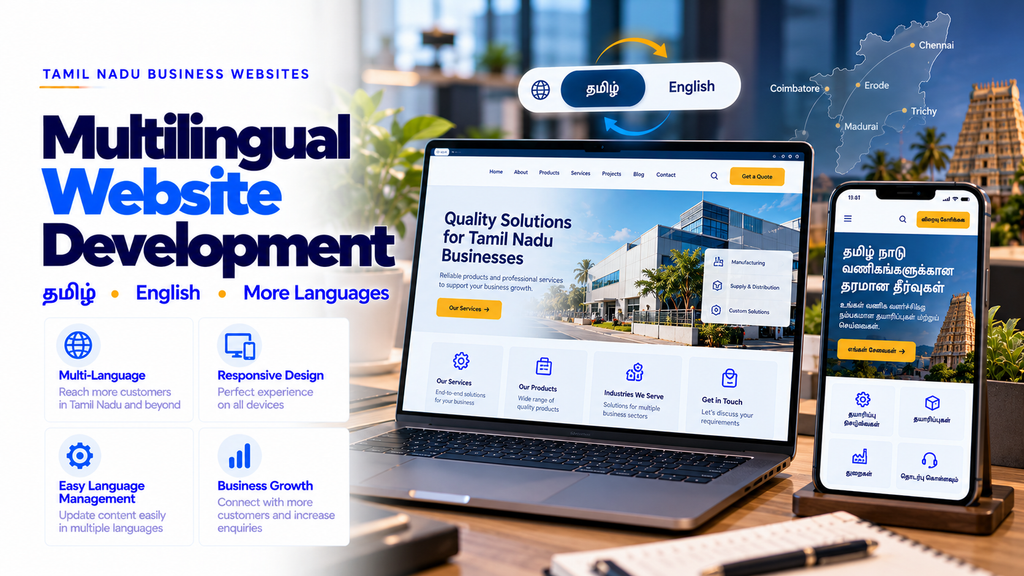
Multilingual website development in Tamil Nadu involves creating a website that allows visitors to access suitable versions of its content in different languages.
For example, a manufacturing company in Erode may use an English website to communicate with distributors across India while providing a Tamil version for local customers, employees or business partners.
However, building a multilingual website requires more than adding a translation button. Businesses should plan content translation, navigation, language-specific URLs, search engine optimization, typography, accessibility and ongoing content management.
This guide explains Tamil and English website development, language switchers, multilingual SEO, WordPress and Laravel solutions, ecommerce localization, costs and important considerations for businesses across Tamil Nadu.
What Is a Multilingual Website?
A multilingual website provides content in two or more languages.
Visitors can select their preferred language and navigate through the corresponding website content.
For example, a Tamil Nadu business may offer:
- Tamil
- English
- Hindi
- Malayalam
- Kannada
- Telugu
The languages should be selected according to the business’s target customers and operational requirements.
What Is a Bilingual Website?
A bilingual website supports two languages.
For many Tamil Nadu businesses, a Tamil and English website may be a practical starting point.
A bilingual website can present business information in both languages while maintaining a consistent design and user experience.
Why Tamil Nadu Businesses Need Multilingual Websites
Customers may use different languages when researching products, comparing services or contacting a business.
A multilingual website can help businesses:
- Present information in preferred languages
- Improve accessibility of business content
- Communicate with regional customers
- Support customers outside Tamil Nadu
- Provide localized product information
- Build a consistent multilingual online presence
The value depends on the target audience and quality of the translated content.
1. Tamil and English Website Development
Tamil and English websites allow businesses to publish content in both languages.
Potential website sections include:
- Home page
- About us
- Services
- Products
- Contact information
- Frequently asked questions
- Blog articles
Each language version should provide useful, accurate information rather than incomplete or automatically generated text that has not been reviewed.
2. Tamil Language Website Development
A Tamil-language website uses Tamil Unicode text for its content and interface.
Important considerations include:
- Correct Tamil spelling
- Readable typography
- Unicode support
- Mobile readability
- Natural business terminology
- Consistent navigation
Tamil content should be reviewed by someone who understands the intended audience and business terminology.
3. English Language Website Development
English website versions may help businesses communicate with customers, suppliers and partners outside Tamil-speaking markets.
Potential audiences include:
- Customers across India
- Corporate buyers
- Distributors
- Export customers
- International business partners
4. Website Language Switcher
A language switcher allows visitors to move between available language versions.
Common formats include:
- Text-based language links
- Dropdown selection
- Header language menu
- Mobile navigation language selector
Language names should be easy to recognize, such as “தமிழ்” and “English”.
5. Language Switcher User Experience
A language switcher should be easy to find and operate.
Important considerations include:
- Clear language labels
- Keyboard accessibility
- Mobile usability
- Consistent placement
- Preserving the current page where possible
When a visitor changes language, the website should ideally open the equivalent translated page rather than automatically returning to the homepage.
6. Manual Website Translation
Manual translation involves preparing and reviewing content for each language.
Potential benefits include:
- Better control over terminology
- More natural language
- Improved cultural relevance
- Greater editorial accuracy
Professional review is particularly important for legal, medical, financial and technical content.
7. Automatic Website Translation
Automatic translation tools can help generate initial translations.
However, machine-generated text may contain errors or unsuitable terminology.
Businesses should review important translated content before publishing it.
8. Human Translation vs Machine Translation
| Factor | Human Translation | Machine Translation |
|---|---|---|
| Primary Strength | Context and editorial judgment | Speed and initial translation assistance |
| Terminology | Can be tailored to the business | May require correction |
| Review | Still benefits from proofreading | Human review is recommended |
| Best Use | Important customer-facing content | Drafting and assisted workflows |
9. Website Localization
Localization involves adapting website content and user experience for a particular language or market.
Localization may include:
- Language
- Currency
- Date formats
- Address formats
- Product descriptions
- Customer support information
- Regional terminology
Translation is one part of localization, but localization may require additional design and content changes.
10. Multilingual Website SEO
Multilingual SEO helps search engines discover and understand different language versions of a website.
Important elements include:
- Language-specific URLs
- Translated page titles
- Localized meta descriptions
- Useful translated content
- Hreflang annotations
- Internal linking
- Indexable language pages
Multilingual SEO supports discoverability but does not guarantee search rankings.
11. Hreflang Tags for Multilingual Websites
Hreflang annotations help search engines understand language or regional alternatives for a page.
For example, a Tamil and English website may identify its corresponding language versions.
Hreflang implementation should use valid language codes and reciprocal annotations where appropriate.
Incorrect hreflang configuration can create confusion, so it should be tested carefully.
12. Language-Specific Website URLs
Multilingual websites commonly use separate URLs for each language version.
For example:
- example.com/en/services/
- example.com/ta/services/
Separate URLs help users share the correct language version and allow search engines to discover individual translated pages.
13. Subdirectories vs Subdomains for Languages
| Structure | Example | Consideration |
|---|---|---|
| Subdirectory | example.com/ta/ | Keeps language sections within one main domain |
| Subdomain | ta.example.com | May support separate technical or operational setups |
| Separate Domain | example-language.tld | Requires additional domain management |
The appropriate structure depends on the website architecture and business requirements.
14. Tamil SEO for Business Websites
Tamil-language pages can target relevant search queries used by Tamil-speaking customers.
Potential content includes:
- Service descriptions
- Product information
- Location information
- Customer FAQs
- Educational articles
Keyword research should consider natural Tamil search behavior rather than translating every English keyword literally.
15. English SEO for Business Websites
English-language pages may target customers searching for products or services in English.
Important considerations include:
- Relevant keywords
- Search intent
- Useful page content
- Clear headings
- Internal links
- Technical SEO
16. Multilingual Meta Titles and Descriptions
Each language version should have suitable metadata.
For example, a Tamil service page should use a title and description that accurately represent its Tamil content.
Metadata should be written naturally and avoid unnecessary keyword repetition.
17. Multilingual XML Sitemaps
XML sitemaps can help search engines discover important website URLs.
Multilingual websites should ensure that intended indexable language pages are included in the appropriate sitemap structure.
Sitemaps should reflect canonical, accessible URLs.
18. Canonical Tags for Multilingual Websites
Canonical tags indicate the preferred URL for duplicate or substantially similar content.
Distinct language versions generally use self-referencing canonicals when they are intended to be indexed independently.
Canonical and hreflang implementations should be coordinated carefully.
19. Multilingual Website Content Management
Businesses need a practical way to update content across multiple languages.
A multilingual CMS may allow editors to manage:
- Translated pages
- Translated menus
- Product descriptions
- SEO metadata
- Language-specific images
- Publication status
20. WordPress Multilingual Website Development
WordPress can support multilingual websites through suitable plugins and development approaches.
Potential functionality includes:
- Translated pages
- Language switchers
- Multilingual menus
- Translated metadata
- Language-specific URLs
Plugin compatibility, licensing and maintenance should be reviewed before implementation.
21. WooCommerce Multilingual Website Development
WooCommerce stores may support multiple languages through compatible multilingual solutions.
Potential translated content includes:
- Product names
- Descriptions
- Categories
- Store pages
- Customer information
Checkout functionality and payment integrations should be tested for every supported language.
22. Shopify Multilingual Ecommerce
Shopify supports multilingual commerce through platform capabilities and compatible applications.
Potential considerations include:
- Translated products
- Localized storefront content
- Language selection
- Markets and currencies
- Localized URLs
Available features depend on the current Shopify plan, theme, apps and platform capabilities.
23. Laravel Multilingual Website Development
Laravel can be used to build custom multilingual business websites and web applications.
Potential features include:
- Language-based routes
- Translation files
- Database-driven translations
- Multilingual admin panels
- Localized validation messages
- Language-specific content
24. React.js Multilingual Website Development
React applications can use internationalization tools to manage translated interface content.
Potential requirements include:
- Language state management
- Translation resources
- Accessible language controls
- Localized navigation
- Consistent content rendering
25. Next.js Multilingual Website Development
Next.js can support multilingual routing and localized content through appropriate application architecture.
Potential benefits include:
- Language-specific routes
- Server-rendered content
- Localized metadata
- Structured content delivery
- Search engine accessible pages
SEO and performance depend on implementation quality, not the framework name alone.
26. Custom PHP Multilingual Website Development
Custom PHP applications can support multilingual content through translation files, databases and language-aware routing.
Developers should plan:
- Translation storage
- URL structure
- Language selection
- Character encoding
- Content administration
27. Multilingual Website Admin Panel
An admin panel can help businesses manage content in multiple languages.
Potential features include:
- Language selection
- Translated content fields
- Publication controls
- Translation status
- SEO metadata
- Media management
28. Tamil Unicode and Font Support
Tamil website content should use Unicode-compatible text and suitable typography.
Important considerations include:
- Correct character rendering
- Readable font size
- Proper line spacing
- Mobile compatibility
- Accessibility
The website should use a font stack that supports Tamil glyphs while maintaining visual consistency.
29. Responsive Multilingual Website Design
Multilingual websites should work across mobile, tablet and desktop devices.
Responsive design should account for differences in text length and script characteristics.
Navigation menus, buttons and cards should remain usable in every supported language.
30. Mobile-First Tamil Website Design
Mobile-first design is important for businesses serving customers who browse primarily through smartphones.
Potential priorities include:
- Readable Tamil text
- Simple navigation
- Visible language selection
- Accessible buttons
- Fast page loading
- Clear contact options
31. Multilingual Website Accessibility
Accessibility helps people use websites with different devices and assistive technologies.
Important considerations include:
- Correct HTML language attributes
- Keyboard navigation
- Readable contrast
- Accessible forms
- Clear language switching
- Appropriate text alternatives
Each translated page should identify its primary language correctly.
32. Multilingual Website Speed Optimization
Adding language support should not unnecessarily slow down a website.
Performance planning may include:
- Efficient translation loading
- Image optimization
- Appropriate caching
- Reduced unnecessary JavaScript
- Font optimization
- Server response improvements
33. Multilingual Website Security
Multilingual functionality introduces additional content and software dependencies.
Security considerations include:
- Translation plugin updates
- Administrator permissions
- Secure content management
- Input validation
- Dependency maintenance
- Backup procedures
34. Multilingual Ecommerce Website Development
Multilingual ecommerce websites allow customers to browse product information in supported languages.
Potential features include:
- Translated product catalogues
- Language selection
- Localized navigation
- Currency presentation
- Checkout localization
- Customer notifications
Payment, shipping and tax functionality should be planned separately from language translation.
35. Multilingual Product Catalogue Websites
Manufacturers and distributors may need product catalogues in Tamil and English.
Potential content includes:
- Product names
- Specifications
- Applications
- Downloads
- Enquiry forms
Technical product terminology should remain accurate across languages.
36. Multilingual B2B Website Development
B2B websites may serve buyers from different regions and language backgrounds.
Potential multilingual features include:
- Company information
- Product catalogues
- Industry solutions
- Dealer enquiries
- Quotation requests
- Contact information
37. Multilingual Manufacturing Websites
Manufacturing businesses in Tamil Nadu may communicate with local teams and customers outside the state.
Multilingual websites can present:
- Manufacturing capabilities
- Product specifications
- Quality information
- Industry applications
- Enquiry details
38. Multilingual Textile Business Websites
Textile manufacturers, garment businesses and yarn traders may use Tamil and English content for different audiences.
Potential website sections include:
- Product catalogues
- Fabric specifications
- Manufacturing information
- Export enquiries
- Company profile
39. Multilingual Retail Websites
Retail businesses may benefit from product and service information in languages familiar to their customers.
Potential features include:
- Localized product descriptions
- Store information
- Delivery details
- Customer support
- Promotional content
40. Multilingual Restaurant Websites
Restaurants may offer menus, location information and booking details in multiple languages.
Potential features include:
- Tamil and English menus
- Food descriptions
- Restaurant information
- Contact details
- Reservation information
41. Multilingual Healthcare Websites
Healthcare websites may present general service and appointment information in multiple languages.
Potential sections include:
- Departments
- Doctor information
- Appointment details
- Contact information
- Patient guidance
Medical translations should receive appropriate professional review.
42. Multilingual Educational Websites
Schools and educational institutions may need multilingual information for students and parents.
Potential content includes:
- Admissions
- Courses
- Announcements
- Contact information
- Parent guidance
43. Multilingual Real Estate Websites
Real estate websites may present property information to customers who prefer different languages.
Potential features include:
- Property descriptions
- Location information
- Project details
- Enquiry forms
- Contact information
44. Multilingual Tourism and Travel Websites
Travel businesses may serve visitors from different states and countries.
Potential multilingual content includes:
- Destination information
- Travel packages
- Booking details
- Terms and conditions
- Customer support information
45. Multilingual Service Business Websites
Service businesses may use multilingual websites to explain their offerings clearly to different customer groups.
Potential examples include:
- Home services
- Automobile services
- Consulting
- Professional services
- Repair services
46. Multilingual Website Development Cost in Tamil Nadu
Multilingual website development costs depend on the website platform, number of languages, content volume and technical requirements.
Important cost factors include:
- Number of languages
- Number of pages
- Translation method
- Custom design
- Language switcher
- SEO configuration
- CMS requirements
- Ecommerce features
- Testing
- Maintenance
Translation and content review may be separate from website development costs.
47. Multilingual Website Budget Planning
| Component | Typical Scope | Cost Consideration |
|---|---|---|
| Website Development | Design and functionality | Website complexity |
| Language Setup | Routing and language switcher | Number of languages |
| Content Translation | Translated pages and text | Content volume |
| Multilingual SEO | Metadata, URLs and hreflang | Number of pages |
| Testing | Language and device checks | Feature complexity |
| Maintenance | Updates and content changes | Ongoing requirements |
48. Multilingual Website Development Timeline
Development time depends on the number of languages, website complexity, translation readiness and approval process.
Businesses can reduce delays by preparing approved content and terminology before development begins.
49. Multilingual Website Development Process
- Requirement Analysis: Identify business goals and target audiences.
- Language Planning: Select supported languages.
- Content Planning: Identify pages requiring translation.
- Architecture: Plan URLs and language routing.
- UI/UX Design: Create responsive multilingual layouts.
- Development: Build website functionality.
- Translation: Prepare and review language content.
- SEO Setup: Configure metadata, canonicals and hreflang.
- Testing: Check all language versions and devices.
- Deployment: Publish the website.
- Maintenance: Update translations and technical components.
50. Multilingual Website Maintenance
Multilingual websites need ongoing content and technical maintenance.
Potential activities include:
- Updating translations
- Checking broken links
- Reviewing hreflang
- Updating plugins
- Checking language switchers
- Testing forms
- Reviewing SEO metadata
51. Common Multilingual Website Mistakes
- Publishing inaccurate translations
- Using the same URL for all language versions without a suitable architecture
- Missing hreflang annotations
- Incorrect canonical tags
- Incomplete translated navigation
- Broken language switchers
- Ignoring Tamil font rendering
- Translating keywords literally without research
- Forgetting translated metadata
- Not testing mobile layouts
- Ignoring accessibility
- Failing to maintain translations after content updates
52. Multilingual Website Launch Checklist
- Identify target languages.
- Confirm translation responsibilities.
- Prepare language-specific content.
- Use Unicode-compatible text.
- Test Tamil font rendering.
- Configure language-specific URLs.
- Add accessible language switching.
- Translate navigation menus.
- Translate page titles.
- Translate meta descriptions.
- Configure hreflang.
- Review canonical tags.
- Include indexable pages in sitemaps.
- Test mobile layouts.
- Test forms in every language.
- Check translated product content.
- Review checkout localization.
- Test page speed.
- Check accessibility.
- Plan ongoing content maintenance.
53. Multilingual Website Development Across Tamil Nadu
Businesses across Tamil Nadu may need multilingual websites to communicate with local and wider markets.
Relevant locations include:
- Erode
- Perundurai
- Bhavani
- Anthiyur
- Gobichettipalayam
- Sathyamangalam
- Coimbatore
- Tiruppur
- Salem
- Karur
- Namakkal
- Chennai
- Madurai
- Tiruchirappalli
- Hosur
- Vellore
- Thanjavur
- Tirunelveli
- Thoothukudi
The languages and content strategy should be selected according to the business’s actual target markets.
54. How to Choose a Multilingual Website Development Company
Before selecting a provider, consider:
- Experience with multilingual websites
- Knowledge of Tamil Unicode
- Responsive design capability
- Multilingual SEO understanding
- CMS experience
- Translation workflow planning
- Language switcher usability
- Testing procedures
- Maintenance support
Ask how translated pages will be managed and how future content updates will be handled.
55. How Greap Technologies Can Help
Greap Technologies can help businesses in Erode and across Tamil Nadu discuss multilingual website development requirements.
Depending on the agreed project scope, potential solutions may include:
- Tamil and English business websites
- Bilingual website development
- Multilingual corporate websites
- Multilingual product catalogues
- WordPress multilingual websites
- WooCommerce multilingual ecommerce
- Laravel multilingual applications
- React and Next.js multilingual websites
- Custom language switchers
- Multilingual CMS functionality
- Language-specific SEO configuration
- Responsive website design
- Multilingual website maintenance
Content translation and language review requirements should be discussed separately where necessary.
Explore Greap Technologies for website development, ecommerce solutions, software development and digital services.
Conclusion
Multilingual website development in Tamil Nadu helps businesses present useful information to customers who prefer Tamil, English or other languages.
A well-planned multilingual website requires accurate translations, accessible language switching, responsive design, language-specific URLs and appropriate SEO configuration.
Businesses should choose languages based on their audience and maintain every published language version as their products and services change.
For businesses serving both local Tamil-speaking customers and wider markets, a properly implemented Tamil and English website may be a practical starting point.
Need a Tamil and English Business Website?
Greap Technologies can help you discuss bilingual websites, multilingual ecommerce, Tamil-language business websites and multilingual SEO requirements.
Frequently Asked Questions
1. What is a multilingual website?
A multilingual website provides content in two or more languages and allows visitors to access suitable language versions.
2. Can a business website support both Tamil and English?
Yes. A bilingual website can provide Tamil and English versions of its pages, navigation and other relevant content.
3. How much does multilingual website development cost in Tamil Nadu?
Cost depends on website complexity, number of languages, page count, translation requirements, SEO configuration and maintenance.
4. Is a Tamil website good for SEO?
Tamil-language content can help serve relevant Tamil-language searches when the content is useful, indexable and technically configured correctly.
5. What is hreflang?
Hreflang is an annotation used to identify language or regional alternatives for webpages.
6. Can WordPress support multiple languages?
Yes. WordPress can support multilingual content through suitable plugins and development approaches.
7. Can Laravel be used for multilingual websites?
Yes. Laravel can support language-aware routing, translation resources and multilingual content management.
8. Can an ecommerce website support Tamil and English?
Yes. Compatible ecommerce platforms can support translated product information, navigation and other storefront content.
9. Is automatic translation enough for a business website?
Automatic translation can assist content creation, but important customer-facing information should be reviewed for accuracy and clarity.
10. Can a multilingual website rank in different languages?
Different language pages may be eligible to appear for relevant searches when they provide useful content and follow appropriate technical SEO practices. Rankings are not guaranteed.
11. Does a multilingual website need separate URLs?
Separate URLs are generally recommended for indexable language versions because they support sharing, discovery and language-specific SEO.
12. Does Greap Technologies provide multilingual website development in Tamil Nadu?
Greap Technologies can assess multilingual website requirements and discuss Tamil, English and other language solutions according to the agreed project scope.