Custom API Development and Third-Party Integration Services in Erode
Many businesses use multiple software systems to manage their daily operations. A company may have a website for customer enquiries, an ecommerce store for online orders, accounting software for invoices, a CRM for sales follow-ups and a separate system for inventory or delivery management.
When these applications operate independently, employees may need to enter the same information into multiple systems. This can create unnecessary manual work, inconsistent records and delays in business processes.
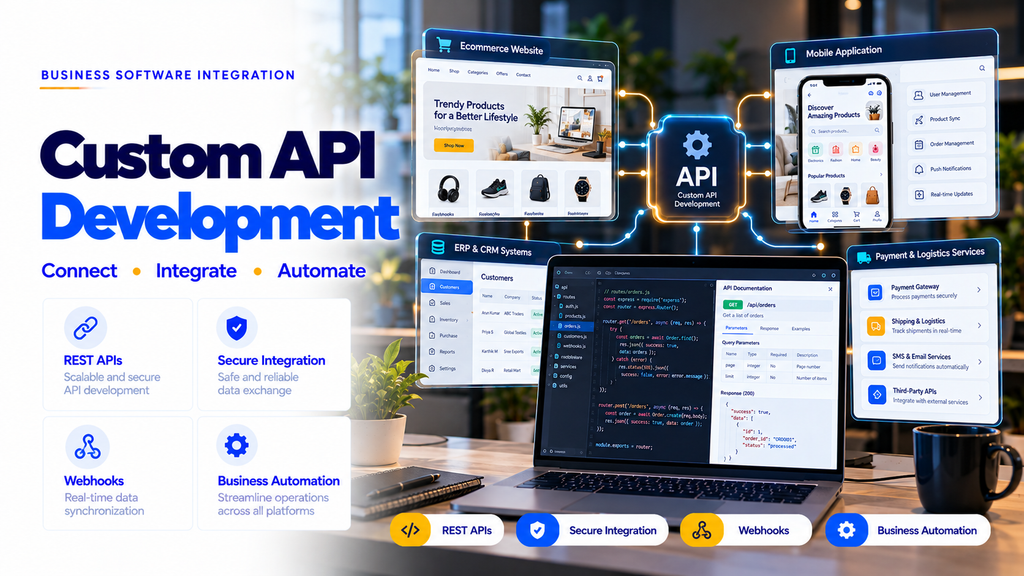
Custom API development and third-party integration services in Erode help businesses connect compatible applications and exchange information through secure, structured interfaces.
For example, an ecommerce website can send confirmed orders to an inventory system, a booking website can communicate with an appointment management platform, or a mobile application can retrieve information from a custom business backend.
However, successful integration requires more than connecting two endpoints. Developers must understand data structures, authentication, business workflows, error handling, security and the limitations of each connected platform.
This guide explains API development, third-party integration, REST APIs, webhooks, ecommerce integrations, ERP and CRM connectivity, costs, security and important considerations for businesses in Erode and across Tamil Nadu.
What Is an API?
API stands for Application Programming Interface.
An API defines how one software application can communicate with another application or service.
For example, a mobile application may request product information from an ecommerce backend through an API.
The backend processes the request and returns a structured response.
APIs are commonly used for websites, mobile applications, ecommerce systems, business software and external service integrations.
What Is Custom API Development?
Custom API development involves designing and implementing interfaces that expose selected software functionality or data to authorized applications.
A custom API may allow an application to:
- Retrieve product information
- Create customer records
- Submit orders
- Check order status
- Manage appointments
- Retrieve inventory information
- Update delivery status
- Access authorized reports
API functionality should be designed around the business requirements and permissions of the connected systems.
What Is Third-Party API Integration?
Third-party API integration connects an application with an external service through the provider’s supported interfaces.
Common examples include:
- Payment gateways
- SMS services
- Email services
- Shipping providers
- Maps and location services
- CRM platforms
- Accounting software
- Ecommerce platforms
Third-party integrations depend on the provider’s documentation, permissions, pricing, service availability and usage limits.
Why Businesses in Erode Need API Integration
Businesses may use different systems for sales, inventory, accounting, customer support and daily operations.
API integration can help reduce repeated manual data entry and support more consistent workflows.
Potential benefits include:
- Connecting existing business applications
- Automating selected repetitive tasks
- Synchronizing business information
- Improving access to operational data
- Supporting mobile application functionality
- Integrating ecommerce and inventory systems
- Connecting customer enquiries with CRM systems
Benefits depend on the quality of the integration and the capabilities of the connected software.
1. REST API Development Services
REST is an architectural style commonly used for web APIs.
REST APIs often communicate over HTTP and exchange information using JSON.
Common HTTP methods include:
- GET: Retrieve information
- POST: Submit or create information
- PUT: Replace a resource representation
- PATCH: Update selected resource fields
- DELETE: Request resource deletion
The exact behavior of each endpoint depends on the API design.
2. Laravel REST API Development
Laravel is a PHP framework that can be used to build custom backend APIs.
Potential Laravel API features include:
- Authentication
- Authorization
- Request validation
- Database operations
- Business logic
- API resource responses
- Rate limiting
- Background jobs
- Logging
Laravel APIs can support websites, mobile applications and custom business software.
3. Node.js API Development
Node.js can be used to develop server-side APIs and integration services.
Potential use cases include:
- Web application backends
- Mobile application APIs
- Webhook processing
- Integration middleware
- Real-time application features
- Background processing
The appropriate framework and runtime depend on the application’s requirements.
4. PHP and MySQL API Development
PHP and MySQL can be used to build APIs for database-driven business applications.
Potential functionality includes:
- Customer management
- Product management
- Order processing
- Employee records
- Booking management
- Inventory information
Applications should use secure database access, prepared queries, validation and appropriate authorization controls.
5. Mobile App API Development
Mobile applications commonly communicate with backend services through APIs.
Potential features include:
- User registration
- Login
- Customer profiles
- Product catalogues
- Order placement
- Booking requests
- Notifications
- Order tracking
APIs can support Android, iOS, Flutter and other compatible application technologies.
6. Website API Integration
Business websites may need integrations with external services.
Potential examples include:
- Contact form submissions to CRM
- Appointment booking systems
- Payment services
- Email notifications
- Customer support systems
- Product catalogue APIs
Integrations should be implemented using supported provider interfaces rather than relying on undocumented access methods.
7. Ecommerce API Integration
Ecommerce APIs can connect storefronts with products, orders, payments and inventory systems.
Potential integration workflows include:
- Product synchronization
- Stock availability
- Cart operations
- Order creation
- Payment status
- Shipping information
- Order tracking
Final prices, inventory and transaction status should be validated through trusted backend services.
8. Shopify API Integration
Shopify provides supported APIs for storefront and administrative functionality.
Potential integration use cases include:
- Custom storefronts
- Product information
- Collections
- Cart functionality
- Order-related administrative workflows
- Inventory-related workflows
API permissions and available operations depend on Shopify’s current platform capabilities.
9. WooCommerce API Integration
WooCommerce provides APIs for storefront functionality and authorized administrative operations.
Potential integrations include:
- Product catalogues
- Product categories
- Shopping carts
- Checkout workflows
- Order management
- Inventory updates
Developers should use the appropriate WooCommerce APIs and protect privileged credentials.
10. Payment Gateway API Integration
Payment gateway integrations allow applications to initiate and manage supported online payment workflows.
Potential features include:
- Payment initiation
- Checkout integration
- Transaction verification
- Payment status
- Refund processing
- Payment notifications
Payment confirmation should be verified through trusted server-side mechanisms rather than relying only on browser responses.
11. Razorpay API Integration
Businesses may integrate Razorpay through supported payment APIs and checkout tools.
Potential use cases include:
- Online payments
- Payment status verification
- Order payment workflows
- Refund processing
- Payment webhooks
Available functionality depends on account eligibility, provider documentation and applicable terms.
12. PhonePe and Other Payment Integrations
Businesses may require payment integrations with supported payment providers.
Important considerations include:
- Merchant onboarding
- API access
- Supported payment methods
- Transaction verification
- Refund workflows
- Webhook security
Developers should confirm the provider’s current integration requirements before implementation.
13. SMS Gateway API Integration
SMS APIs may be used for transactional notifications and other permitted communication.
Potential use cases include:
- Booking confirmations
- Order updates
- Delivery notifications
- Account alerts
- Verification codes
SMS usage must follow provider policies and applicable messaging regulations.
14. WhatsApp Business API Integration
Supported WhatsApp Business Platform integrations can help businesses manage permitted customer communication.
Potential use cases include:
- Order notifications
- Appointment reminders
- Customer support workflows
- Delivery updates
- Approved message templates
Business verification, messaging permissions, templates, pricing and eligibility depend on the platform’s current requirements.
15. Email API Integration
Email service APIs can support automated transactional communication.
Potential use cases include:
- Account verification
- Password reset
- Order confirmation
- Invoice delivery
- Booking confirmation
- Support notifications
Businesses should configure appropriate sender authentication and monitor delivery failures.
16. Google Maps API Integration
Maps and location services may be integrated into supported business applications.
Potential features include:
- Address selection
- Location display
- Place search
- Route information
- Delivery area workflows
Usage, billing and available features depend on the selected maps APIs and provider terms.
17. Shipping and Courier API Integration
Shipping integrations can connect ecommerce systems with supported logistics providers.
Potential workflows include:
- Shipment creation
- Shipping rate calculation
- Tracking information
- Pickup requests
- Delivery status updates
- Shipping labels
18. ERP API Integration
ERP integration connects business applications with enterprise resource planning systems.
Potential workflows include:
- Inventory synchronization
- Sales order transfer
- Purchase information
- Invoice records
- Customer information
- Production status
Integration feasibility depends on the ERP system’s available APIs and permissions.
19. CRM API Integration
CRM integrations can help businesses organize customer enquiries and sales activities.
Potential workflows include:
- Website lead capture
- Contact creation
- Enquiry assignment
- Sales status updates
- Customer activity records
- Follow-up workflows
20. Accounting Software API Integration
Businesses may connect supported accounting software with their sales and operational systems.
Potential workflows include:
- Invoice creation
- Customer synchronization
- Payment records
- Credit notes
- Sales data transfer
Accounting integrations should be reviewed for data accuracy, tax treatment and reconciliation requirements.
21. Tally Integration
Some businesses use Tally for accounting and financial records.
Integration possibilities depend on the installed Tally product, version, available interfaces and deployment environment.
Potential workflows include:
- Sales invoice transfer
- Customer ledger information
- Inventory-related data
- Transaction synchronization
A technical feasibility review is important before committing to an integration approach.
22. Inventory Management API Integration
Inventory APIs may connect sales channels with stock management systems.
Potential functionality includes:
- Stock availability
- Stock adjustments
- Warehouse information
- Product synchronization
- Inventory movement records
Developers must plan how the systems handle conflicting or delayed inventory updates.
23. Warehouse Management API Integration
Warehouse integrations may connect ecommerce or ERP systems with warehouse workflows.
Potential use cases include:
- Order fulfilment
- Picking requests
- Packing status
- Dispatch confirmation
- Stock transfers
- Warehouse reports
24. POS System API Integration
Retail businesses may need to connect point-of-sale systems with ecommerce and inventory platforms.
Potential workflows include:
- Sales synchronization
- Product information
- Inventory updates
- Customer records
- Return information
25. Booking System API Integration
Booking APIs can connect customer interfaces with appointment or reservation systems.
Potential features include:
- Available time slots
- Booking creation
- Booking confirmation
- Cancellation requests
- Rescheduling
- Notifications
Availability should be revalidated before final booking confirmation.
26. Hospital and Clinic API Integration
Healthcare software may require carefully controlled integrations between authorized systems.
Potential workflows include:
- Appointment information
- Patient registration
- Billing records
- Laboratory workflows
- Authorized reporting
Healthcare integrations require appropriate privacy, access control, security and regulatory review.
27. School Management API Integration
Educational institutions may connect student portals, administrative software and communication services.
Potential workflows include:
- Student information
- Attendance records
- Fee information
- Announcements
- Parent notifications
Student information should be protected with suitable authorization and privacy safeguards.
28. HR and Payroll API Integration
Businesses may integrate supported HR and payroll systems with employee management software.
Potential workflows include:
- Employee records
- Attendance information
- Leave records
- Payroll inputs
- Department information
Payroll and employee data require strict access controls and careful validation.
29. Biometric Attendance API Integration
Attendance systems may connect to supported biometric devices or attendance management platforms.
Potential features include:
- Attendance event synchronization
- Employee mapping
- Shift information
- Attendance reporting
Integration depends on device compatibility, vendor interfaces and data protection requirements.
30. Manufacturing Software API Integration
Manufacturing businesses may need integrations between production, inventory, purchasing and sales systems.
Potential workflows include:
- Production orders
- Raw material information
- Inventory updates
- Purchase records
- Dispatch information
- Production reports
31. Textile Business Software Integration
Textile manufacturers and traders may use multiple systems for yarn, fabric, production and order management.
Potential integrations include:
- Yarn inventory
- Fabric stock
- Production tracking
- Sales orders
- Purchase records
- Dispatch information
32. Dealer and Distributor API Integration
Dealer portals may connect to central inventory and order management systems.
Potential workflows include:
- Dealer authentication
- Product catalogues
- Customer-specific pricing
- Order submission
- Stock availability
- Invoice information
- Dispatch status
33. Webhook Integration Services
A webhook allows one system to send an event notification to another system through a configured endpoint.
For example, a payment provider may send a webhook when a transaction status changes.
Common webhook use cases include:
- Payment updates
- Order events
- Shipment updates
- Form submissions
- Subscription events
Webhook handlers should verify authenticity, handle repeated events and support safe retries.
34. API Authentication and Authorization
APIs should restrict access to authorized applications and users.
Common approaches include:
- API keys
- OAuth 2.0
- Access tokens
- Session-based authentication
- Role-based authorization
The correct mechanism depends on the application’s security requirements and the connected provider.
35. API Security Best Practices
Security is essential when APIs process customer records, payments or operational information.
Important safeguards include:
- HTTPS
- Strong authentication
- Server-side authorization
- Input validation
- Rate limiting
- Credential protection
- Secure logging
- Dependency updates
- Security testing
API credentials should not be exposed in public frontend code or repositories.
36. API Rate Limiting
Rate limiting controls how frequently clients can make requests.
It can help manage:
- Excessive traffic
- Resource usage
- Automated abuse
- Third-party usage limits
Rate limiting should be combined with appropriate authentication and monitoring.
37. API Error Handling
Reliable APIs should return meaningful responses when operations fail.
Common error categories include:
- Invalid input
- Authentication failure
- Permission denial
- Missing resources
- Rate limit exceeded
- Temporary service failure
Error messages should help developers diagnose problems without exposing sensitive system information.
38. API Logging and Monitoring
Monitoring helps identify integration failures and operational issues.
Potential monitoring areas include:
- Request failures
- Response times
- Webhook processing
- Synchronization failures
- External service availability
- Unusual traffic patterns
Logs should avoid unnecessary exposure of credentials and personal information.
39. API Documentation
API documentation helps developers understand available endpoints and expected behavior.
Documentation may include:
- Endpoint URLs
- HTTP methods
- Authentication requirements
- Request parameters
- Example responses
- Error codes
- Usage limits
OpenAPI specifications may be used to document suitable HTTP APIs.
40. API Testing Services
API testing verifies functionality, security and reliability.
Potential testing activities include:
- Endpoint testing
- Authentication testing
- Validation testing
- Integration testing
- Error handling tests
- Load testing
- Webhook testing
Testing should include realistic failure scenarios and unexpected inputs.
41. API Performance Optimization
API performance depends on backend processing, database queries, network conditions and external services.
Potential improvements include:
- Database query optimization
- Pagination
- Appropriate caching
- Efficient payloads
- Background processing
- Connection management
- Monitoring
42. API Data Synchronization
Some integrations need to synchronize information between multiple systems.
Potential approaches include:
- Scheduled synchronization
- Webhook-triggered updates
- Event-driven processing
- On-demand synchronization
Data synchronization requires careful planning for duplicate records, conflicts, failed requests and eventual consistency.
43. API Integration Middleware
Integration middleware can coordinate communication between multiple applications.
Potential responsibilities include:
- Data transformation
- Request routing
- Authentication handling
- Retry management
- Event processing
- Error logging
Middleware may be useful when connected systems use different data structures or communication patterns.
44. API Development vs API Integration
| Factor | API Development | API Integration |
|---|---|---|
| Purpose | Create a new interface for software functionality | Connect existing applications or services |
| Main Work | Endpoints, business logic and security | Authentication, data mapping and workflows |
| Typical Example | Custom order management API | Connect orders to accounting software |
| Testing | API functionality and security | End-to-end integration behavior |
| Maintenance | Versioning and backend updates | Compatibility and provider changes |
45. API Development Technologies
Different technologies may be suitable for different API projects.
| Technology | Potential Use |
|---|---|
| Laravel | PHP-based business APIs and backend applications |
| Node.js | JavaScript-based API services and integrations |
| PHP | Custom web backend APIs |
| MySQL | Relational data storage |
| REST | HTTP-based resource interfaces |
| GraphQL | Schema-based data queries and mutations |
| Webhooks | Event notifications between systems |
The technology stack should be selected according to the existing systems, performance requirements, security needs and maintenance resources.
46. API Development Cost in Erode
API development and integration costs depend on the number of systems, available documentation, data complexity, security requirements and business workflows.
Important cost factors include:
- Number of endpoints
- Custom business logic
- Authentication requirements
- Third-party API availability
- Data mapping complexity
- Webhook development
- Synchronization requirements
- Admin interfaces
- Testing
- Documentation
- Hosting
- Maintenance
A simple contact form integration may require less work than a multi-system ERP, ecommerce and accounting synchronization project.
47. API Integration Budget Planning
| Component | Typical Scope | Cost Consideration |
|---|---|---|
| Requirement Analysis | System and workflow assessment | Business complexity |
| API Development | Custom endpoints | Endpoint count and logic |
| Third-Party Integration | External service connectivity | Provider requirements |
| Data Synchronization | Mapping and transfer | Data complexity |
| Security | Authentication and authorization | Risk and compliance needs |
| Testing | Functional and integration testing | Number of workflows |
| Maintenance | Updates and monitoring | Agreed support scope |
48. API Development Timeline
Development time depends on project scope, third-party API access, documentation, approval processes and testing requirements.
Some integrations require provider onboarding or sandbox access before development can begin.
Businesses should agree on milestones and acceptance criteria based on actual integration requirements.
49. Custom API Development Process
- Requirement Analysis: Identify systems and workflows.
- Feasibility Review: Confirm API availability and permissions.
- Architecture Planning: Define data flow and responsibilities.
- API Design: Specify endpoints and data structures.
- Security Planning: Define authentication and authorization.
- Development: Build endpoints and integration logic.
- Data Mapping: Align information between systems.
- Webhook Configuration: Implement event handling where required.
- Testing: Validate successful and failed workflows.
- Documentation: Record interfaces and operating requirements.
- Deployment: Configure production credentials and infrastructure.
- Monitoring: Track failures and service behavior.
- Maintenance: Update integrations as systems change.
50. API Integration for Small Businesses
Small businesses may benefit from connecting existing applications rather than replacing every system.
Potential examples include:
- Website forms to CRM
- Online orders to inventory
- Booking systems to notifications
- Invoices to accounting software
- Customer enquiries to support platforms
51. API Integration for Startups
Startups may use APIs to build products without developing every supporting service internally.
Potential integrations include:
- Authentication services
- Payment providers
- Email services
- Maps
- Notifications
- Analytics
Provider pricing, reliability and long-term dependency should be considered.
52. Enterprise API Integration
Larger businesses may need integrations across departments and systems.
Potential requirements include:
- Multiple data sources
- Role-based permissions
- High-volume synchronization
- Audit logs
- System monitoring
- Failure recovery
- Version management
53. API Development Across Erode District
Businesses across Erode district may require API development for websites, ecommerce platforms, manufacturing software, retail systems and internal applications.
Relevant locations include:
- Erode
- Perundurai
- Bhavani
- Anthiyur
- Gobichettipalayam
- Sathyamangalam
- Modakkurichi
- Kodumudi
- Nambiyur
- Chennimalai
- Kavindapadi
- Ammapettai
- Arachalur
- Sivagiri
- Punjai Puliampatti
- Thalavadi
- Solar
- Surampatti
- Veerappanchatram
- Nasiyanur
Businesses in Coimbatore, Tiruppur, Salem, Karur, Namakkal, Chennai, Madurai and Tiruchirappalli may also require software integration solutions.
54. How to Choose an API Development Company in Erode
Before selecting an API development provider, consider:
- Experience with relevant backend technologies
- Understanding of business workflows
- Knowledge of third-party API documentation
- Authentication and security practices
- Data synchronization planning
- Webhook development knowledge
- Error handling
- Testing procedures
- Documentation
- Maintenance support
Ask for a written scope describing the systems, endpoints, permissions, workflows and testing responsibilities.
55. Common API Integration Mistakes
- Starting development without verifying API access
- Exposing API credentials
- Ignoring rate limits
- Failing to validate incoming data
- Trusting unverified webhook requests
- Not handling duplicate events
- Ignoring synchronization conflicts
- Skipping retry mechanisms
- Not monitoring failures
- Using undocumented provider interfaces
- Skipping integration testing
- Failing to plan API version updates
56. API Integration Launch Checklist
- Identify all connected systems.
- Confirm API availability.
- Review provider documentation.
- Define data ownership.
- Map required fields.
- Plan authentication.
- Define authorization rules.
- Protect credentials.
- Implement request validation.
- Handle API errors.
- Plan retries and idempotency.
- Verify webhook authenticity.
- Test data synchronization.
- Review rate limits.
- Configure logging.
- Test failure scenarios.
- Prepare documentation.
- Configure production access.
- Plan monitoring.
- Define maintenance responsibilities.
57. How Greap Technologies Can Help
Greap Technologies can help businesses in Erode and Tamil Nadu discuss custom API development and third-party integration requirements.
Depending on the agreed project scope and available provider interfaces, solutions may include:
- Custom REST API development
- Laravel API development
- PHP and MySQL backend APIs
- Website API integration
- Mobile application API development
- Ecommerce API integration
- Shopify integration
- WooCommerce integration
- Payment gateway integration
- SMS and email integration
- WhatsApp Business Platform integration
- Shipping and logistics integration
- ERP and CRM integration
- Inventory synchronization
- Webhook development
- Business workflow automation
- API testing and documentation
- Integration maintenance
Explore Greap Technologies for custom software development, ecommerce solutions, website development and business technology services.
Conclusion
Custom API development and third-party integration services in Erode can help businesses connect compatible software applications and automate selected information flows.
From ecommerce orders and payment updates to ERP synchronization, CRM enquiries and mobile application backends, APIs provide structured ways for systems to communicate.
However, successful integration depends on reliable architecture, secure authentication, accurate data mapping, testing, monitoring and ongoing maintenance.
Before beginning an API project, businesses should identify which systems need to communicate, what information must be exchanged and whether the necessary APIs are available.
Need Custom API Development or Software Integration?
Greap Technologies can help you discuss API development, ecommerce integrations, payment gateways, mobile app backends and business software connectivity.
Frequently Asked Questions
1. What is custom API development?
Custom API development involves creating interfaces that allow authorized applications to access selected software data or functionality.
2. What is third-party API integration?
Third-party API integration connects an application with an external service using supported interfaces provided by that service.
3. How much does API development cost in Erode?
Cost depends on the number of endpoints, integration complexity, authentication, data synchronization, testing and maintenance requirements.
4. Can Laravel be used for API development?
Yes. Laravel can be used to build secure, database-driven REST APIs for websites, mobile applications and business systems.
5. Can an API connect a website and mobile app?
Yes. A shared backend API can provide suitable functionality to both a website and a mobile application.
6. Can ecommerce websites connect with inventory software?
Yes, when both systems provide suitable integration capabilities or an approved integration method is available.
7. Can APIs integrate payment gateways?
Yes. Supported payment APIs can be used for payment initiation, transaction verification and related workflows.
8. What is a webhook?
A webhook is a mechanism that allows one system to send an event notification to another system through a configured endpoint.
9. Are REST APIs secure?
REST APIs can be secured through HTTPS, authentication, authorization, validation, rate limiting and other safeguards. Security depends on implementation.
10. Can Tally be integrated with custom software?
Integration may be possible depending on the Tally product, version, available interfaces and deployment environment.
11. Can APIs automate business workflows?
Yes. APIs can support selected automated workflows between compatible applications, subject to permissions and business rules.
12. Does Greap Technologies provide API integration services in Erode?
Greap Technologies can assess custom API development and third-party integration requirements and propose solutions according to the agreed project scope.