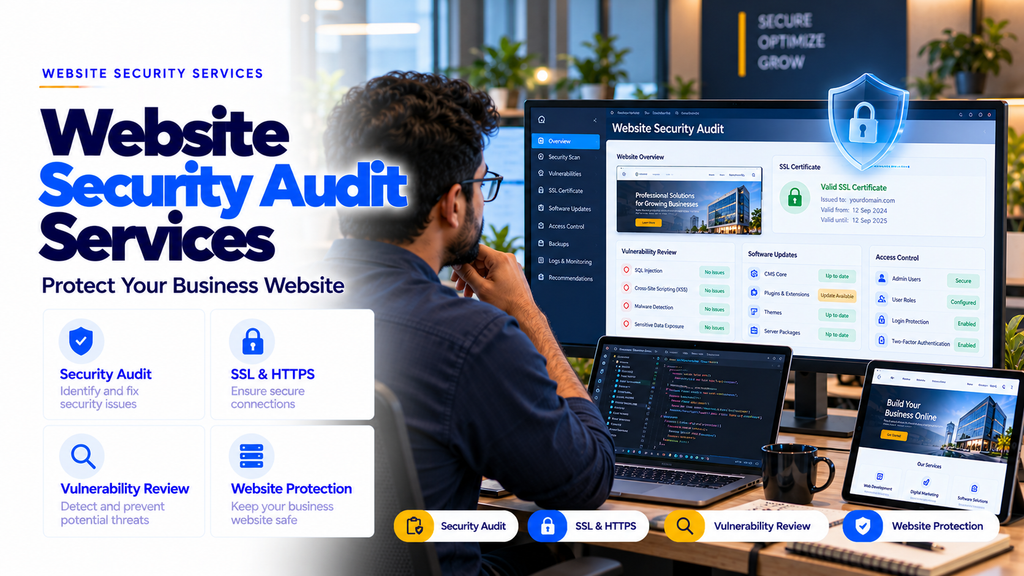
Website Security Audit Services in Erode: Protect Your Business Website
A business website is more than an online brochure. It may collect customer enquiries, process orders, manage appointments, display products or connect with internal business systems.
When website security is overlooked, businesses may face unauthorized access, data exposure, malware infections, website downtime or disruptions to customer services.
Many website security problems develop because of outdated software, weak access controls, insecure configurations, vulnerable plugins or insufficient maintenance.
Website security audit services in Erode help businesses assess their websites, identify potential security weaknesses and plan appropriate improvements.
A security audit does not guarantee that a website will never experience an attack. However, a structured assessment can help identify known risks and support better protection practices.
In this guide, we explain website security audits, vulnerability assessments, malware checks, WordPress and Laravel security, SSL configuration, ecommerce protection, maintenance and the factors that affect website security audit costs.
What Is a Website Security Audit?
A website security audit is a structured review of a website’s security configuration, software components, access controls and potential vulnerabilities.
The purpose is to understand where security weaknesses may exist and recommend appropriate improvements.
A website security audit may include:
- Website software review
- CMS and plugin assessment
- SSL and HTTPS configuration
- User account and access review
- Security header review
- Authentication assessment
- Backup configuration review
- Malware indicators review
- Hosting configuration assessment
- Security monitoring recommendations
The exact scope depends on the website technology, available access and agreed audit requirements.
Why Website Security Matters for Businesses in Erode
Businesses in Erode increasingly depend on websites for enquiries, ecommerce, customer communication and digital operations.
A security incident may affect:
- Website availability
- Customer trust
- Business enquiries
- Online orders
- Appointment systems
- Customer information
- Internal business workflows
Regular security reviews can help businesses identify weaknesses before they create larger operational problems.
1. Website Vulnerability Assessment
A vulnerability assessment examines a website for known weaknesses in software, configuration and application behavior.
Potential assessment areas include:
- Outdated software components
- Insecure configurations
- Weak authentication controls
- Unnecessary exposed services
- Missing security updates
- Improper access permissions
Assessment activities should be performed only with the website owner’s authorization.
2. Website Security Audit vs Penetration Testing
A security audit and penetration test are related but different activities.
| Factor | Security Audit | Penetration Testing |
|---|---|---|
| Primary Goal | Review security controls and identify weaknesses | Validate selected vulnerabilities through authorized testing |
| Typical Activities | Configuration review, software assessment and control checks | Controlled security testing within an agreed scope |
| Access Requirements | Depend on audit scope | Require explicit authorization and testing rules |
| Deliverable | Findings and improvement recommendations | Validated findings and remediation guidance |
Businesses should confirm which assessment activities are included before commissioning a service.
3. WordPress Website Security Audit
WordPress websites require attention to core software, themes, plugins, accounts and hosting configuration.
A WordPress security review may include:
- WordPress core version
- Plugin versions
- Theme versions
- Inactive or unnecessary plugins
- Administrator accounts
- User roles
- Login security
- Backup configuration
- File permissions
Keeping components updated and reducing unnecessary software can help limit exposure to known vulnerabilities.
4. WordPress Plugin Security
Plugins extend WordPress functionality but also add software dependencies.
Important review areas include:
- Plugin update status
- Known security advisories
- Developer maintenance activity
- Plugin necessity
- Compatibility with the website
Plugins should be obtained from trustworthy sources and maintained appropriately.
5. WordPress Theme Security
Website themes may contain custom code and third-party dependencies.
Security review considerations include:
- Theme update status
- Known vulnerabilities
- Unnecessary bundled components
- Custom code quality
- Compatibility with current WordPress versions
6. Laravel Website Security Audit
Laravel applications may require security reviews covering framework dependencies, authentication, authorization and server configuration.
Potential assessment areas include:
- Framework and dependency versions
- Environment configuration
- Authentication workflows
- Authorization policies
- Input validation
- File uploads
- Session handling
- API access controls
- Logging configuration
Application security depends on both framework configuration and the custom code developed for the project.
7. PHP Website Security Audit
Custom PHP websites should be reviewed for software updates, input handling, access controls and secure database interactions.
Important areas include:
- Supported PHP versions
- Database access
- Authentication
- Session management
- Input validation
- File upload handling
- Error reporting configuration
8. Ecommerce Website Security Audit
Ecommerce websites may process customer information, orders and payment-related workflows.
A security audit may review:
- Customer account security
- Administrator permissions
- Checkout configuration
- Payment integration
- Order management access
- Customer data handling
- Third-party integrations
- Software updates
Payment security responsibilities depend on the selected platform and payment provider.
9. WooCommerce Website Security
WooCommerce security depends on WordPress, WooCommerce extensions, payment integrations and hosting.
Potential checks include:
- WooCommerce updates
- Payment plugin updates
- Customer account controls
- Administrator access
- Checkout configuration
- Backup procedures
- Third-party integrations
10. Shopify Website Security Review
Shopify provides managed commerce infrastructure, but store owners still have security responsibilities.
Potential review areas include:
- Staff permissions
- Account security
- Installed apps
- App permissions
- Domain configuration
- Custom integrations
- Customer data handling
Infrastructure-level assessment activities are limited by Shopify’s platform policies and access restrictions.
11. SSL Certificate and HTTPS Security
HTTPS helps protect information transmitted between a visitor’s browser and the website.
Security checks may include:
- Certificate validity
- Certificate expiration
- HTTPS redirects
- Mixed content
- TLS configuration
- Secure resource loading
An SSL certificate does not guarantee that a website’s application code or database is secure.
12. Website Security Headers
HTTP security headers can help browsers enforce selected security policies.
Common headers include:
- Content-Security-Policy
- Strict-Transport-Security
- X-Content-Type-Options
- Referrer-Policy
- Permissions-Policy
Headers should be configured according to the website’s actual functionality and tested for compatibility.
13. Website Malware Detection
Malware can affect website files, scripts and application behavior.
A malware review may examine:
- Unexpected file changes
- Suspicious scripts
- Unrecognized administrator accounts
- Unexpected redirects
- Known malicious file indicators
Malware detection tools have limitations, and a clean scan does not prove that a website is free of compromise.
14. Website Malware Removal and Recovery
If a website is compromised, recovery should follow a controlled process.
Typical recovery considerations include:
- Preserving relevant evidence
- Identifying affected systems
- Removing unauthorized changes
- Updating vulnerable components
- Resetting compromised credentials
- Restoring trusted backups where appropriate
- Verifying website functionality
- Monitoring for recurrence
Complex incidents may require a specialist incident response provider.
15. Website Login Security
Login security helps reduce unauthorized account access.
Potential improvements include:
- Strong authentication
- Multi-factor authentication
- Appropriate login rate limits
- Secure password reset workflows
- Account activity review
- Removal of unused accounts
16. Administrator Access Security
Administrator accounts often have extensive website permissions.
Security reviews should consider:
- Number of administrator accounts
- Role assignments
- Former employee access
- Shared account usage
- Multi-factor authentication
- Access logging
Users should receive only the permissions required for their responsibilities.
17. Role-Based Access Control
Role-based access control restricts application functionality according to assigned roles.
Potential roles include:
- Administrator
- Content editor
- Sales manager
- Support staff
- Customer
Authorization must be enforced by the application backend rather than relying only on hidden interface elements.
18. Database Security Audit
Databases may contain customer records, product information, enquiries and operational data.
Potential review areas include:
- Database user permissions
- Credential storage
- Backup security
- Database exposure
- Access restrictions
- Software updates
- Query handling
19. SQL Injection Risk Review
SQL injection vulnerabilities can occur when untrusted input is handled unsafely in database queries.
Security reviews may examine whether the application uses:
- Parameterized queries
- Appropriate input validation
- Limited database permissions
- Secure database access patterns
These controls should be reviewed within the application’s actual architecture.
20. Cross-Site Scripting Risk Review
Cross-site scripting vulnerabilities can arise when untrusted content is inserted into webpages without appropriate protection.
Potential safeguards include:
- Context-appropriate output encoding
- Safe template rendering
- Input handling
- Content Security Policy
- Dependency maintenance
21. CSRF Protection Review
Cross-Site Request Forgery protection helps prevent certain unauthorized actions performed through an authenticated user’s browser.
Depending on the application, safeguards may include:
- Anti-CSRF tokens
- Appropriate SameSite cookie settings
- Origin validation
- Secure session design
22. File Upload Security
Business websites may allow users to upload images, documents or other files.
Security reviews may examine:
- Allowed file types
- File size limits
- Storage location
- Access permissions
- Malware scanning where appropriate
- Safe file serving
23. Website Backup Security
Backups are important for recovery after accidental changes, software failures or security incidents.
Backup reviews may consider:
- Backup frequency
- Backup storage
- Access restrictions
- Retention periods
- Backup encryption
- Restoration testing
A backup strategy is more reliable when restoration procedures are tested periodically.
24. Hosting Security Audit
Website hosting configuration can influence the overall security of an application.
Potential review areas include:
- Server software updates
- Hosting account access
- File permissions
- Database access
- Backup availability
- Logging
- Network exposure
The audit scope depends on whether the website uses shared hosting, VPS, cloud hosting or managed infrastructure.
25. Shared Hosting Security
Businesses using shared hosting should understand which security responsibilities belong to the hosting provider and which belong to the website owner.
Website owners may need to manage:
- Application updates
- Website credentials
- File permissions
- Application backups
- Third-party plugins
Server-level controls may be managed by the hosting provider.
26. VPS and Cloud Hosting Security
VPS and cloud environments may provide greater configuration control, along with additional maintenance responsibilities.
Potential security areas include:
- Operating system updates
- Firewall configuration
- Service access
- Administrative authentication
- Backup management
- Security monitoring
27. Website Firewall Review
Firewalls can help control certain types of network or application traffic.
A review may consider:
- Firewall availability
- Rule configuration
- Blocked traffic monitoring
- Application compatibility
- False-positive handling
A firewall is one security layer and does not replace secure application development.
28. Web Application Firewall Assessment
A Web Application Firewall, or WAF, can help filter selected malicious HTTP requests.
Potential review areas include:
- Rule configuration
- Traffic monitoring
- Protection coverage
- False positives
- Application compatibility
WAF effectiveness depends on configuration, traffic patterns and the types of threats encountered.
29. API Security Audit
Websites connected to mobile applications and external services may expose APIs.
API security reviews may include:
- Authentication
- Authorization
- Input validation
- Rate limiting
- Credential protection
- Error handling
- Logging
30. Third-Party Integration Security
External integrations may introduce additional security dependencies.
Potential review areas include:
- API key storage
- Permission scopes
- Webhook verification
- Provider access
- Unused integrations
- Dependency updates
31. Payment Gateway Security Review
Payment integrations should follow supported provider workflows and applicable security requirements.
Potential checks include:
- Payment verification
- Webhook authenticity
- Credential storage
- Transaction status handling
- Refund permissions
- Logging practices
Businesses handling payment card information may have additional PCI DSS responsibilities depending on their payment architecture.
32. Customer Data Protection
Websites may collect customer names, contact details, addresses and other information.
Security reviews should consider:
- Data collection requirements
- Access controls
- Secure transmission
- Storage protection
- Retention practices
- Data deletion workflows
Businesses should review applicable privacy and data protection obligations.
33. Website Form Security
Contact forms, enquiry forms and registration forms may receive untrusted input.
Potential safeguards include:
- Server-side validation
- Spam prevention
- Input limits
- Safe database handling
- Secure email processing
- Privacy-conscious data collection
34. Website Security Monitoring
Security monitoring helps businesses identify unusual events and operational problems.
Potential monitoring areas include:
- Unexpected administrator activity
- File changes
- Application errors
- Login failures
- Security alerts
- Website availability
Monitoring should include a defined process for reviewing and responding to alerts.
35. Website Uptime and Security
Website downtime can result from many causes, including hosting problems, application errors and security incidents.
Uptime monitoring can help identify availability problems.
However, uptime monitoring alone does not detect every security issue.
36. Website Security and SEO
Security incidents can affect search visibility and website accessibility.
Potential problems include:
- Malicious redirects
- Spam content injection
- Website downtime
- Unsafe page warnings
- Unauthorized content changes
Security maintenance helps support a trustworthy and accessible website, but it does not guarantee higher search rankings.
37. Website Security and Customer Trust
Customers may hesitate to submit information when a website appears unreliable or displays security warnings.
Clear website functionality, HTTPS, responsible data handling and reliable operations can contribute to a more trustworthy user experience.
38. Security Audit for Business Websites
Business websites may include contact forms, enquiry systems, content management and administrative access.
Potential audit priorities include:
- Administrator security
- Form security
- Software updates
- Hosting configuration
- Backups
- HTTPS
39. Security Audit for Ecommerce Websites
Ecommerce websites often require additional attention because they manage orders, customer accounts and payment-related workflows.
Potential priorities include:
- Checkout security
- Customer account protection
- Payment integration
- Order management access
- Plugin security
- Data protection
40. Security Audit for Educational Websites
School and educational websites may include student portals, fee information and administrative systems.
Potential priorities include:
- Student data access
- Role permissions
- Account security
- Payment workflows
- Backup procedures
41. Security Audit for Healthcare Websites
Healthcare websites may include appointment booking, patient information and administrative workflows.
Potential priorities include:
- Patient data protection
- Account permissions
- Secure appointment systems
- Application updates
- Backup and recovery
Systems processing sensitive medical information require appropriate specialist review and regulatory consideration.
42. Security Audit for Manufacturing Websites
Manufacturing websites may connect to product catalogues, dealer portals and internal software.
Potential priorities include:
- Dealer authentication
- Business data access
- API security
- Document downloads
- Administrative permissions
43. Security Audit for B2B Portals
B2B portals may manage customer-specific pricing, purchase orders and business account information.
Potential review areas include:
- Business account authentication
- Customer data separation
- Role permissions
- Order access controls
- API authorization
44. How Often Should a Website Security Audit Be Conducted?
The appropriate frequency depends on website complexity, exposure, software changes and business risk.
Security reviews may be especially useful:
- Before a major launch
- After significant code changes
- After introducing new integrations
- Following a security incident
- When critical security advisories affect installed software
- As part of a risk-based maintenance schedule
High-risk applications may require more frequent monitoring and assessment.
45. Signs Your Website May Need a Security Review
Consider reviewing your website if you notice:
- Unexpected redirects
- Unknown administrator accounts
- Unexplained website changes
- Security warnings
- Outdated software
- Unusual login activity
- Unexpected files
- Repeated application errors
These symptoms can have different causes and do not always confirm a security compromise.
46. Website Security Audit Cost in Erode
Website security audit costs depend on the website’s technology, complexity, number of applications, access requirements and testing scope.
Important factors include:
- Website platform
- Number of applications
- Custom code complexity
- Authentication features
- Third-party integrations
- Hosting environment
- Vulnerability assessment scope
- Reporting requirements
- Remediation work
- Retesting
A basic configuration review and a comprehensive application security assessment have different scopes and should not be treated as equivalent services.
47. Website Security Audit Budget Planning
| Service Component | Typical Scope | Cost Consideration |
|---|---|---|
| Initial Assessment | Website and technology review | Application complexity |
| CMS Security | Core, theme and plugin checks | Number of components |
| Configuration Review | HTTPS, headers and permissions | Hosting access |
| Application Review | Authentication and access controls | Custom functionality |
| Security Report | Findings and recommendations | Reporting depth |
| Remediation | Agreed security improvements | Required changes |
| Retesting | Verification of fixes | Number of findings |
48. Website Security Audit Process
- Requirement Discussion: Understand the website and business needs.
- Authorization: Confirm ownership and permitted assessment activities.
- Scope Definition: Identify systems and security controls to review.
- Technology Review: Identify frameworks, CMS and dependencies.
- Configuration Review: Examine HTTPS, access and hosting settings.
- Application Assessment: Review agreed application security areas.
- Findings Analysis: Evaluate identified risks.
- Security Report: Document findings and recommendations.
- Remediation Planning: Prioritize appropriate improvements.
- Retesting: Verify agreed fixes.
- Maintenance Planning: Establish ongoing security responsibilities.
49. What Should a Website Security Audit Report Include?
A useful security audit report may include:
- Assessment scope
- Methodology
- Systems reviewed
- Identified findings
- Risk severity
- Supporting evidence
- Business impact
- Recommended fixes
- Remediation priorities
- Assessment limitations
The report should clearly distinguish confirmed findings from potential risks requiring further validation.
50. Website Security Remediation Services
After an audit, businesses may need to implement recommended security improvements.
Potential remediation work includes:
- Updating vulnerable components
- Removing unnecessary plugins
- Improving authentication
- Correcting permissions
- Updating security headers
- Improving backup procedures
- Fixing application code
- Securing integrations
Remediation should be tested to ensure that business functionality continues working correctly.
51. Website Security Maintenance
Website security is an ongoing responsibility rather than a one-time activity.
Maintenance may include:
- Software updates
- Backup monitoring
- Account reviews
- Security alert monitoring
- Dependency reviews
- Configuration checks
- Periodic security assessments
52. Website Security Audit Services Across Erode District
Businesses across Erode district may require website security reviews for corporate websites, ecommerce stores, WordPress websites and custom applications.
Relevant locations include:
- Erode
- Perundurai
- Bhavani
- Anthiyur
- Gobichettipalayam
- Sathyamangalam
- Modakkurichi
- Kodumudi
- Nambiyur
- Chennimalai
- Kavindapadi
- Ammapettai
- Arachalur
- Sivagiri
- Punjai Puliampatti
- Thalavadi
- Solar
- Surampatti
- Veerappanchatram
- Nasiyanur
Businesses in Coimbatore, Tiruppur, Salem, Karur, Namakkal, Chennai, Madurai and Tiruchirappalli may also benefit from structured website security reviews.
53. How to Choose a Website Security Audit Company in Erode
Before choosing a provider, consider:
- Relevant website security knowledge
- Understanding of the website technology
- Clear assessment scope
- Written authorization procedures
- Responsible testing practices
- Actionable reporting
- Remediation capabilities
- Retesting options
- Confidentiality practices
- Maintenance support
For complex applications or regulated environments, businesses may require independent specialist penetration testing or compliance assessment.
54. Common Website Security Mistakes
- Ignoring software updates
- Using weak administrator authentication
- Keeping unnecessary plugins
- Sharing administrator accounts
- Failing to test backups
- Exposing private credentials
- Using insecure third-party integrations
- Ignoring access permissions
- Assuming HTTPS makes the entire website secure
- Skipping security monitoring
- Not reviewing custom application code
- Failing to plan incident response
55. Website Security Audit Checklist
- Confirm website ownership and authorization.
- Identify the website platform.
- Review software versions.
- Check plugins and themes.
- Review administrator accounts.
- Enable appropriate multi-factor authentication.
- Review user permissions.
- Check SSL and HTTPS.
- Review security headers.
- Assess application authentication.
- Review authorization controls.
- Check file upload handling.
- Review database access.
- Protect API credentials.
- Review third-party integrations.
- Check backup procedures.
- Test restoration capability.
- Review hosting security.
- Check logging and monitoring.
- Document identified findings.
- Prioritize remediation.
- Retest agreed fixes.
- Plan ongoing maintenance.
56. How Greap Technologies Can Help
Greap Technologies can help businesses in Erode and Tamil Nadu discuss website security review and maintenance requirements.
Depending on the agreed scope and available technical access, potential services may include:
- Website security assessment planning
- WordPress security review
- WooCommerce security review
- Laravel application security review
- PHP website security checks
- SSL and HTTPS configuration review
- Website software update assessment
- Administrator access review
- Backup configuration review
- Security configuration improvements
- Website maintenance
- Security remediation support
Specialist penetration testing, incident response and formal compliance certification should be separately scoped with appropriately qualified providers where required.
Explore Greap Technologies for website development, maintenance and custom software solutions.
Conclusion
Website security audit services in Erode help businesses identify potential security weaknesses and plan appropriate improvements.
Whether a business uses WordPress, WooCommerce, Laravel, PHP or another website platform, important security considerations include software updates, authentication, authorization, HTTPS, hosting configuration, backups and monitoring.
A structured security review can provide useful information about website risks, but security requires continuous maintenance and responsible operational practices.
Businesses should choose an assessment scope based on their website’s complexity, customer data, integrations and operational requirements.
Want to Review Your Business Website Security?
Greap Technologies can help you discuss WordPress, WooCommerce, Laravel and business website security requirements, including configuration reviews and maintenance improvements.
Frequently Asked Questions
1. What is a website security audit?
A website security audit is a structured review of security controls, software, configurations and potential vulnerabilities.
2. Why does my business website need a security audit?
A security audit can help identify known weaknesses, outdated software and configuration problems that may affect website security.
3. How much does a website security audit cost in Erode?
Cost depends on the website platform, application complexity, testing scope, reporting requirements and remediation work.
4. Can WordPress websites be audited for security?
Yes. WordPress security reviews can examine core software, themes, plugins, user accounts, permissions and hosting configuration.
5. Is an SSL certificate enough to secure a website?
No. HTTPS protects data in transit, but websites also require secure code, authentication, access controls, updates and other safeguards.
6. Can a website security audit detect malware?
Malware checks may be included in an audit, but no scan can guarantee detection of every compromise.
7. How often should a website security audit be performed?
Frequency depends on business risk, software changes, website complexity and security requirements. Reviews are particularly useful after major changes or incidents.
8. Can Laravel websites be audited?
Yes. Laravel security reviews may examine dependencies, authentication, authorization, configuration, APIs and custom application code.
9. Does website security affect SEO?
Security incidents can disrupt website availability or introduce malicious content that affects search visibility. Security alone does not guarantee rankings.
10. What is the difference between a security audit and penetration testing?
A security audit reviews controls and potential weaknesses, while penetration testing uses authorized testing to validate selected security issues.
11. Can security issues be fixed after an audit?
Many identified issues can be addressed through software updates, configuration changes, access control improvements or code remediation.
12. Does Greap Technologies provide website security audit services in Erode?
Greap Technologies can assess website security review requirements and discuss an appropriate service scope, including maintenance and configuration improvements.