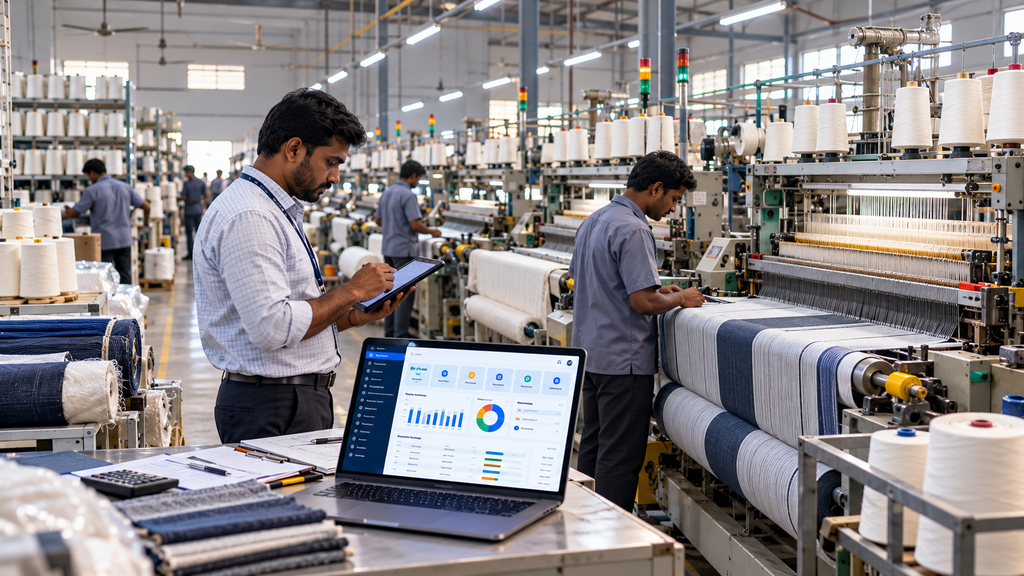
Powerloom and weaving businesses manage a continuous flow of information between customer orders, yarn, weaving requirements, loom planning, production, work-in-progress, fabric inspection, finished fabric, packing and dispatch.
When production details are maintained across notebooks, spreadsheets, paper registers, messaging conversations and separate software systems, understanding the current status of orders and looms can require considerable manual coordination.
Powerloom management software development in Erode can help weaving businesses organize these operations through a centralized digital system designed around their actual production workflow.
A custom solution can connect order management, yarn inventory, loom planning, production orders, shift-wise production records, WIP, fabric production, quality workflows, job work, inventory and dispatch.
The software should not force every weaving business into the same process. A job-work powerloom unit, an integrated textile manufacturer and a company producing its own fabric can have substantially different operational requirements.
This guide explains the important modules, workflows, integrations and implementation considerations for developing custom powerloom management software.
At Greap Technologies, we develop custom textile and manufacturing software for businesses in Erode and nearby areas.
What Is Powerloom Management Software?
Powerloom management software is a business and production application designed to organize the operational workflows of powerloom and weaving units.
Depending on the business, the software can include:
- Customer management
- Weaving order management
- Yarn master
- Yarn inward
- Yarn inventory
- Weaving specifications
- Loom master
- Loom planning
- Production orders
- Production tracking
- Shift-wise production entries
- Work-in-progress tracking
- Job-work management
- Fabric production records
- Fabric inspection
- Quality workflows
- Finished fabric inventory
- Packing
- Dispatch
- Dashboards and reports
- ERP integrations
The final modules should be selected after studying the weaving unit’s actual process.
Powerloom Software vs Textile ERP
Powerloom software focuses on weaving operations, while a broader textile ERP can connect weaving with purchasing, sales, dyeing, garment production, accounting and other business functions.
| Textile ERP | Powerloom Management Software |
|---|---|
| Enterprise-wide textile management | Weaving-focused operations |
| Can cover multiple textile processes | Loom planning and weaving production |
| Purchase, sales and financial integrations | Yarn, WIP and fabric workflows |
| Company-wide reporting | Loom and production-level visibility |
For a broader system, read Textile ERP Software Development in Erode: Features and Benefits.
Typical Powerloom Production Workflow
A simplified weaving workflow can look like:
Customer / Production Requirement → Yarn → Weaving Planning → Loom Allocation → Weaving Production → Fabric Inspection → Finished Fabric → Packing → Dispatch
Actual weaving workflows vary. The software should therefore be configured according to the unit’s materials, machinery, processes and commercial model.
1. Powerloom Business Process Study
Custom software development should begin with a detailed understanding of how the powerloom unit currently operates.
Important questions include:
- Does the unit manufacture its own fabric or perform job work?
- How are weaving orders received?
- Who owns the yarn?
- How is yarn received and stored?
- How are weaving specifications maintained?
- How are looms selected?
- How is production planned?
- How is production recorded?
- How is WIP tracked?
- How is fabric inspected?
- How are finished rolls or quantities recorded?
- How is packing handled?
- How is dispatch handled?
- Which existing applications need integration?
2. Customer Management
Customer records can connect enquiries, weaving requirements, orders, production and dispatch history.
Only information required for legitimate business workflows should be collected and maintained.
3. Weaving Order Management
A confirmed customer or internal production requirement can become a weaving order.
Depending on the business, an order can reference:
- Customer
- Fabric requirement
- Quantity
- Relevant yarn requirement
- Approved weaving specification
- Required date
- Customer reference
- Internal order number
- Order status
4. Internal Order Numbering
Structured order numbers can help connect planning, production, quality, packing and dispatch records.
5. Order Status Management
Statuses should reflect the company’s actual workflow rather than adding unnecessary stages.
For example, an order might move through planning, production, inspection, packing and completion states.
6. Make-to-Order Weaving
A business producing fabric against customer requirements may follow:
Customer Order → Weaving Requirement → Yarn Availability → Loom Planning → Production → Inspection → Dispatch
7. Make-to-Stock Weaving
A business manufacturing fabric for stock can follow a different flow:
Internal Demand → Production Plan → Yarn → Loom → Fabric Production → Finished Stock
8. Job-Work Powerloom Operations
Some powerloom units weave material for another textile business rather than purchasing and selling the complete material themselves.
A simplified job-work flow can be:
Customer Material / Requirement → Material Receipt → Weaving Order → Loom Production → Fabric Inspection → Return / Dispatch
9. Customer-Owned Yarn
If yarn belongs to the customer, the system should distinguish it from company-owned inventory.
This ownership distinction should remain clear through receipt, production, balance and dispatch workflows.
10. Company-Owned Yarn
Where the powerloom business purchases its own yarn, purchasing and inventory can connect with production planning.
Read Purchase Order Management Software Development in Erode.
11. Yarn Master
A yarn master can provide consistent references across inventory and production.
Only attributes genuinely required by the weaving operation should be maintained.
12. Yarn Inward Management
Incoming yarn can be recorded against the appropriate purchase, customer or job-work reference.
13. Yarn Lot References
Where lot information is operationally important, the relevant yarn lot can remain connected to inventory and production records.
14. Yarn Inventory
Stores users can view recorded yarn quantities according to the dimensions required by the business.
If a dedicated trading operation is also involved, read Yarn Trading Software Development for Textile Businesses in Erode.
15. Yarn Stock by Location
Where multiple storage locations are used, inventory can be maintained by godown or store.
16. Yarn Reservation for Production
Where required, recorded yarn quantities can be reserved against approved production requirements.
The reservation logic should be clearly defined so users understand the difference between physical, available and allocated stock.
17. Material Requirement Planning
Production requirements can be used to identify the materials required for planned weaving.
The calculation rules should be based on approved business and technical information.
18. Yarn Shortage Workflow
When required yarn is not available, a controlled workflow can connect production with purchasing.
Production Requirement → Yarn Availability Check → Shortage Review → Purchase Requirement → Purchase Order → Receipt → Production
19. Weaving Specification Management
The system can maintain the production specifications required by the powerloom business.
Technical specifications should be created and approved by appropriate textile-production personnel.
20. Specification Version Control
If approved weaving specifications change, version control can preserve which version was associated with a particular production requirement.
21. Loom Master
Each relevant loom can be represented within a loom master.
Depending on operational requirements, the record may include:
- Loom code
- Loom type or approved classification
- Production unit or location
- Operational status
- Other required production references
22. Loom Status
The software can maintain defined operational statuses for looms where this information supports planning or maintenance workflows.
23. Loom Planning
Production planners can assign approved weaving requirements to appropriate looms according to operational considerations.
The software can present planning information, but loom-selection decisions should remain with authorized personnel where technical context is required.
24. Loom Allocation
A production order can be associated with the loom or group of looms planned for the work.
25. Multiple Looms for One Order
Where required, one weaving order can be distributed across multiple looms.
The software should support this relationship rather than assuming every order belongs to a single machine.
26. Multiple Orders Across Looms
Production planners may need to coordinate several active orders across the available loom capacity.
A planning view can organize these assignments in one place.
27. Loom Schedule
Planned assignments can be displayed through a production schedule showing relevant orders and loom allocations.
Schedules should remain editable by authorized users when operating conditions change.
28. Production Order Management
An approved production order can connect the weaving requirement with relevant yarn, specifications, planned quantity and loom allocation.
29. Production Order Number
A structured production-order reference can support traceability between planning, material issue, weaving, quality and finished fabric.
30. Yarn Issue to Production
Yarn issued from stores can be recorded against the appropriate production order or approved weaving requirement.
31. Yarn Return from Production
If unused yarn returns to stores, the movement should be recorded through a proper return transaction rather than directly changing inventory quantities.
32. Production Start
The system can record when an approved production order enters the defined active production stage.
33. Shift-Wise Production Entry
Where a weaving unit records production by shift, authorized users can enter the relevant production information against the loom and production order.
The exact data captured should match actual management requirements.
34. Daily Production Entry
Businesses that do not require shift-level information may use daily production records instead.
The system should avoid collecting additional data simply because it is technically possible.
35. Loom-Wise Production
Recorded production quantities can be associated with individual looms where that information supports production management.
36. Order-Wise Production
Production information can also be consolidated against the relevant weaving order.
37. Production Tracking
Authorized users can review recorded progress for active production orders.
Read Production Tracking Software for Manufacturing Companies in Erode.
38. Planned Quantity
The approved production requirement can provide the planned quantity for the production order.
39. Recorded Completed Quantity
Production entries can update the quantity recorded as completed according to the business’s defined rules.
40. Remaining Quantity
Where appropriate, the system can derive an outstanding quantity from approved planned and recorded completed values.
41. Work-in-Progress
Production that has started but has not reached the company’s defined finished-fabric stage can be represented as WIP.
42. WIP by Order
Authorized users can review WIP against the relevant weaving order.
43. WIP by Loom
Where useful, active production can also be viewed according to loom allocation.
44. Partial Production Completion
The software should support partial completion when an order is produced over several production entries.
45. Production Hold
An authorized user can place production into an appropriate hold state when the company’s process requires further review or action.
46. Resume Production
When the appropriate operational decision has been made, an authorized user can return the order to active production.
47. Loom Downtime Records
Where operationally useful, the system can record defined loom-unavailability or downtime events.
These records should support production and maintenance workflows rather than being used as simplistic employee-performance measures.
48. Maintenance Integration
If loom maintenance is managed digitally, maintenance status can potentially be connected with production planning.
A loom unavailable for maintenance can then be represented appropriately in planning views.
49. Machine Data Integration
Some businesses may want production information to come directly from machinery or industrial systems.
Feasibility depends on the specific loom, controller, supported protocols, available interfaces, documentation and the existing factory architecture.
Software should not promise automatic integration with every loom model.
50. Manual vs Automatic Production Capture
Production information may be entered manually, imported from another system or captured through supported machine integration.
The interface should clearly reflect the actual data source.
51. Real-Time Production Information
The term “real-time” should only be used when the system actually receives updates at the required frequency.
Manual shift entries or periodic synchronization should not be presented as continuous machine-level monitoring.
52. Fabric Production Records
Completed weaving quantities can create or update appropriate fabric-production records according to the company’s inventory process.
53. Fabric Roll Management
If the unit manages finished fabric as individual rolls, roll references can be created where required.
54. Roll Identification
Each relevant roll can use an internal identifier connected to the production order and other required traceability information.
55. Barcode or QR Identification
Where useful, roll or material identifiers can be represented using barcode or QR labels to support selected production and warehouse workflows.
56. Fabric Inspection
Completed fabric can move through the quality-inspection process defined by the weaving business.
Inspection standards and technical acceptance rules should be established by qualified textile and quality personnel.
57. Quality Status
Fabric can be assigned approved quality workflow statuses according to the company’s inspection process.
58. Quality Hold
Material requiring further review can be placed on hold so it is not unintentionally treated as dispatch-ready inventory.
59. Rework or Further Processing
If fabric requires additional approved processing, the software can retain the relationship between the original production record and the subsequent workflow.
60. Quality Traceability
Where required, quality information can remain associated with the relevant order, production record and roll or batch reference.
61. Avoid Automatic Quality Judgments
Software can organize inspection information, but technical quality decisions should follow approved textile-quality procedures and human review.
62. Finished Fabric Inventory
Fabric that has reached the company’s approved finished stage can move into finished-goods inventory.
63. Finished Fabric by Order
Inventory can remain associated with the relevant customer or production order where traceability is required.
64. Finished Fabric by Roll
If roll-level management is used, inventory can be organized according to individual roll references.
65. Warehouse Management
Finished fabric can move to the relevant warehouse or dispatch-ready location.
Read Warehouse Management Software Development in Erode.
66. Multiple Warehouses
Businesses operating multiple storage locations can maintain location-specific inventory where required.
67. Packing Management
Finished fabric can enter a packing workflow according to the company’s fulfilment process.
68. Dispatch Management
A connected fulfilment flow can look like:
Weaving Order → Production → Fabric Inspection → Finished Fabric → Packing → Dispatch
69. Partial Dispatch
Where a customer order is delivered in several shipments, the system can maintain dispatched and outstanding quantities.
70. Dispatch Documentation
Relevant approved documents can be associated with dispatch transactions according to the company’s accounting and compliance processes.
71. Transport Integration
Businesses requiring more extensive transport management can connect dispatch workflows with an appropriate logistics system where integration is supported.
Read Transport and Logistics Management Software Development in Erode.
72. Powerloom Job Work Management
Job-work businesses need clear separation between customer-owned materials, processing activities, production records and returned goods.
73. Job Work Order
An approved job-work order can connect the customer requirement with received yarn or other relevant materials and weaving production.
74. Job Work Material Balance
Where required, authorized users can review recorded customer material received, issued, returned and otherwise handled according to the defined process.
75. Job Work Production History
Production records can remain connected to the relevant customer and job-work order.
76. Job Work Dispatch
Completed fabric can be returned through a structured dispatch workflow associated with the original job-work reference.
77. Sales Order Integration
For businesses producing against confirmed customer sales orders, the weaving requirement can originate from the sales workflow.
Sales Order → Production Requirement → Loom Planning → Weaving → Finished Fabric → Dispatch
Read Sales Order Management Software for Manufacturing Businesses in Erode.
78. Purchase Integration
Company-owned yarn requirements can connect to procurement when sufficient approved inventory is unavailable.
79. Yarn Trading Integration
Businesses that both trade yarn and manufacture fabric may require the trading and production systems to share relevant master and inventory information.
A broader workflow can be:
Supplier → Yarn Purchase → Yarn Inventory → Weaving → Fabric Inventory → Customer
80. Dyeing Unit Integration
Vertically integrated textile businesses may send woven fabric to a dyeing or processing operation.
A possible workflow can be:
Yarn → Weaving → Grey Fabric → Dyeing / Processing → Finished Fabric
Read Dyeing Unit Management Software Development in Erode.
81. Garment Production Integration
If finished fabric is used internally for garment manufacturing, the system can potentially connect weaving with subsequent garment-production workflows.
Read Garment Production Management Software Development in Erode.
82. Textile ERP Integration
For integrated textile businesses, powerloom management can operate as one production module within a broader ERP architecture.
Purchase → Yarn Inventory → Weaving → Fabric → Processing → Finished Goods → Sales → Dispatch
83. Define the Source of Truth
When multiple systems are connected, the business should define which application is authoritative for each major category of information.
| Information | Possible Authoritative System |
|---|---|
| Customers | ERP / CRM |
| Sales Orders | ERP / Sales System |
| Yarn Inventory | ERP / Warehouse System |
| Loom Planning | Powerloom Management System |
| Production Status | Powerloom Management System |
| Finished Fabric | ERP / Warehouse System |
| Financial Records | Accounting / Financial System |
84. API and ERP Integrations
Integration feasibility depends on the external software’s APIs or other supported methods, authentication, permissions, documentation and technical architecture.
85. Powerloom Production Dashboard
A production dashboard can present operational information relevant to the user’s responsibilities.
Depending on requirements, it might include:
- Open weaving orders
- Planned production
- Active production orders
- Loom allocations
- Recorded WIP
- Orders on hold
- Fabric awaiting inspection
- Completed fabric
- Pending dispatches
86. Loom-Wise Production Report
Authorized users can review recorded production information by loom and period where this supports operational analysis.
87. Order-Wise Production Report
Production information can be consolidated according to the corresponding customer or internal order.
88. Shift-Wise Production Report
If shift-based production is recorded, the system can provide a structured view of those production entries.
89. WIP Report
A WIP report can show production orders that have started but have not reached the defined finished-fabric stage.
90. Yarn Consumption Information
Where the business records relevant planned and actual material information, authorized users can review it in context.
Differences should not automatically be treated as employee error because production outcomes can have multiple operational causes.
91. Fabric Production Report
Finished fabric records can be organized by order, production period, loom or other relevant dimensions.
92. Quality Report
Recorded inspection information can be organized according to the company’s quality workflow.
93. Pending Order Report
Management users can review orders with quantities or process stages that remain open.
94. Dispatch Report
Dispatch records can be reviewed according to customer, order, date or other relevant business dimensions.
95. Reports Should Support Decisions
A large number of reports does not automatically improve a powerloom business.
Each report should answer a useful operational or management question.
96. Role-Based Access Control
Different users can receive access according to their responsibilities.
Possible roles include:
- Sales user
- Yarn stores user
- Production planner
- Production supervisor
- Quality user
- Warehouse user
- Dispatch user
- Manager
- Administrator
97. Production Software Should Not Become Worker Surveillance
The purpose of powerloom management software should be to improve production information and workflow visibility.
Raw loom quantities, timestamps or downtime records should not automatically be used to make unsupported judgments about individual workers.
98. Audit Trails
Important inventory, production and order transactions can retain appropriate audit information.
99. Responsive Web Application
A responsive powerloom management system can support desktop, tablet and selected smartphone workflows.
100. Shop-Floor Interface
Shop-floor screens should be simple and focused on the tasks users actually need to perform.
101. Multi-Unit Powerloom Management
Businesses operating multiple weaving units can maintain unit-specific looms, production and users while providing appropriate consolidated information to management.
102. Data Migration
Existing customer, yarn, loom, order and production records may currently exist in spreadsheets or older software.
Migration should focus on required and reviewed information.
103. Data Cleaning Before Migration
Common issues to review include:
- Duplicate yarn records
- Inconsistent yarn names
- Duplicate customers
- Duplicate loom codes
- Incorrect units
- Inactive records
- Obsolete product information
- Inconsistent warehouse names
104. Security and Backups
Production software can contain commercially important customer, inventory and manufacturing information.
Authentication, authorization, backups, software updates and recovery procedures should form part of implementation planning.
105. Performance and Scalability
A powerloom system can accumulate significant production and inventory transaction history.
Database design, indexing, reporting, pagination and infrastructure should account for expected usage and future growth.
106. Benefits of Powerloom Management Software
When properly designed and adopted, potential operational benefits can include:
- Centralized weaving-order information
- Structured yarn inventory records
- Clearer loom planning information
- Connected production orders
- Recorded production progress
- WIP visibility
- Connected fabric-inspection workflows
- Structured finished-fabric inventory
- Connected packing and dispatch records
- Role-specific dashboards and reports
- Reduced duplicate data entry where systems are integrated
Actual outcomes depend on the business process, implementation, source data and user adoption.
107. Powerloom Software vs Spreadsheet Management
| Spreadsheet / Manual Process | Custom Powerloom Software |
|---|---|
| Orders may exist across multiple files | Weaving orders can be centrally maintained |
| Loom plans may require manual coordination | Assignments can be organized in a planning view |
| Production updates may be separate | Production records can connect with orders |
| Yarn and production records may be disconnected | Material transactions can connect with production |
| WIP may require manual consolidation | Defined WIP can be calculated from recorded workflows |
| Reports require repeated preparation | Defined reports can use structured transaction data |
108. Custom Powerloom Software vs Ready-Made ERP
Ready-made software can be suitable when its weaving, inventory and production workflows closely match the business.
Custom development can be considered when the powerloom unit has specialized loom planning, job-work, production, quality, inventory or integration requirements.
The decision should be based on operational fit rather than assuming one approach is always better.
109. Start With a Powerloom Software MVP
A focused first version can include:
Customer / Order → Yarn → Loom Planning → Production → Fabric → Quality → Dispatch
Additional modules can be introduced as the business validates the core workflows.
110. Phased Implementation
A possible implementation plan can be:
Phase 1: Customers + Orders + Yarn + Loom Master
Phase 2: Planning + Production Orders + Production Tracking + WIP
Phase 3: Fabric + Quality + Warehouse + Dispatch
Phase 4: Job Work + ERP + Machine Integration + Advanced Reporting
The actual sequence should follow business priorities.
111. Powerloom Management Software Development Cost in Erode
There is no universal fixed price for custom powerloom management software.
Cost can depend on:
- Number of modules
- Number of users
- Number of looms
- Number of units
- Yarn inventory requirements
- Production-planning complexity
- Job-work workflows
- Quality requirements
- Roll-level tracking
- Reports and dashboards
- ERP integrations
- Machine integrations
- Data migration
- Security requirements
- Training
- Maintenance and support
112. Development Timeline
Project duration depends on scope, workflow complexity, integrations, migration and testing requirements.
A detailed process and requirement study should be completed before committing to a reliable development schedule.
113. Powerloom Software Development Process
A structured development process can follow:
Business Study → Weaving Workflow Mapping → Requirements → Integration Review → Architecture → UI/UX → Development → Integration → Migration → Testing → UAT → Training → Deployment → Support
114. User Acceptance Testing
Representative users should test realistic workflows before full deployment.
Important scenarios can include:
- Weaving order creation
- Customer-owned yarn receipt
- Company-owned yarn receipt
- Yarn allocation
- Loom planning
- Production-order creation
- Multiple looms against one order
- Shift or daily production entry
- Partial production completion
- Production hold and resume
- Fabric roll creation
- Quality hold
- Finished-fabric transfer
- Partial dispatch
- User permissions
- Reports
- Integrations
115. Training and Post-Launch Support
Training should be role-specific. Stores users, planners, production teams, quality teams and management users may require different workflows.
After deployment, support can include software updates, bug fixes, security improvements, backup monitoring, performance improvements, integration maintenance, workflow changes and future enhancements.
Questions to Ask Before Developing Powerloom Management Software
- Do we manufacture our own fabric or perform job work?
- Who owns the yarn?
- How is yarn received?
- Do we require lot-wise yarn tracking?
- How are weaving specifications maintained?
- How many looms do we operate?
- How many production units are there?
- How are orders allocated to looms?
- Can one order run on multiple looms?
- How is production recorded?
- Do we use shift-wise or daily production entries?
- How do we define WIP?
- Do we track fabric rolls individually?
- How is fabric inspected?
- How is finished fabric stored?
- How are partial dispatches handled?
- Do we need job-work management?
- Do we need ERP integration?
- Do we need machine integration?
- Which reports are actually required?
Powerloom Management Software Checklist
| Area | Requirement to Define |
|---|---|
| Business Model | Own manufacturing, job work or both |
| Orders | Customer and internal weaving requirements |
| Yarn | Ownership, lot, inventory and issue |
| Specifications | Approved weaving information |
| Looms | Master, status and allocation |
| Planning | Order-to-loom scheduling |
| Production | Shift/daily entry and completion rules |
| WIP | Definition and reporting |
| Fabric | Production and roll management |
| Quality | Inspection and hold workflows |
| Warehouse | Finished-fabric inventory |
| Dispatch | Full and partial fulfilment |
| Integration | ERP, accounting and machine systems |
| Security | Roles, authorization and audit trails |
| Implementation | Migration, UAT, training and support |
Common Powerloom Software Development Mistakes
- Starting development before understanding the weaving workflow
- Assuming all powerloom units operate in the same way
- Mixing customer-owned and company-owned yarn
- Using inconsistent yarn and fabric masters
- Ignoring yarn lots where traceability is required
- Ignoring multiple looms against one order
- Ignoring partial production
- Collecting unnecessary shop-floor data
- Confusing planned production with recorded production
- Calling manual updates real-time machine monitoring
- Ignoring WIP
- Ignoring fabric inspection and quality holds
- Using production data as simplistic worker scoring
- Ignoring job-work workflows
- Maintaining conflicting inventory across systems
- Assuming every loom supports direct software integration
- Creating excessive dashboards and reports
- Migrating unclean legacy data
- Trying to launch every module at once
- Ignoring training and post-launch support
Powerloom Management Software in Erode and Nearby Areas
Erode and the surrounding textile region includes businesses involved in yarn, weaving, processing, garment manufacturing, textile trading and related supply-chain operations.
Greap Technologies develops custom textile software for businesses in Erode and nearby areas including Perundurai, Chennimalai, Bhavani, Anthiyur, Gobichettipalayam, Sathyamangalam, Modakkurichi, Kavindapadi, Kodumudi, Nambiyur and surrounding locations.
Local targeting should remain based on genuine service coverage and useful content rather than creating near-identical pages for every nearby town.
Why Consider Greap Technologies for Powerloom Management Software?
Greap Technologies develops custom software around the operating process of the business.
Depending on requirements, a powerloom solution can include:
- Customer management
- Weaving orders
- Yarn master
- Yarn inventory
- Yarn inward and issue
- Loom master
- Loom planning
- Production orders
- Shift-wise production
- Production tracking
- WIP
- Job-work management
- Fabric production
- Roll management
- Quality workflows
- Finished-fabric inventory
- Packing
- Dispatch
- Dashboards
- Reports
- Role-based access
- Audit trails
- ERP integration
- Supported machine integrations
- Data migration
- Responsive interfaces
- Maintenance and support
Explore Greap Technologies for custom textile and manufacturing software development.
Final Checklist Before Starting Powerloom Software Development
- Map the complete weaving workflow
- Define own-manufacturing and job-work processes
- Define yarn ownership
- Standardize yarn records and units
- Define yarn lot requirements
- Document weaving specifications
- Create a clean loom master
- Map loom planning
- Define production-entry frequency
- Define WIP
- Define fabric and roll tracking
- Map quality workflows
- Define finished-fabric inventory
- Map packing and dispatch
- Define roles and permissions
- Identify ERP integrations
- Verify machine-integration feasibility where required
- Clean legacy data
- Plan UAT with actual users
- Plan training and ongoing support
Conclusion
Powerloom management software development in Erode can help weaving businesses organize the information connecting customer requirements, yarn, loom planning, production, WIP, fabric, quality, inventory and dispatch.
A connected workflow can look like:
Customer / Production Order → Yarn → Loom Planning → Production → WIP → Fabric → Quality → Finished Fabric → Packing → Dispatch
For job-work units, the workflow may instead begin with customer-owned material:
Customer Yarn → Material Receipt → Weaving Order → Loom → Production → Fabric Inspection → Finished Fabric → Customer Dispatch
The software should reflect the actual weaving operation rather than forcing a generic ERP workflow onto the factory.
For vertically integrated textile companies, powerloom management can become one part of a larger flow:
Yarn Purchase → Yarn Inventory → Weaving → Grey Fabric → Dyeing / Processing → Finished Fabric → Garment / Sales → Dispatch
This allows the powerloom module to connect naturally with Textile ERP, Dyeing Unit Management Software and Garment Production Management Software without making those pages target the same search intent.
Looking for Powerloom Management Software Development in Erode?
If your powerloom business currently manages yarn, loom planning, production, WIP, fabric quality and dispatch through spreadsheets, registers or disconnected systems, Greap Technologies can study your current workflow and plan custom powerloom management software around your requirements.
Discuss Your Powerloom Software Requirements on WhatsApp
Frequently Asked Questions
1. What is powerloom management software?
Powerloom management software is a business application designed to organize weaving workflows such as yarn inventory, loom planning, production orders, production tracking, WIP, fabric production, quality, warehouse and dispatch.
2. Can powerloom software manage multiple looms?
Yes. Custom software can maintain a loom master and support planning and production workflows across multiple looms or production units.
3. Can one weaving order be assigned to multiple looms?
Yes. Where the production process requires it, one weaving order can be divided across multiple looms while production records remain associated with the relevant order.
4. Can the software manage yarn inventory?
Yes. It can support relevant yarn inward, stock, reservation, issue, return and location workflows according to the business’s inventory process.
5. Can powerloom software track shift-wise production?
Yes. If shift-level production information is required, authorized users can record production against the relevant loom and production order.
6. Can the software track WIP?
Yes. Production that has started but has not reached the defined finished-fabric stage can be represented as work in progress according to the company’s workflow.
7. Can powerloom software manage job-work weaving?
Yes. Custom software can support customer-owned material, job-work orders, production, material balances, fabric completion and dispatch workflows.
8. Can the software manage fabric rolls and quality?
Yes. Where required, finished fabric can be identified by roll and connected with the company’s approved fabric-inspection and quality workflows.
9. Can powerloom software integrate directly with weaving machines?
Potentially. Machine integration depends on the loom model, controller, supported communication methods, documentation and factory infrastructure. Feasibility should be verified for the specific equipment before development.
10. Can powerloom software integrate with textile ERP?
Yes. Where supported, weaving orders, yarn inventory, production information and finished fabric can connect with a broader textile ERP architecture.
11. How much does powerloom management software development cost in Erode?
Cost depends on the required modules, users, looms, production workflows, inventory, job work, quality, reports, ERP or machine integrations, migration, security, training and support. A requirement study is needed before estimating a custom project.
12. Does Greap Technologies develop powerloom software in Erode?
Yes. Greap Technologies develops custom textile and manufacturing software for businesses in Erode and nearby areas based on their operational, production and integration requirements.