
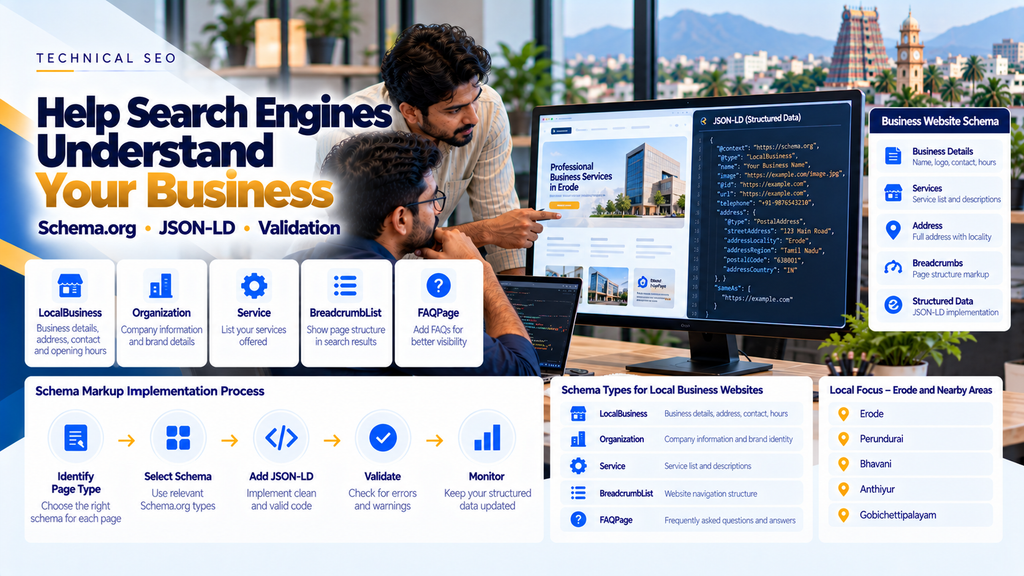
When a customer searches for a local business, search engines need to understand more than the words displayed on a website.
They may need to identify the business name, location, contact information, services, website identity, and relationships between different pages.
One way to communicate this information in a machine-readable format is through schema markup SEO for local business websites.
Schema markup is a form of structured data that helps search engines interpret information published on a website.
For businesses in Erode, including service providers, manufacturers, retailers, software companies, and professional organizations, appropriate structured data can support a clearer technical SEO foundation.
However, schema markup is not a shortcut to guaranteed rankings or rich results.
This guide explains how structured data works, which schema types may be relevant, how to implement JSON-LD, how to validate it, and which mistakes local businesses should avoid.
What Is Schema Markup in SEO?
Schema markup is structured information added to a website using a vocabulary such as Schema.org.
It describes entities and relationships in a format that software systems can interpret.
For example, a website might visually display:
- Business name
- Business address
- Phone number
- Opening hours
- Services
Structured data can identify these details using specific properties rather than relying only on surrounding text.
A simplified model is:
Visible Website Information → Structured Data → Search Engine Interpretation
Why Is Schema Markup Important for Local Businesses?
Local business websites often contain several kinds of information.
A single website may describe the organization, its physical location, services, articles, and navigation structure.
Appropriate schema markup can make those relationships more explicit.
1. Clarifies Business Identity
Structured data can identify the organization associated with a website.
2. Describes Local Business Details
LocalBusiness markup can communicate a genuine business location and related information.
3. Supports Eligible Search Features
Some structured data types can make pages eligible for specific Google Search appearances when all requirements are met.
4. Clarifies Page Relationships
Breadcrumb markup can describe a website’s navigational hierarchy.
5. Improves Data Consistency
Structured data implementation encourages businesses to maintain accurate names, addresses, URLs, and other details.
None of these benefits guarantees a ranking improvement.
Schema.org vs JSON-LD: What Is the Difference?
These terms are closely related but are not interchangeable.
| Term | Meaning |
|---|---|
| Schema.org | Vocabulary of structured data types and properties |
| JSON-LD | Format for representing structured data in JSON |
| Structured Data | Machine-readable information describing page content |
| Rich Result | An enhanced search appearance supported for eligible content |
Google supports JSON-LD, Microdata, and RDFa for structured data, and generally recommends JSON-LD when practical.
What Is JSON-LD?
JSON-LD stands for JavaScript Object Notation for Linked Data.
For website SEO, it is commonly added through a script element using the type application/ld+json.
The script describes information about the page without changing its visible layout.
JSON-LD is often convenient because developers can manage structured data separately from the visible HTML structure.
Important Schema Types for Local Business Websites
| Schema Type | Typical Application |
|---|---|
| LocalBusiness | Eligible businesses with genuine local business information |
| Organization | Organization identity and official details |
| WebSite | Website identity |
| BreadcrumbList | Page navigation hierarchy |
| Service | Information about a service offered |
| BlogPosting | Blog article information |
| Product | Product information where applicable |
| FAQPage | Frequently asked questions, subject to feature-specific limitations |
Not every schema type provides a dedicated Google rich result. Choose structured data based on the actual page content and current search engine documentation.
1. LocalBusiness Schema Markup
LocalBusiness schema is especially relevant to businesses with a genuine local presence.
Examples may include:
- Retail stores
- Restaurants
- Clinics
- Salons
- Repair businesses
- Local professional service providers
Some organizations have more specific Schema.org business types, such as Restaurant, Dentist, or Store.
Choose the most accurate applicable type rather than using the same generic type for every business.
Example: LocalBusiness JSON-LD
The following example uses fictional business details. Replace every value with accurate information before publishing.
<script type="application/ld+json">
{
  "@context": "https://schema.org",
  "@type": "LocalBusiness",
  "name": "Example Business",
  "url": "https://www.example.com/",
  "telephone": "+91-0000000000",
  "address": {
    "@type": "PostalAddress",
    "streetAddress": "Example Street",
    "addressLocality": "Erode",
    "addressRegion": "Tamil Nadu",
    "postalCode": "000000",
    "addressCountry": "IN"
  }
}
</script>
The sample phone number, street, and postal code are placeholders, not real business information.
For Google’s LocalBusiness rich-result documentation, name and address are required properties. Additional recommended properties depend on the business and its available information.
2. Organization Schema
Organization markup can identify the entity operating a website.
It may contain information such as:
- Official business name
- Website URL
- Logo URL
- Contact information
- Official social profiles
- Verified organization details
For businesses with an appropriate LocalBusiness subtype, LocalBusiness can also communicate organization information because it is a subtype of Organization.
A website should avoid creating conflicting representations of the same business.
3. WebSite Schema
WebSite schema describes the website itself rather than a physical business location.
A basic example is:
<script type="application/ld+json">
{
  "@context": "https://schema.org",
  "@type": "WebSite",
  "name": "Example Business Website",
  "url": "https://www.example.com/"
}
</script>
Use the actual website name and canonical homepage URL.
4. BreadcrumbList Schema
Breadcrumbs help users understand where a page sits within a website’s structure.
For example:
Home → SEO Services → Technical SEO → Schema Markup
BreadcrumbList structured data can represent this navigation path.
Example: Breadcrumb JSON-LD
<script type="application/ld+json">
{
  "@context": "https://schema.org",
  "@type": "BreadcrumbList",
  "itemListElement": [
    {
      "@type": "ListItem",
      "position": 1,
      "name": "Home",
      "item": "https://www.example.com/"
    },
    {
      "@type": "ListItem",
      "position": 2,
      "name": "SEO Services",
      "item": "https://www.example.com/seo-services/"
    },
    {
      "@type": "ListItem",
      "position": 3,
      "name": "Schema Markup Guide",
      "item": "https://www.example.com/schema-guide/"
    }
  ]
}
</script>
Only include navigation items that accurately represent the website’s page hierarchy.
5. Service Schema
Service schema describes a service provided by an organization or professional.
Examples include:
- Website development
- Software development
- SEO services
- Website maintenance
- Business consulting
Service schema can describe the service name, provider, and service area.
However, Service schema alone does not guarantee a special Google Search result.
Example: Service JSON-LD
<script type="application/ld+json">
{
  "@context": "https://schema.org",
  "@type": "Service",
  "name": "Website Development",
  "serviceType": "Business Website Development",
  "provider": {
    "@type": "Organization",
    "name": "Example Business",
    "url": "https://www.example.com/"
  },
  "areaServed": {
    "@type": "Place",
    "name": "Erode, Tamil Nadu, India"
  }
}
</script>
Include service areas only when they accurately reflect the business’s operations.
6. BlogPosting Schema
BlogPosting schema can describe editorial information about an article.
Relevant properties may include:
- Headline
- Author
- Publisher
- Date published
- Date modified
- Article image
- Article URL
Dates should reflect real publication and modification events.
Do not update the modification date solely to make an unchanged article appear fresh.
7. FAQPage Schema
FAQPage schema describes a page containing questions and their answers.
However, FAQ rich-result eligibility in Google Search has been restricted to eligible, authoritative government and health websites.
Most ordinary business websites should not expect FAQ rich results merely because FAQPage markup is present.
Businesses can still publish useful FAQ sections for readers without relying on FAQ schema as a visibility tactic.
8. Product Schema
Product structured data may be relevant for ecommerce websites and genuine product pages.
Depending on the product and supported feature, information can include:
- Product name
- Description
- Image
- Offer details
- Availability
- Price
- Brand
- Eligible reviews
Product markup must accurately reflect the visible product information and follow the relevant Google feature guidelines.
9. Schema Markup for Local SEO
Local SEO aims to help businesses become discoverable for geographically relevant searches.
Structured data can complement local SEO by clearly describing accurate business information.
But schema markup is only one part of local search optimization.
Other relevant activities include:
- Accurate Google Business Profile information
- Relevant service pages
- Useful local content
- Consistent business citations
- Genuine customer reviews
- Technical SEO
- Internal linking
Read Google Maps SEO for Service Businesses in Erode.
10. Schema Markup for Erode and Nearby Locations
Businesses serving customers across Erode district may provide accurate information about their service coverage.
Relevant locations may include:
- Erode
- Perundurai
- Bhavani
- Anthiyur
- Gobichettipalayam
- Sathyamangalam
- Chennimalai
- Modakkurichi
- Kodumudi
- Nambiyur
- Kavindapadi
- Ammapettai
- Arachalur
- Sivagiri
- Punjai Puliampatti
- Thalavadi
Do not create fictional business addresses or separate LocalBusiness locations merely because the company serves customers in those towns.
A service area is not the same as a physical branch.
11. Schema Markup for Multiple Business Locations
Businesses with multiple genuine branches may need structured information for each location.
For example, a company operating real branches in Erode and another city may maintain separate location pages.
Each page should contain accurate information about that particular branch.
Do not copy the same address, coordinates, and business details across invented locations.
12. Schema Markup for Service-Area Businesses
Some businesses serve customers at their locations without operating public-facing premises in every service area.
For these businesses, structured data should reflect their actual organizational identity and any genuine business location.
Do not invent storefronts, branches, or map coordinates.
Service-area descriptions can be useful when they are accurate, but they do not automatically qualify a business for higher rankings in those areas.
13. Schema Markup for Healthcare Websites
Healthcare websites may use appropriate structured data to describe organizations, medical businesses, departments, or relevant services.
The exact schema type depends on the actual business and page.
Healthcare providers should ensure that professional qualifications, departments, locations, and services are accurate.
Do not invent doctors, credentials, patient ratings, or treatment capabilities.
14. Schema Markup for Ecommerce Websites
Ecommerce websites may need different structured data across different page types.
| Page Type | Potential Structured Data |
|---|---|
| Homepage | Organization, WebSite |
| Category Page | BreadcrumbList |
| Product Page | Product, applicable Offer information |
| Blog Article | BlogPosting, BreadcrumbList |
| Physical Store Page | Appropriate LocalBusiness subtype |
Product and merchant-listing features have additional eligibility and data requirements.
15. Schema Markup for Software Companies
Software companies may use Organization, WebSite, Service, and article-related structured data where appropriate.
If a company offers an actual software product, software-specific structured data may also be relevant depending on the product and supported search features.
A custom software development service should not automatically be described as a purchasable software product.
16. How to Add Schema Markup to an HTML Website
For a custom HTML website, developers can add JSON-LD through a script element in the document head or body.
A typical implementation process is:
- Identify the page’s actual content and purpose.
- Select the appropriate Schema.org type.
- Review Google’s documentation for any desired search feature.
- Collect accurate business or page information.
- Generate the JSON-LD.
- Add it to the correct page or template.
- Validate the markup.
- Publish and monitor the implementation.
17. Schema Markup in WordPress
WordPress websites may generate structured data through SEO plugins, themes, ecommerce extensions, or custom code.
Before adding new markup, check what the website already generates.
Multiple plugins can sometimes produce overlapping or conflicting structured data.
Developers should review the final rendered page rather than assuming a plugin’s settings are sufficient.
18. Schema Markup in Shopify
Shopify themes and apps may already output structured data for products, breadcrumbs, and business information.
When adding an SEO app or custom JSON-LD, review existing markup to avoid duplication and conflicting values.
For ecommerce pages, ensure structured data matches current product availability and pricing.
19. Schema Markup in WooCommerce
WooCommerce websites may generate product-related structured data through WordPress, WooCommerce, themes, or SEO extensions.
Review how the website handles:
- Product names
- Prices
- Availability
- Product variations
- Breadcrumbs
- Business identity
Data should remain consistent with the visible product page.
20. How to Test Schema Markup
Schema implementation should always be tested.
Two useful tools are:
The Google Rich Results Test checks structured data relevant to Google-supported rich-result features.
The Schema.org Validator can help examine general Schema.org markup, including types that do not produce Google rich results.
21. What to Check During Validation
- Valid JSON syntax
- Correct schema type
- Required properties for the desired feature
- Recommended properties where applicable
- Accurate URLs
- Accurate business information
- Correct nesting
- Matching visible content
- Duplicate or conflicting schema
- Page accessibility
A successful syntax test does not automatically mean the page qualifies for every Google search feature.
22. Common Schema Markup Errors
Common implementation problems include:
- Missing required properties
- Invalid JSON syntax
- Incorrect schema types
- Broken URLs
- Outdated business details
- Conflicting business addresses
- Duplicate markup generated by plugins
- Invented ratings or reviews
- Structured data unrelated to visible content
- Using an unsupported type and expecting rich results
23. Can Schema Markup Improve Google Rankings?
Schema markup helps communicate information about a page, but it is not a guaranteed ranking improvement technique.
Google may use structured data to understand content and enable supported search appearances.
Whether an enhanced appearance is displayed depends on feature eligibility, page quality, search context, and other factors.
Businesses should evaluate structured data as part of technical SEO rather than as a replacement for useful content and overall website quality.
24. Can Schema Markup Improve AI Search Visibility?
Structured data can provide machine-readable context about a business and its content.
However, there is no general guarantee that adding schema will cause an AI search system to cite, recommend, or prominently display a website.
For businesses interested in both traditional search and AI-assisted discovery, useful priorities include:
- Clear business identity
- Accurate organization information
- Useful original content
- Accessible website pages
- Logical page relationships
- Appropriate structured data
- Consistent business information
25. Schema Markup and Technical SEO
Structured data should work alongside a technically sound website.
Important supporting areas include:
- Crawl accessibility
- Indexing controls
- Canonical URLs
- HTTPS
- Mobile usability
- Website performance
- Internal links
- XML sitemaps
Read Technical SEO Services in Erode: Why Your Website Needs Them.
26. Schema Markup and Local Citations
Local citations and structured data both involve business information, but they are different.
Schema markup describes information on your own website.
Local citations are references to your business on other platforms or websites.
Businesses should keep genuine business information consistent across these sources.
Read Local Citation Building for Erode Businesses.
27. Schema Markup and On-Page SEO
Schema markup cannot compensate for missing or misleading page content.
A service page should still explain the service clearly through:
- Page title
- H1 heading
- Useful service description
- Relevant supporting headings
- Customer-focused content
- Internal links
- Appropriate calls to action
Read On-Page SEO Services in Erode: Complete Business Guide.
28. How Often Should Schema Markup Be Reviewed?
Structured data should be reviewed when the information it describes changes.
Examples include:
- Business relocation
- Phone number changes
- Opening-hour changes
- Website redesign
- Service changes
- New branches
- Product pricing changes
- CMS or plugin changes
- New structured-data errors
29. Professional Schema Markup Implementation Workflow
Website Audit
↓
Page Type Identification
↓
Schema Selection
↓
Data Verification
↓
JSON-LD Implementation
↓
Validation
↓
Deployment
↓
Monitoring and Maintenance
30. Schema Markup SEO Checklist
- Identify the business and page types.
- Choose accurate Schema.org types.
- Check current Google feature support.
- Use verified business information.
- Match schema with visible content.
- Use canonical URLs.
- Use appropriate JSON-LD properties.
- Do not invent physical locations.
- Do not invent ratings or reviews.
- Avoid duplicate or conflicting schema.
- Validate syntax.
- Check feature eligibility.
- Review rendered website markup.
- Monitor relevant Search Console reports.
- Update schema when business details change.
31. How Greap Technologies Can Help
Greap Technologies can support structured-data implementation as part of an agreed technical SEO and website optimization scope.
Depending on the website and project requirements, this may include:
- Structured-data audit
- Schema type selection
- LocalBusiness schema implementation
- Organization markup
- Service schema
- Breadcrumb structured data
- Blog structured data
- Product markup review
- JSON-LD development
- Validation and error correction
- Duplicate schema review
- Technical SEO integration
Explore Greap Technologies SEO Services and Website Development Services.
32. How Much Does Schema Markup Implementation Cost?
The cost depends on the website structure and implementation requirements.
Factors may include:
- Number of website templates
- Number of genuine business locations
- Required schema types
- CMS or framework
- Existing plugin conflicts
- Custom development
- Dynamic product data
- Validation requirements
- Ongoing maintenance
A small service website may require a different implementation scope from a multi-location business or large ecommerce platform.
Conclusion
Schema markup SEO for local business websites is an important technical consideration for businesses that want their website information to be clear, accurate, and machine-readable.
For local businesses in Erode, relevant structured data may describe business identity, genuine locations, services, articles, and website navigation.
The best approach is not to add every available schema type.
Instead, follow a structured process:
Identify Real Information → Select Appropriate Schema → Implement JSON-LD → Validate → Maintain Accuracy
Schema markup cannot guarantee rankings, rich results, or AI recommendations.
However, correct implementation can support a better-organized technical SEO foundation.
Need Schema Markup SEO Services in Erode?
Greap Technologies can review your website’s structured data and help plan suitable schema implementation alongside technical SEO improvements.
Frequently Asked Questions
1. What is schema markup in SEO?
Schema markup is structured data that describes website information using a machine-readable vocabulary, commonly Schema.org.
2. What is LocalBusiness schema?
LocalBusiness schema describes information about a genuine local business, such as its name, physical address, contact details, and other relevant properties.
3. Is schema markup important for local SEO?
It can support clearer business information and eligibility for applicable search features, but it is only one part of local SEO.
4. Does schema markup guarantee Google rankings?
No. Adding structured data does not guarantee ranking improvements or rich results.
5. What is JSON-LD?
JSON-LD is a structured-data format commonly used to describe entities and page content through a script element.
6. Which schema is best for a local business?
The best type depends on the business. Use the most accurate applicable LocalBusiness subtype where appropriate, together with other relevant page-specific markup.
7. Can I add multiple schema types to one page?
Yes, when they accurately describe different relevant entities or aspects of the page and do not create contradictory information.
8. Does FAQ schema show questions in Google Search?
Most ordinary business websites should not expect FAQ rich results. Google’s FAQ rich-result eligibility has been restricted to qualifying authoritative government and health websites.
9. How do I test schema markup?
Use Google’s Rich Results Test for supported Google search features and the Schema.org Validator for broader structured-data validation.
10. Can schema markup help AI search?
Structured data can provide machine-readable context, but there is no guarantee that AI search systems will cite or recommend a website because it contains schema markup.
11. Can WordPress and Shopify websites use schema?
Yes. Both platforms can support structured data through their themes, extensions, or custom implementation. Existing markup should be reviewed before adding more.
12. Does Greap Technologies provide schema markup SEO services?
Greap Technologies can assist with schema audits, implementation planning, JSON-LD development, validation, and technical SEO work according to the agreed project requirements.