Web Application Development for Textile Businesses in Erode
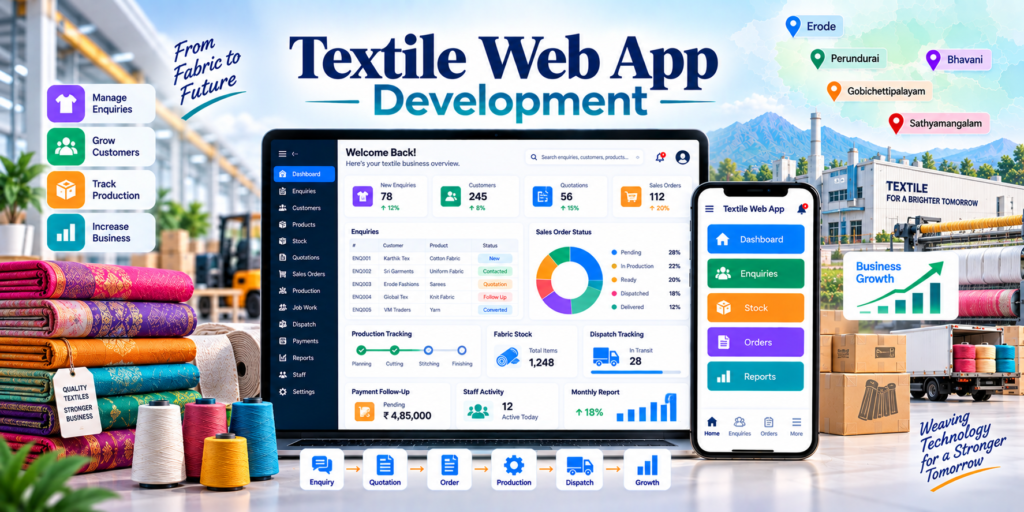
Web application development for textile businesses in Erode helps textile manufacturers, fabric suppliers, garment companies, saree shops, home textile businesses, weaving units, dyeing units, wholesalers, exporters and textile ecommerce businesses manage important operations through one secure browser-based system.
Textile businesses often handle customer enquiries, product catalogues, quotations, stock, purchases, production, job work, orders, dispatch, payments and reports across multiple departments. When these activities depend on notebooks, Excel sheets, WhatsApp conversations and disconnected software, it can become difficult for owners and teams to get a clear operational view.
A custom textile web application can connect these processes and provide different dashboards for owners, sales teams, inventory staff, production teams, dispatch staff, customers or dealers.
At Greap Technologies, we provide web application development for textile businesses in Erode, helping textile companies build practical, secure and scalable web applications based on their actual workflow and growth requirements.
Quick Answer: What Is Web Application Development for Textile Businesses?
Web application development for textile businesses means creating custom business software that works through a web browser and helps textile companies manage operational data, users and workflows online.
A textile web application can include:
- Admin dashboard
- Staff login
- Role-based permissions
- CRM and enquiry management
- Customer management
- Product catalogue
- Inventory management
- Purchase management
- Quotation management
- Sales orders
- Production tracking
- Job work management
- Quality control
- Packing and dispatch
- Payment follow-up
- Customer portal
- Dealer or distributor portal
- Vendor management
- Reports and analytics
- API integrations
The required modules depend on whether the business operates in retail, wholesale, manufacturing, exports or ecommerce.
Web Application Development for Textile Businesses in Erode: Service Overview
| Detail | Information |
|---|---|
| Service | Web Application Development for Textile Businesses |
| Company | Greap Technologies |
| Location | Erode, Tamil Nadu |
| Main Audience | Textile manufacturers, suppliers, wholesalers, retailers, exporters and ecommerce businesses |
| Main Goal | Digitize and connect textile business workflows |
| Core Modules | CRM, catalogue, inventory, orders, production, job work, portals and reports |
| Best For | Fabric, garments, sarees, home textiles, weaving, dyeing, wholesale and exports |
| Service Area | Erode District and nearby areas |
Why Textile Businesses in Erode Need Custom Web Applications
Textile businesses can involve large product catalogues, multiple customers and dealers, production stages, supplier coordination and frequent stock movement.
Without a centralized application, it can become difficult to track:
- Customer enquiries
- Buyer requirements
- Quotation status
- Sample requests
- Product and fabric stock
- Size and colour variants
- Roll-wise or metre-wise stock
- Pending purchases
- Confirmed customer orders
- Production progress
- Material sent for job work
- Quality status
- Packing and dispatch
- Pending payments
- Staff activity
- Dealer enquiries
- Management reports
A custom web application can bring these records into one structured system and provide authorized users with up-to-date business information.
What Types of Textile Businesses Can Use Web Applications?
1. Textile Manufacturing Companies
Manufacturers can manage raw materials, customer orders, production, job work, quality control, finished stock and dispatch.
2. Fabric Suppliers
Fabric suppliers can manage buyer enquiries, product catalogues, roll-wise stock, sample requests, quotations and follow-ups.
3. Garment Manufacturers
Garment businesses can manage:
- Buyer orders
- Style numbers
- Size breakdown
- Cutting
- Stitching
- Finishing
- Quality checking
- Packing
4. Saree Shops and Textile Retailers
Retail textile businesses can manage products, variants, barcode billing, purchase, stock, customers and online orders.
5. Home Textile Companies
Home textile businesses can manage bedsheets, towels, curtains, pillow covers, hotel linen, bulk orders and dispatch.
6. Textile Wholesalers
Wholesalers can manage dealers, bulk enquiries, quotations, orders, dispatch and outstanding payment follow-ups.
7. Dyeing and Processing Units
Processing businesses can track inward material, batch details, colour, process status, quality checks and outward dispatch.
8. Weaving and Knitting Units
These businesses can track yarn, machine or loom production, fabric output, rolls and order-wise progress.
9. Textile Export Businesses
Exporters can manage buyer enquiries, samples, quotations, production progress, documents, shipments and payment follow-ups.
10. Textile Ecommerce Businesses
Ecommerce businesses can manage products, inventory synchronization, customer orders, packing, shipping, returns and refunds.
Benefits of Web Application Development for Textile Businesses
1. One System for Multiple Departments
A custom textile web application can connect:
- Sales
- Purchase
- Inventory
- Production
- Job work
- Quality
- Dispatch
- Customer support
- Management
2. Better Customer Enquiry Management
CRM functionality can track leads from:
- Website forms
- Phone calls
- Google Ads
- Meta Ads
- Referrals
- Dealer networks
- Exhibitions
- Social media
Actual lead-source automation depends on the integration methods and permissions available from each platform.
3. Better Product Catalogue Management
Products can be organized using:
- Product code
- Category
- Fabric type
- Colour
- Size
- Design
- Images
- Specifications
- Stock status
4. Better Textile Inventory Visibility
Depending on the business, inventory can include:
- Raw materials
- Yarn
- Fabric
- Finished goods
- Roll-wise stock
- Metre-wise stock
- Size-wise stock
- Colour-wise stock
- Low-stock levels
- Stock adjustments
5. Better Order Tracking
Order stages can be configured as:
Enquiry → Quotation → Order Confirmed → Production → Quality Check → Packing → Dispatch → Delivered → Payment Follow-Up → Closed
6. Better Quotation Management
Quotation records can include:
- Quotation number
- Customer
- Products
- Quantity
- Rate
- Taxes
- Delivery terms
- Payment terms
- Revision history
- Status
7. Better Management Reporting
Reports can include:
- Enquiries
- Quotations
- Sales orders
- Inventory
- Production
- Job work
- Dispatch
- Payments
- Staff activity
- Customer-wise business
Important Modules in Textile Web Applications
1. Admin Dashboard
The dashboard can display:
- New enquiries
- Pending follow-ups
- Open quotations
- Pending orders
- Stock alerts
- Production status
- Pending job work
- Orders ready for dispatch
- Pending payments
2. CRM and Enquiry Management
The CRM module can include:
- Lead creation
- Customer details
- Product interest
- Lead source
- Salesperson assignment
- Follow-up reminders
- Call notes
- Quotation history
- Lead stages
3. Customer Management
Customer profiles can store:
- Company/customer name
- Contact person
- Phone
- Address
- Product interests
- Past enquiries
- Quotation history
- Order history
- Payment-related notes
4. Product Catalogue Module
A digital product catalogue can support:
- Categories
- Products
- Variants
- Specifications
- Images
- Pricing or enquiry-only pricing
- Stock visibility
5. Inventory Management
Inventory functionality can include:
- Stock inward
- Stock issue
- Stock transfer
- Stock adjustment
- Roll tracking
- Metre tracking
- Variant stock
- Low-stock alerts
6. Purchase and Supplier Management
The purchase module can include:
- Suppliers
- Purchase requests
- Purchase orders
- Material inward
- Purchase returns
- Pending purchases
7. Quotation Management
Authorized users can create, revise, approve and track customer quotations.
8. Sales Order Management
Confirmed orders can include:
- Customer
- Product
- Quantity
- Colour
- Size
- Specification
- Target date
- Production status
- Dispatch status
9. Production Management
Manufacturing businesses can track:
- Production orders
- Production planning
- Material issues
- Work-in-progress
- Completed quantity
- Rejected quantity
- Rework
- Production status
10. Job Work Management
Job work can include dyeing, printing, stitching, finishing or other outsourced processing.
The system can track:
- Job worker
- Material sent
- Quantity sent
- Expected return date
- Received quantity
- Pending quantity
- Wastage
- Charges
11. Quality Control
Quality records can include:
- Inspection stage
- Accepted quantity
- Rejected quantity
- Defect type
- Rework
- Remarks
12. Dispatch Management
Dispatch functionality can include:
- Packing status
- Dispatch date
- Invoice reference
- Transporter
- Courier or LR details
- Delivery location
- Delivery status
13. Payment Follow-Up
The application can maintain:
- Invoice reference
- Invoice value
- Advance
- Pending amount
- Due date
- Payment status
- Follow-up notes
Full accounting and statutory reporting may require suitable accounting software or ERP integration.
Customer Portal and Dealer Portal for Textile Businesses
Textile web applications can include secure portal access for customers, dealers or distributors.
Customer Portal Features
- Customer login
- Quotation access
- Order history
- Order status
- Invoice download
- Payment status
- Document access
- Support requests
Dealer Portal Features
- Dealer login
- Product catalogue
- Dealer-specific pricing where applicable
- Bulk order request
- Order history
- Invoices
- Payment status
- Support
Each logged-in user should only be able to access information they are authorized to view.
Best Web Application Structure for Textile Businesses
Textile Manufacturing Web Application
- Dashboard
- Customers
- Sales Orders
- Raw Materials
- Inventory
- Purchase
- Production
- Job Work
- Quality
- Dispatch
- Reports
Textile Wholesale Web Application
- Dashboard
- Dealer Enquiries
- Catalogue
- Quotations
- Bulk Orders
- Dispatch
- Outstanding Payments
- Reports
Textile Ecommerce Web Application
- Dashboard
- Online Orders
- Customers
- Products
- Inventory
- Payments
- Packing
- Shipping
- Returns
- Reports
Textile Retail / Saree Shop Application
- Dashboard
- Products
- Size / Colour Variants
- Barcode
- Purchase
- Stock
- Billing
- Returns
- Reports
Website vs Web Application for Textile Businesses
| Feature | Website | Web Application |
|---|---|---|
| Main Purpose | Online presence and enquiries | Business workflow management |
| Main Users | Public visitors | Staff, admin, customers or dealers |
| Login | Optional | Common |
| Product Display | Yes | Can include management functions |
| Inventory | Usually limited | Can be fully managed |
| Production | No | Can be included |
| Reports | Limited | Can be detailed |
A textile business can use a public website for marketing and enquiries while using a secure web application for internal operations.
Web Application vs ERP Software
| Feature | Web Application | ERP Software |
|---|---|---|
| Main Meaning | Any browser-based application | Integrated business operations software |
| Modules | Highly flexible | Operations-focused |
| CRM | Can be included | Can be included |
| Inventory | Can be included | Usually core |
| Production | Can be included | Core for manufacturing ERP |
| Customer Portal | Can be included | Depends on ERP |
| Best For | Custom workflows | Integrated operational control |
A textile ERP can itself be developed as a custom web application.
Web Application vs CRM Software
| Feature | Web Application | CRM Software |
|---|---|---|
| Main Purpose | Custom business workflows | Sales enquiries and relationships |
| Lead Management | Can be included | Core focus |
| Inventory | Can be included | Usually limited |
| Production | Can be included | Not core |
| Orders | Can be detailed | Usually limited |
| Portals | Can be included | Depends on CRM |
Security for Textile Web Applications
Business web applications can contain customer, pricing, stock, supplier and order information. Security should therefore be planned from the beginning.
Depending on requirements, controls can include:
- HTTPS
- Secure password hashing
- Role-based access control
- Session management
- Password reset controls
- Audit logs
- User activity history
- Secure file uploads
- Data validation
- Database backups
- Customer/dealer data isolation
- Restricted admin permissions
Users should only be able to view or modify information required for their job role.
Web Application Design Style for Textile Businesses
| User Type | Primary Requirement |
|---|---|
| Business Owner | Dashboard, reports and control |
| Sales Team | Enquiries, quotations and follow-ups |
| Inventory Team | Stock inward, issue and balances |
| Production Team | Production and job-work updates |
| Dispatch Team | Packing and delivery status |
| Accounts Team | Invoice and payment visibility |
| Customer / Dealer | Orders, invoices and documents |
Useful UI principles include:
- Clean dashboards
- Simple forms
- Fast search
- Useful filters
- Clear statuses
- Mobile-responsive layouts
- Role-specific menus
- Exportable reports
Textile Web Application Integrations
Web application development for textile businesses in Erode becomes more useful when the application connects with other business systems where suitable integrations are available.
Possible integrations include:
- Company website
- Product catalogue website
- Ecommerce website
- CRM
- ERP
- Inventory software
- Accounting software
- Payment gateway
- WhatsApp communication
- Email notifications
- Barcode or QR systems
- Document storage
- Mobile applications
Explore API integration services for suitable integration requirements.
Advanced Features for Textile Web Applications
- Multi-branch management
- Multiple warehouses
- Customer portal
- Dealer portal
- Vendor portal
- Quotation PDF generation
- Barcode stock tracking
- QR roll tracking
- Lot and batch tracking
- Sample request management
- BOM / MRP
- Production planning
- Job-work management
- Quality control
- Dispatch tracking
- Payment reminders
- WhatsApp notifications
- Email notifications
- Document management
- Audit logs
- Analytics dashboard
- Mobile application
Advanced modules should be added according to actual business requirements rather than making the system unnecessarily complicated.
Web Application Development Process
Step 1: Textile Business Requirement Analysis
Important questions include:
- What type of textile business do you operate?
- Do you sell retail, wholesale, B2B, export or ecommerce?
- Which processes are currently manual?
- Do you need CRM?
- Do you need inventory?
- Do you need production or job work?
- Do you need quotations?
- Do customers or dealers need login access?
- How many staff members will use the system?
- What reports does management need?
Step 2: Workflow Mapping
Example:
Enquiry → Quotation → Order → Stock / Production → Quality → Packing → Dispatch → Payment Follow-Up
Step 3: Module Planning
Modules can be divided into:
- Core modules
- Recommended modules
- Future modules
Step 4: Role and Permission Planning
Define access for:
- Owner
- Admin
- Sales
- Stores
- Production
- Dispatch
- Accounts
- Customers
- Dealers
Step 5: UI/UX Design
Frequently used activities should be easy to complete with minimal unnecessary steps.
Step 6: Web Application Development
Development can be completed module by module according to project priority.
Step 7: Existing Data Migration
Existing data can include:
- Customers
- Suppliers
- Products
- Stock
- Orders
- Quotations
- Staff users
Existing data should be cleaned and validated before import.
Step 8: Testing
Testing should include:
- Authentication
- Role permissions
- Enquiries
- Quotations
- Stock
- Orders
- Production
- Job work
- Dispatch
- Reports
- Mobile responsiveness
Step 9: Staff Training
Users should be trained according to their individual modules and responsibilities.
Step 10: Launch and Improvement
After launch, workflows and reports can be refined based on real team usage.
Textile Web Application Features Checklist
| Feature | Recommendation |
|---|---|
| Admin Dashboard | Required |
| Staff Login | Required |
| Role-Based Access | Recommended |
| Customer Management | Required |
| CRM / Enquiries | Recommended |
| Product Catalogue | Recommended |
| Inventory | Based on business type |
| Purchase | Based on requirement |
| Quotation Management | Recommended |
| Sales Orders | Recommended |
| Production | Based on business type |
| Job Work | Based on workflow |
| Quality Control | Based on requirement |
| Dispatch | Recommended |
| Payment Follow-Up | Recommended |
| Customer Portal | Based on requirement |
| Dealer Portal | Based on requirement |
| Reports | Required |
| Audit Logs | Recommended |
| Mobile Responsive Design | Required |
| API Integration | Based on requirement |
| Mobile App | Based on requirement |
Common Mistakes Textile Businesses Should Avoid
1. Developing Software Before Mapping the Workflow
The application should reflect how the business actually operates.
2. Copying Generic Software
Textile businesses may require specialized stock, quotation, job-work or production workflows.
3. No Role-Based Permissions
Different teams should have access only to the information they need.
4. Poor Product and Stock Structure
Products, variants, units and textile specifications should be structured correctly before migration.
5. Complicated User Interface
Daily operational screens should remain simple for staff.
6. No Backup Planning
Business data should have an appropriate backup and recovery process.
7. No Audit History
Important actions such as stock adjustments or order-status changes should be traceable where appropriate.
8. No Integration Planning
The business should decide which system is responsible for customers, products, stock, accounting and other shared data.
9. No Staff Training
Software value depends heavily on consistent user adoption.
10. Building Too Many Modules in Phase One
Businesses can prioritize the highest-value modules first and add additional features later.
Erode District Textile Web Application Development Strategy
Greap Technologies supports textile businesses across:
Erode, Perundurai, Bhavani, Anthiyur, Gobichettipalayam, Sathyamangalam, Modakkurichi, Kodumudi, Nambiyur, Thalavadi, Chennimalai, Kavindapadi, Ammapettai, Arachalur, Sivagiri, Punjai Puliampatti, Solar, Surampatti, Veerappanchatram, Nasiyanur and nearby areas.
Location-specific SEO pages should only be created for genuine service locations and should provide unique, useful information instead of repeating the same content with a different place name.
How Greap Technologies Helps Textile Businesses
Greap Technologies can develop custom web applications around the actual workflow of textile businesses in Erode.
Our textile web application development services can include:
- Requirement analysis
- Workflow planning
- UI/UX design
- Admin dashboard
- Secure staff login
- Role-based permissions
- CRM development
- Customer management
- Product catalogue
- Inventory management
- Purchase management
- Quotation management
- Sales-order management
- Production tracking
- Job-work management
- Quality control
- Dispatch management
- Payment follow-up
- Customer portal
- Dealer portal
- Vendor portal
- API integrations
- Reports and analytics
- Data migration
- Testing and training
- Maintenance support
Explore related Greap services:
- Web Application Development
- Custom Software Development
- API Integration Services
- Ecommerce Development
- Mobile App Development
- Website Development Services
Why Choose Greap Technologies?
Textile Workflow-Based Development
We can design the application around textile workflows such as enquiry, quotation, inventory, production, job work, orders and dispatch.
Custom Web Application Development
The software can match your business process instead of forcing users into a generic workflow.
Modular and Scalable Architecture
Businesses can start with core modules and expand the system as operational requirements grow.
Role-Based and Secure Access
Staff, customers and dealers can be given different permissions according to their responsibilities.
Integration Support
The web application can connect with supported ecommerce, accounting, CRM, ERP and other systems where appropriate.
Complete Digital Support
Greap Technologies also provides websites, ecommerce development, CRM, ERP, mobile applications, SEO and digital marketing services.
Conclusion
Web application development for textile businesses in Erode can help textile companies move important business workflows from disconnected manual systems into one structured online application.
A practical textile web application can include CRM, customer management, product catalogue, inventory, quotations, sales orders, production, job work, dispatch, portals and management reports depending on the business model.
The best solution should be based on the company’s actual workflow, user roles, data structure and future growth requirements rather than simply adding every possible module.
Greap Technologies helps textile manufacturers, suppliers, wholesalers, retailers and exporters in Erode build custom web applications for more organized business operations.
Need a Custom Web Application for Your Textile Business in Erode?
Greap Technologies can help you build a textile web application with CRM, product catalogue, inventory, quotations, orders, production, job work, dispatch, customer/dealer portals and reports.
Frequently Asked Questions
1. What is web application development for textile businesses?
It is the development of custom browser-based business software for managing textile enquiries, customers, products, stock, orders, production, job work, dispatch and reports.
2. Why do textile businesses in Erode need web applications?
Web applications can help textile businesses centralize data, reduce fragmented manual tracking, improve workflow visibility and provide useful management reports.
3. What features can a textile web application include?
A textile web application can include CRM, customer management, catalogue, inventory, purchase, quotations, sales orders, production, job work, dispatch, portals and reports.
4. Can a textile web application include ERP features?
Yes. Inventory, purchase, production, job work, quality control and dispatch modules can be included when the business requires ERP-style operational management.
5. Can a textile web application include CRM?
Yes. CRM functionality can manage leads, enquiries, quotations, sales assignments, follow-up reminders and customer communication.
6. Can textile businesses provide customer or dealer login?
Yes. Customer, dealer, distributor or vendor portals can be developed with restricted access to authorized information.
7. Can Greap Technologies build custom textile web applications?
Yes. Greap Technologies can develop web applications based on textile business workflow, user roles, product structure and integration requirements.
8. Can a textile web application work on mobile phones?
Yes. Responsive web applications can be designed to work across desktop, tablet and mobile screen sizes.
9. Can textile web applications integrate with ecommerce or accounting systems?
Yes. Integration may be possible with supported ecommerce, accounting, CRM, ERP and other systems depending on their APIs and permissions.
10. Can web applications improve textile business operations?
A properly designed web application can improve operational visibility and coordination when the workflow matches the business and users maintain accurate data.