Wholesale businesses can process large numbers of customer, dealer and distributor orders across multiple products, price structures, warehouses and delivery schedules. As the business grows, coordinating these orders through spreadsheets, phone calls, messaging applications and separate billing or inventory systems can become difficult.
Wholesale order management software development in Erode can help wholesalers organize customer requirements, quotations, pricing, bulk orders, inventory availability, allocation, packing, dispatch and order history through a centralized digital workflow.
The objective is not simply to replace a paper order book with a digital form. A useful wholesale order management system should connect sales with inventory and fulfilment so authorized teams can understand what was ordered, what is available, what has been allocated, what has been dispatched and what remains pending.
At Greap Technologies, we develop custom order, distribution and business-management software for wholesalers and other businesses in Erode and nearby areas.
What Is Wholesale Order Management Software?
Wholesale order management software is a business application designed to manage the lifecycle of B2B and bulk customer orders.
Depending on requirements, it can include:
- Customer management
- Dealer and distributor management
- Product catalogue
- Customer enquiries
- RFQs
- Quotations
- Price lists
- Customer-specific pricing
- Bulk orders
- Sales orders
- Order approvals
- Inventory availability
- Stock reservation
- Warehouse coordination
- Picking
- Packing
- Partial dispatch
- Returns where applicable
- Payment or outstanding visibility through appropriate integrations
- Order history
- Dashboards and reports
- ERP and accounting integrations
Who Can Use Wholesale Order Management Software?
The software can be configured for different wholesale and B2B distribution businesses, including:
- Textile wholesalers
- Building-material wholesalers
- Industrial-product distributors
- Electrical-product wholesalers
- Hardware distributors
- Garment wholesalers
- Packaging-material suppliers
- FMCG distributors
- Manufacturers selling through wholesale channels
- Other B2B product businesses
The product, pricing, inventory and fulfilment workflows should be configured around the actual business rather than using one generic model for every wholesaler.
Typical Wholesale Order Management Workflow
A simplified wholesale order workflow can look like:
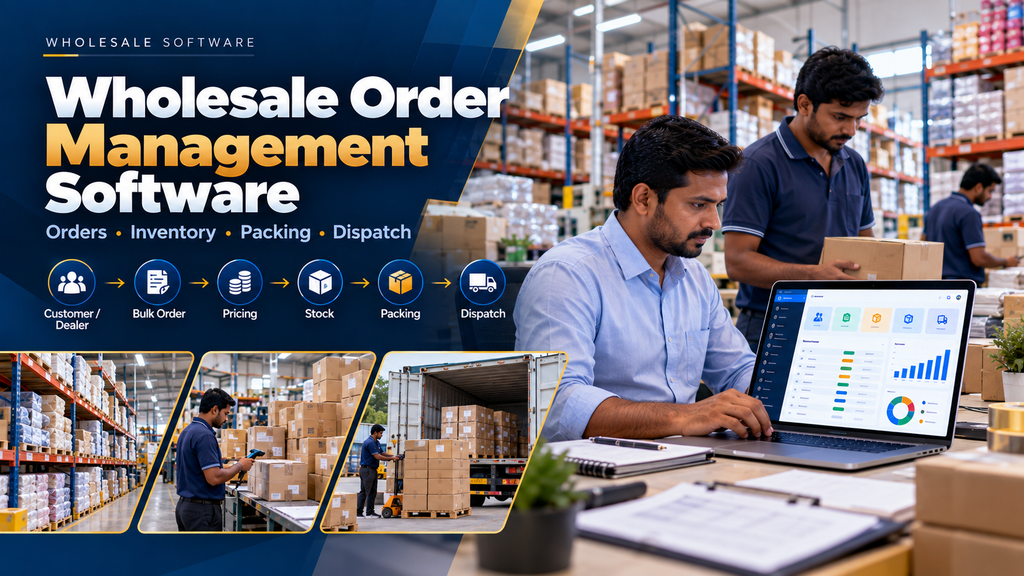
Customer / Dealer → Enquiry / RFQ → Quotation → Sales Order → Stock Allocation → Picking → Packing → Dispatch → Completion
If stock is unavailable, the workflow can extend to purchasing or production depending on the business.
Wholesale Order Management vs Retail POS
Wholesale order management and retail point-of-sale software solve different operational problems.
| Wholesale Order Management | Retail POS |
|---|---|
| B2B customers and dealers | Primarily retail transactions |
| Bulk quantities | Typically smaller immediate purchases |
| Customer-specific pricing may be required | Standard retail pricing is common |
| Orders may be fulfilled later | Products are often supplied immediately |
| Partial dispatch may be required | Transaction is commonly completed at sale |
| Warehouse coordination can be significant | Store-level stock is often central |
Wholesale Order Management vs ERP
Order management focuses on customer orders and fulfilment. ERP can cover a much wider business workflow including purchasing, inventory, manufacturing, warehouse operations and financial integrations.
A wholesaler may use order management as a dedicated application or as a module within a broader ERP architecture.
1. Customer Management
A centralized customer master can provide a consistent customer reference across quotations, orders, dispatches and integrations.
2. B2B Customer Accounts
Wholesale customers may be businesses rather than individual retail consumers.
The system can maintain the business information genuinely required for the commercial relationship.
3. Dealer Management
Businesses operating through dealers can maintain approved dealer accounts within the order-management system.
4. Distributor Management
Where distributors form part of the sales channel, their records and transactions can be managed according to the company’s structure.
Read Distributor Management Software Development in Erode.
5. Customer Categories
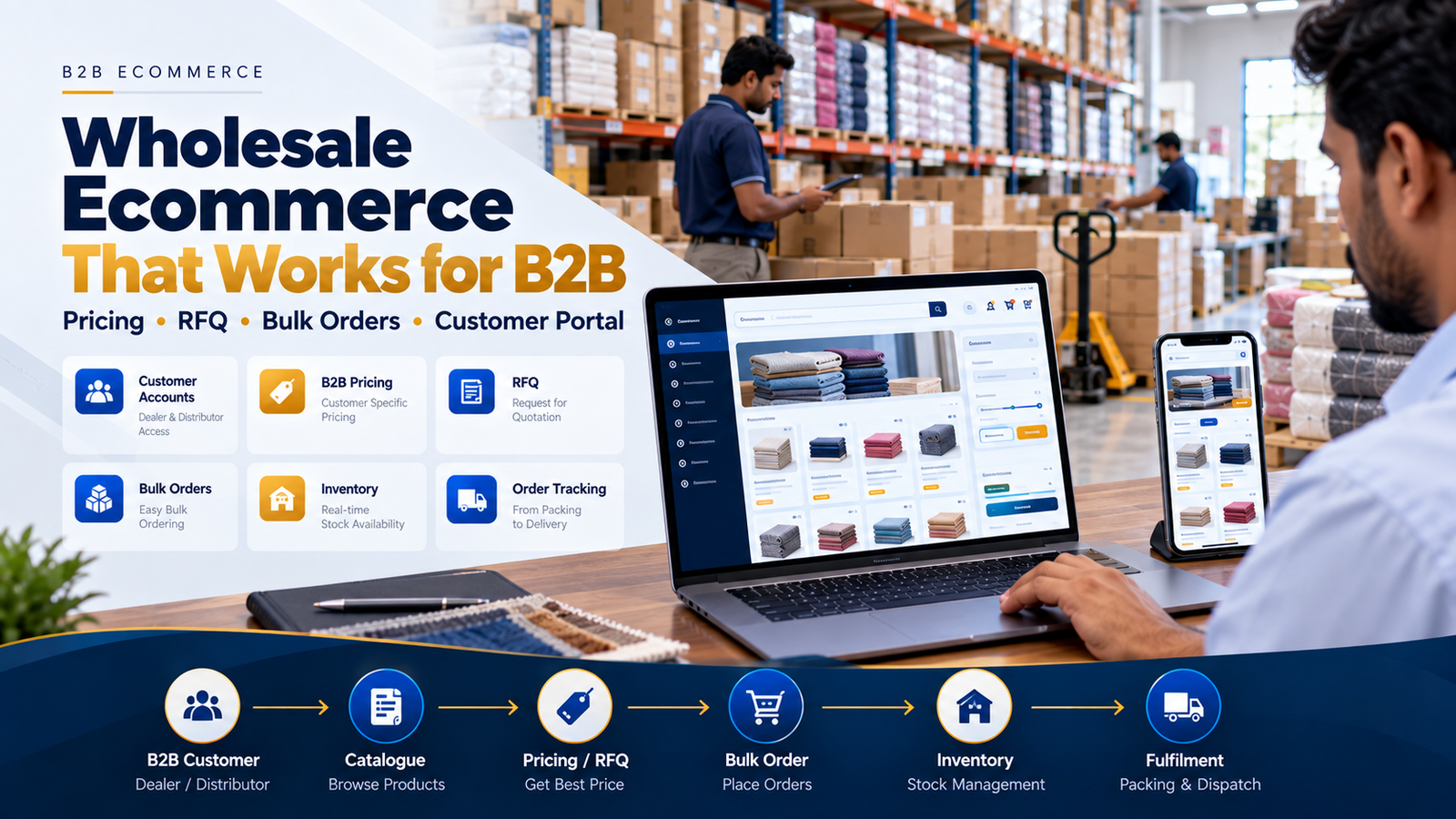
If the company genuinely uses customer categories for commercial workflows, these can be represented in the system.
6. Avoid Arbitrary Customer Scoring
Customer transaction history can provide commercial context, but software should not automatically create unsupported judgments about customer quality or creditworthiness.
7. Product Master
A structured product master can provide consistent product information across quotations and orders.
8. Product SKU or Internal Code
Products can use unique internal identifiers where this supports inventory and order operations.
9. Product Categories
Large wholesale catalogues can be organized into relevant categories and subcategories.
10. Product Variants
Where products have legitimate variants such as size, model, specification or packaging, the system can represent them appropriately.
11. Units of Measure
Wholesale products may be sold and stored using different units.
The company should clearly define approved units and conversion rules where conversions are required.
12. Pack and Carton Configurations
Where products are commonly sold by pack, carton or another business-defined configuration, this can be represented within the product and order workflow.
13. Minimum Order Requirements
If the company has genuine minimum-order rules for specific products or customers, the software can enforce or communicate them according to approved business policy.
14. Product Catalogue
Sales users can access a centralized catalogue of active products and relevant approved information.
15. Customer Enquiry
A wholesale requirement may begin as an enquiry rather than a confirmed order.
16. RFQ Management
B2B customers may request pricing before placing a bulk order.
A typical flow is:
Customer Requirement → RFQ → Price Review → Quotation → Confirmation
17. Quotation Management
Authorized users can prepare quotations based on approved products, quantities and commercial terms.
Read Quotation and Invoice Management Software Development in Erode.
18. Quotation Revision
Where pricing or quantities change during negotiation, quotation versions can preserve relevant history.
19. Price List Management
Wholesalers can maintain approved price lists according to their commercial requirements.
20. Customer-Specific Pricing
Where legitimate commercial agreements require different prices, authorized customer-specific pricing can be supported.
21. Quantity-Based Pricing
If the business uses approved quantity-based price structures, these rules can be represented in the software.
22. Effective Price Dates
Price lists can include appropriate validity or effective dates where required.
23. Price History
Historical approved prices can be preserved rather than overwriting every previous value.
24. Pricing Permissions
Commercial pricing and discount controls should be available only to authorized roles.
25. Sales Order Creation
Once a customer confirms the requirement, an approved quotation or requirement can become a sales order.
26. Unique Sales Order Number
Each sales order can receive a unique internal reference for subsequent fulfilment transactions.
27. Customer Purchase Order Reference
Where B2B customers provide their own PO numbers, those can be maintained separately from the wholesaler’s internal sales-order number.
28. Multiple Products Per Order
A wholesale order can contain multiple products, variants and quantities.
29. Order-Level and Line-Level Status
For larger orders, individual line items may have different availability or fulfilment status.
30. Order Approval
Approval workflows can be introduced where the business genuinely requires them for pricing, discounts or other commercial conditions.
31. Avoid Unnecessary Approvals
Every order does not need multiple approval levels. Approval logic should support genuine business controls without creating unnecessary delays.
32. Order Amendment
Changes to confirmed orders can follow an authorized amendment workflow while preserving relevant historical information.
33. Order Cancellation
Authorized users can cancel orders according to established business rules.
34. Inventory Availability Check
When inventory integration exists, sales users can review appropriate recorded stock information before confirming fulfilment.
35. Physical Stock
Physical stock generally represents inventory recorded as physically present according to the company’s inventory process.
36. Reserved Stock
Stock committed to existing orders can be maintained separately where reservation is used.
37. Available Stock
The company should clearly define how available stock is calculated within its inventory process.
38. Avoid Double Allocation
Centralized reservation and allocation logic can help prevent the same recorded available quantity from being committed to multiple customer orders unintentionally.
39. Stock Reservation
Approved quantities can be reserved against confirmed orders where this matches the business workflow.
40. Partial Stock Availability
If only part of an order is available, the system can maintain available and pending quantities separately.
41. Backorder or Pending Quantity
Where the business uses this concept, the unfulfilled portion of an order can remain open for later fulfilment.
42. Purchase Requirement
When stock is unavailable, the shortage can potentially connect with procurement.
43. Purchase Order Integration
A controlled procurement flow can look like:
Customer Order → Inventory Check → Shortage Review → Purchase Requirement → Purchase Order → Goods Receipt → Allocation
Read Purchase Order Management Software Development in Erode.
44. Do Not Automatically Purchase Every Shortage
A recorded shortage does not necessarily mean a new supplier order should be created immediately.
Existing purchase orders, expected receipts, approved substitutes and business priorities may need to be reviewed first.
45. Manufacturing Integration
Wholesalers that also manufacture products may connect unavailable order quantities with production requirements.
Sales Order → Stock Check → Production Requirement → Production → Finished Goods → Allocation
46. Warehouse Integration
Confirmed orders can connect with warehouse operations.
Read Warehouse Management Software Development in Erode.
47. Warehouse Selection
Businesses operating multiple warehouses may require fulfilment from an appropriate stock location.
48. Picking Workflow
Allocated products can move into a warehouse picking workflow.
49. Pick List
A structured pick list can provide warehouse users with the relevant products and quantities required for approved orders.
50. Partial Picking
The system can support partial picking when the complete order cannot be prepared in one operation.
51. Packing Management
Picked products can move into the appropriate packing process.
52. Packing Instructions
Where customers have approved packing requirements, those instructions can remain connected to the order.
53. Package Information
Where operationally required, packages can be associated with the relevant order or dispatch.
54. Dispatch Planning
Packed orders can move into dispatch planning according to the company’s delivery process.
55. Dispatch Management
Dispatch transactions should remain connected with the originating sales order.
56. Partial Dispatch
Wholesale orders often need support for multiple dispatches.
The system can maintain:
- Ordered quantity
- Allocated quantity
- Packed quantity
- Dispatched quantity
- Remaining quantity
57. Multiple Dispatches Against One Order
A single sales order can be associated with multiple dispatch transactions where required.
58. Dispatch Documentation
Relevant approved commercial and logistics documents can be associated with the dispatch process according to the company’s accounting and compliance requirements.
59. Transport Management Integration
Wholesalers with broader logistics requirements can potentially connect dispatch with a transport-management workflow.
Read Transport and Logistics Management Software Development in Erode.
60. Order Status Tracking
Authorized users can review the recorded status of an order as it moves through fulfilment.
61. Order Timeline
An internal timeline can organize relevant events such as quotation, confirmation, allocation, picking, packing and dispatch.
62. Customer-Facing Order Status
Selected approved order-status information can potentially be made available to customers through a secure B2B portal.
63. B2B Customer Portal
A customer portal can provide selected self-service features to approved wholesale customers.
64. Secure Customer Login
Authorized customers can access their permitted account information through authenticated access.
65. B2B Product Catalogue
Customers can browse products relevant to their account or sales channel.
66. Account-Specific Pricing
Approved customer-specific prices can be presented after authentication where required.
67. Online RFQ
Customers can potentially submit quotation requests directly through the portal.
68. Online Wholesale Ordering
Approved customers can potentially place B2B orders according to the company’s commercial workflow.
69. Order History
Customers can access appropriate historical order information where this feature is required.
70. B2B Ecommerce Integration
Wholesale order management can connect with a B2B ecommerce website.
Customer Login → Product Catalogue → Account Pricing → RFQ / Order → Order Management → Inventory → Fulfilment
Read B2B Ecommerce Website Development for Wholesalers and Manufacturers in Erode.
71. Dealer Portal Integration
Businesses selling through dealer networks can connect wholesale orders with a dedicated dealer portal.
Read Dealer Portal Development for Manufacturers and Distributors in Erode.
72. Distributor Management Integration
Wholesale order processing can operate within a broader distributor-management system when the business manages a structured distribution network.
73. Sales Team Integration
Internal sales users can create and manage customer orders according to their permissions.
74. Field Sales Integration
Wholesalers with field-sales representatives can connect customer visits, enquiries and orders with the central system.
Read Field Sales Management Software for Businesses in Erode.
75. CRM Integration
Customer enquiries and follow-ups can connect with quotation and order workflows.
Lead → Requirement → Follow-Up → Quotation → Sales Order
Read WhatsApp CRM and Lead Follow-Up Software for Businesses in Erode.
76. Communication Workflows
Selected customer communications can potentially be integrated using supported communication platforms and approved business processes.
77. Invoice Coordination
Relevant sales-order and dispatch information can potentially flow to the company’s invoicing or accounting system.
78. Accounting Integration
If an accounting application already manages invoices, payments and financial balances, the order-management application should avoid unnecessarily duplicating those records.
79. Outstanding Information
Where supported by the authoritative financial system, authorized users can access relevant customer outstanding information.
80. Customer Credit Limits
If the company formally uses approved credit limits, the relevant information should come from the appropriate commercial or financial process.
81. Avoid Arbitrary Credit Scores
Order history alone should not automatically be converted into an unsupported creditworthiness score.
82. Payment Status
Relevant payment status can be displayed to authorized users when supplied by the appropriate financial source.
83. Returns Management
Where the business accepts returns, approved return workflows can remain connected to the original sales or dispatch records.
84. Return Approval
Returned products can follow the company’s defined inspection, inventory and financial process.
85. Wholesale Order Dashboard
A role-specific dashboard can summarize relevant operational information such as:
- New enquiries
- Pending quotations
- Confirmed orders
- Orders awaiting stock
- Orders awaiting allocation
- Orders being picked
- Orders awaiting packing
- Orders ready for dispatch
- Partially dispatched orders
- Completed orders
86. Pending Order Report
Users can review orders that still contain outstanding fulfilment quantities or incomplete workflow stages.
87. Customer-Wise Order Report
Recorded order information can be organized according to customer.
88. Product-Wise Order Report
Order quantities can be reviewed according to products or product categories.
89. Salesperson-Wise Order Information
Where useful, orders can be associated with the relevant sales representative.
Sales data should provide business context rather than becoming an unsupported measure of an employee’s overall performance.
90. Area-Wise Order Report
Businesses using defined sales territories can organize order information according to those areas.
91. Pending Dispatch Report
Orders that are approved but not fully dispatched can be organized for operational review.
92. Dispatch Report
Dispatch information can be reviewed according to customer, order, product, warehouse or date.
93. Order History Report
Historical transactions can provide context for customer relationships and previous product requirements.
94. Historical Orders Are Not Guaranteed Forecasts
Previous customer orders can support analysis but do not guarantee future purchasing behaviour.
95. Reports Should Answer Operational Questions
Instead of creating large numbers of reports, the system should focus on questions users actually need answered.
Examples include:
- Which orders are awaiting confirmation?
- Which orders are awaiting stock?
- Which quantities have been allocated?
- Which orders are ready for packing?
- Which orders are ready for dispatch?
- Which orders are partially dispatched?
- What quantities remain pending?
96. Role-Based Access
Access should be based on legitimate business responsibilities.
Possible roles can include:
- Sales user
- Sales manager
- Purchase user
- Warehouse user
- Packing user
- Dispatch user
- Accounts user
- Management user
- B2B customer
- Administrator
97. Internal vs Customer Permissions
External customer accounts should not receive the same permissions as internal employees.
98. Pricing Security
Sensitive pricing, discounts and commercial information should be protected according to role permissions.
99. Server-Side Authorization
Access restrictions should be enforced by the backend rather than relying only on hidden frontend elements.
100. Audit Trails
Important order, pricing, approval and status changes can retain appropriate audit information.
101. Responsive Wholesale Software
A responsive application can support appropriate workflows across desktop, tablet and mobile devices.
102. Mobile Sales Interface
Sales representatives can use a focused mobile interface for customers, products, quotations and orders where required.
103. Mobile Warehouse Interface
Selected warehouse workflows can be optimized for appropriate mobile or handheld devices where practical.
104. Barcode and QR Workflows
Barcode or QR scanning can potentially support product identification, picking, packing and warehouse workflows where it provides a genuine operational benefit.
105. Multi-Warehouse Wholesale Businesses
Businesses operating multiple warehouses can maintain location-specific inventory and fulfilment information.
106. Multi-Branch Operations
Wholesalers with multiple branches can require branch-specific customers, users, inventory or order processing.
107. Source of Truth Architecture
When order management connects with CRM, inventory, warehouse and accounting applications, each category of data should have a clearly defined authoritative system.
| Information | Possible Authoritative System |
|---|---|
| Leads | CRM |
| Customers | ERP / CRM |
| Products | ERP |
| Pricing | ERP / Approved Pricing System |
| Sales Orders | Order Management / ERP |
| Inventory | ERP / Warehouse System |
| Dispatch | ERP / Warehouse System |
| Invoices and Payments | Accounting / Financial System |
108. API Integration
Integration depends on the external application’s supported APIs or other integration methods, documentation, authentication, permissions and architecture.
109. Avoid Duplicate Records Across Systems
When a connected system already owns products, inventory or financial records, the order-management application should avoid maintaining conflicting versions where practical.
110. Data Migration
Existing customer, product, pricing and order information may currently exist in spreadsheets or older software.
111. Clean Master Data Before Migration
Businesses should review existing information for:
- Duplicate customers
- Duplicate products
- Inconsistent product names
- Incorrect units
- Outdated price lists
- Inactive customers
- Duplicate warehouses
- Inconsistent order statuses
112. Opening Orders
Active orders moved into the new system should be carefully verified so ordered, allocated, dispatched and pending quantities begin accurately.
113. Security and Backups
Wholesale software can contain commercially sensitive customer, pricing, order and inventory information.
Authentication, authorization, backups, updates and recovery planning should be included in implementation.
114. Benefits of Wholesale Order Management Software
When properly designed and adopted, potential operational benefits can include:
- Centralized B2B customer information
- Structured product and pricing data
- Connected quotation and sales-order workflows
- Better visibility into recorded inventory availability
- Controlled stock allocation
- Support for bulk orders
- Support for partial fulfilment
- Connected picking and packing
- Structured dispatch records
- Customer order history
- Role-specific dashboards
- Reduced duplicate entry where integrations are available
Actual results depend on business processes, implementation, data quality and user adoption.
115. Wholesale Software vs Spreadsheet Order Management
| Spreadsheet / Manual Workflow | Wholesale Order Software |
|---|---|
| Orders may exist in separate files | Orders can use centralized records |
| Pricing may require manual checking | Approved pricing can connect with orders |
| Stock may be checked separately | Inventory information can be integrated |
| Allocation may require manual coordination | Reservation and allocation can be structured |
| Partial dispatch requires manual reconciliation | Dispatched and pending quantities can remain connected |
| Order status requires repeated follow-up | Recorded fulfilment status can be centralized |
116. Custom Wholesale Software vs Ready-Made ERP
Ready-made software can be appropriate when its products, pricing, inventory and order workflows closely match the wholesaler’s requirements.
Custom development can be considered when the business has specialized price structures, order approvals, units, warehouse workflows, customer portals or integrations.
The appropriate approach depends on operational fit and long-term requirements.
117. Start With a Wholesale Order Management MVP
A focused first version can include:
Customers → Products → Pricing → Quotations → Sales Orders → Inventory → Dispatch
Warehouse automation, customer portals, accounting integrations and advanced reports can be added according to actual requirements.
118. Phased Implementation
A possible implementation sequence is:
Phase 1: Customers + Products + Pricing + Quotations
Phase 2: Sales Orders + Inventory + Allocation
Phase 3: Warehouse + Picking + Packing + Dispatch
Phase 4: B2B Portal + ERP + Accounting + Advanced Reporting
119. Wholesale Order Management Software Cost in Erode
There is no universal fixed price for custom wholesale order management software.
Development cost can depend on:
- Number of users
- Number of products
- Product and variant complexity
- Pricing rules
- Order workflows
- Number of warehouses
- Inventory requirements
- Picking and packing workflows
- Dispatch requirements
- B2B customer portal
- Barcode or QR workflows
- ERP integration
- Accounting integration
- Reports and dashboards
- Data migration
- Security requirements
- Training and support
120. Development Timeline
Development time depends on modules, business rules, integrations, migration and testing requirements.
A proper requirement study should be completed before estimating a reliable implementation schedule.
121. Wholesale Order Management Software Development Process
A structured development process can follow:
Business Study → Order Workflow Mapping → Requirements → Architecture → UI/UX → Development → Integration → Migration → Testing → UAT → Training → Deployment → Support
122. User Acceptance Testing
Representative users should test realistic wholesale scenarios before full deployment.
Important scenarios can include:
- Customer creation
- Product selection
- Quotation creation
- Price approval
- Bulk sales order
- Multiple products
- Order amendment
- Partial stock availability
- Stock reservation
- Picking
- Partial picking
- Packing
- Partial dispatch
- Returns
- Order cancellation
- User permissions
- Reports
- External integrations
Common Wholesale Order Management Software Mistakes
- Starting development without mapping the actual order workflow
- Maintaining duplicate customer and product masters
- Using inconsistent units of measure
- Allowing uncontrolled pricing changes
- Ignoring quotation revisions
- Adding unnecessary approvals
- Ignoring order amendments
- Confusing physical stock with available stock
- Allowing double allocation
- Ignoring partial fulfilment
- Ignoring partial dispatch
- Maintaining conflicting inventory across applications
- Duplicating accounting records
- Exposing sensitive information through customer portals
- Creating arbitrary customer credit scores
- Creating excessive reports without clear use cases
- Assuming every external system supports API integration
- Migrating unclean master data
- Trying to implement every feature in the first release
Questions to Ask Before Developing Wholesale Order Management Software
- Who places our orders?
- Do we sell to customers, dealers, distributors or all three?
- How many products do we manage?
- Which units of measure do we use?
- Do customers have different price lists?
- Do we use quantity-based pricing?
- Do orders require approval?
- How do we define available stock?
- Do we reserve stock against orders?
- How do we handle shortages?
- How many warehouses do we operate?
- How are products picked?
- How are products packed?
- Do we support partial dispatch?
- Do customers need online order access?
- Do we need a B2B portal?
- Which system manages invoices and payments?
- Which reports are actually needed?
- Which integrations are required?
- What historical data needs migration?
Wholesale Order Management Software in Erode and Nearby Areas
Wholesale and distribution businesses operate across Erode’s textile, manufacturing, construction, industrial, retail-supply and other B2B sectors.
Greap Technologies develops custom wholesale and order-management software for businesses in Erode and nearby areas including Perundurai, Bhavani, Chennimalai, Anthiyur, Gobichettipalayam, Sathyamangalam, Modakkurichi, Kavindapadi, Kodumudi, Nambiyur and surrounding locations.
The software can be planned around the company’s actual customers, products, pricing, inventory, warehouse and fulfilment processes.
Why Consider Greap Technologies?
Greap Technologies develops custom software around business workflows rather than simply assembling a generic collection of modules.
Depending on requirements, a wholesale order management system can include customers, products, catalogues, quotations, price lists, bulk orders, approvals, inventory availability, stock reservation, warehouse operations, picking, packing, dispatch, customer portals, CRM integration, ERP integration, accounting integration, dashboards, reports, permissions and audit trails.
Explore Greap Technologies for custom wholesale, distribution and order-management software development.
Final Checklist Before Starting
- Map customer and channel structure
- Clean customer master data
- Standardize product information
- Define units of measure
- Define price lists
- Define customer-specific pricing
- Map RFQ and quotation workflows
- Map sales-order processing
- Define approvals
- Define physical, reserved and available stock
- Define stock allocation
- Map warehouse picking
- Map packing
- Define partial dispatch
- Define customer-facing order status
- Define financial source of truth
- Define roles and permissions
- Identify required reports
- Identify integrations
- Plan migration, UAT and training
Conclusion
Wholesale order management software development in Erode can help wholesalers connect customer requirements, pricing, bulk orders, inventory, warehouse operations and dispatch within a structured digital workflow.
A typical wholesale order journey can be:
Customer / Dealer → RFQ → Quotation → Sales Order → Stock Allocation → Picking → Packing → Dispatch → Completion
When inventory is unavailable, the workflow can connect with procurement or production rather than forcing users to manage shortages separately.
For businesses requiring online B2B ordering, the same architecture can extend into a secure customer or dealer portal. For companies requiring wider operations, order management can become part of a broader ERP, warehouse and distribution system.
Looking for Wholesale Order Management Software Development in Erode?
If your wholesale business currently manages customer orders, prices, inventory, packing and dispatch through spreadsheets, phone calls, messaging conversations or disconnected applications, Greap Technologies can study your workflow and plan custom wholesale order management software around your requirements.
Discuss Your Wholesale Software Requirements on WhatsApp
Frequently Asked Questions
1. What is wholesale order management software?
Wholesale order management software organizes B2B customers, products, pricing, quotations, bulk sales orders, inventory allocation, packing, dispatch and related fulfilment workflows.
2. Can wholesale software manage bulk orders?
Yes. A custom system can manage orders containing multiple products, variants and quantities according to the wholesaler’s business process.
3. Can different wholesale customers have different prices?
Yes. Approved price lists, account-specific pricing and quantity-based pricing can be supported according to the company’s commercial rules.
4. Can the software check stock before confirming an order?
Yes, where inventory is managed within the system or available through an appropriate integration. Physical, reserved and available stock should be clearly defined.
5. Can it reserve stock for customer orders?
Yes. Approved inventory quantities can be reserved against confirmed orders where this matches the company’s fulfilment workflow.
6. Can wholesale order software handle partial dispatch?
Yes. Multiple dispatches can be recorded against the same order while maintaining ordered, dispatched and remaining quantities.
7. Can customers place wholesale orders online?
Yes. A secure B2B portal can allow approved customers to browse relevant products, access permitted pricing and submit RFQs or orders.
8. Can it support multiple warehouses?
Yes. The system can support location-specific inventory and fulfilment workflows according to business requirements.
9. Can wholesale order software integrate with accounting software?
Potentially. Integration depends on the accounting application’s supported APIs or other integration methods, authentication, documentation and permissions.
10. Can it integrate with warehouse and distributor management software?
Yes. Wholesale order management can form part of a broader architecture connecting distribution, inventory, warehouse, dispatch and ERP workflows.
11. How much does wholesale order management software cost in Erode?
Cost depends on users, products, pricing rules, order workflows, warehouses, inventory, portals, integrations, reports, migration, security and support. A requirement study is needed before estimating a custom implementation.
12. Does Greap Technologies develop wholesale order management software in Erode?
Yes. Greap Technologies develops custom wholesale, distribution and order-management software for businesses in Erode and nearby areas based on their operational requirements.