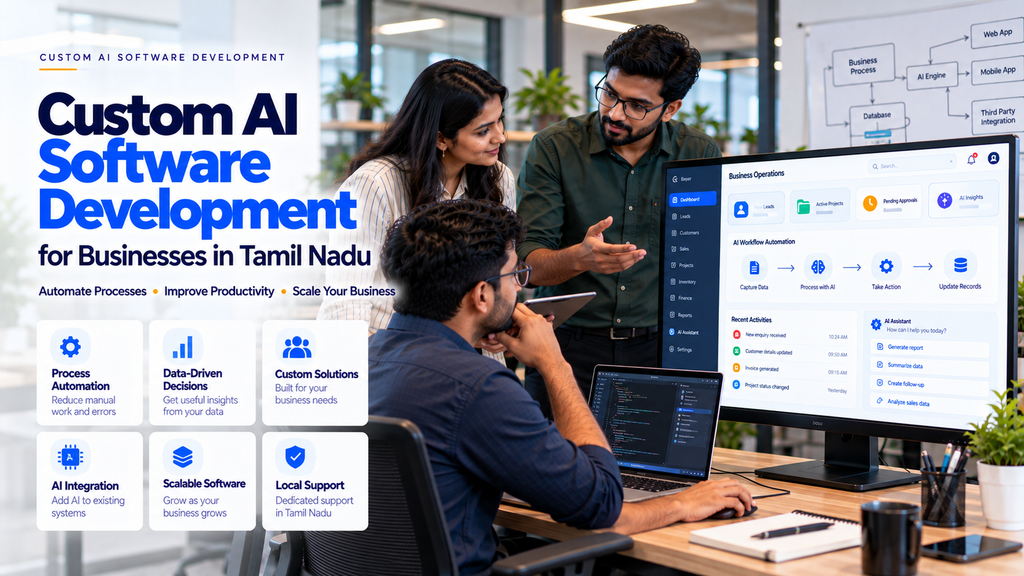
Custom AI Software Development for Businesses in Tamil Nadu
Businesses across Tamil Nadu are exploring new ways to manage operations, improve customer communication, organize information, and reduce repetitive administrative work.
Many companies already use software for accounting, inventory, sales, customer management, production, and reporting.
However, standard software may not always support every business-specific workflow.
For example, a textile manufacturer may need software that connects customer orders, production tracking, inventory, and dispatch activities. A wholesale distributor may need automated lead assignment, order management, and reporting. A service company may want an AI assistant that helps organize customer enquiries and internal tasks.
These requirements are some of the reasons businesses consider custom AI software development in Tamil Nadu.
Custom AI software combines tailored application development with artificial intelligence capabilities where they provide practical value.
Depending on the project, AI may help interpret customer messages, extract document information, summarize business records, support forecasting, or assist employees with repetitive information-processing tasks.
Not every business process requires AI. In many cases, conventional software development and rule-based automation are more predictable and cost-effective.
This guide explains what custom AI software is, how it differs from ready-made solutions, which industries may benefit, how development works, and what businesses should consider before starting an AI software project.
What Is Custom AI Software Development?
Custom AI software development involves designing and building applications around specific business requirements while integrating suitable artificial intelligence capabilities.
Unlike generic software products, custom applications can be structured around a company’s workflows, user roles, business rules, and existing systems.
Examples may include:
- AI-assisted CRM software
- Customer support assistants
- Document processing applications
- Intelligent business reporting tools
- AI-assisted inventory forecasting
- Automated enquiry management
- Custom workflow management systems
- AI-powered knowledge search
The AI component should address a clearly identified requirement rather than being added only as a marketing feature.
How Custom AI Software Works
A custom AI application typically combines several components.
- Frontend user interface
- Backend business logic
- Database or approved data sources
- AI model or AI service
- Workflow automation
- Integrations with existing systems
- Security and access controls
A simplified workflow is:
Business Data → Application Logic → AI Processing → Validation → Staff Review or Automated Action → Reporting
The exact architecture depends on the application and the reliability required.
Custom AI Software vs Ready-Made AI Tools
| Ready-Made AI Tools | Custom AI Software |
|---|---|
| Provide predefined functionality | Can be tailored to business-specific workflows |
| May offer faster initial setup | May require more development time |
| Customization depends on the provider | Can support specialized business rules |
| Often use subscription pricing | May involve development and recurring infrastructure costs |
| Integrations depend on available features | Can be designed around supported APIs and systems |
Businesses should compare total cost, functionality, security, maintenance, and long-term flexibility before choosing a solution.
Why Businesses in Tamil Nadu Consider Custom AI Solutions
Companies operating in manufacturing, textiles, wholesale distribution, retail, logistics, healthcare, education, and professional services often have different operational requirements.
Some common challenges include:
- Repeated manual data entry
- Customer enquiries spread across multiple channels
- Disconnected software systems
- Time-consuming document processing
- Delayed operational reports
- Difficulty tracking workflow status
- Inconsistent internal follow-ups
- Limited access to organized business information
Custom software can help address selected challenges when requirements are clearly defined and the necessary data is available.
1. AI-Powered CRM Software Development
Customer relationship management software helps businesses organize sales leads, customer records, and follow-up activities.
AI-assisted CRM features may include:
- Customer enquiry classification
- Conversation summaries
- Suggested follow-up tasks
- Lead categorization
- Customer information search
- Sales activity summaries
AI recommendations should support employees rather than automatically make sensitive customer decisions.
2. AI Chatbot Development
AI chatbots can help businesses provide conversational assistance through websites or approved messaging channels.
Possible applications include:
- Service information
- Product enquiries
- Lead capture
- Appointment requests
- Customer support routing
- Business knowledge search
Chatbots should use verified business information and provide human escalation when necessary.
Read AI Chatbot Development for Business Websites in Erode.
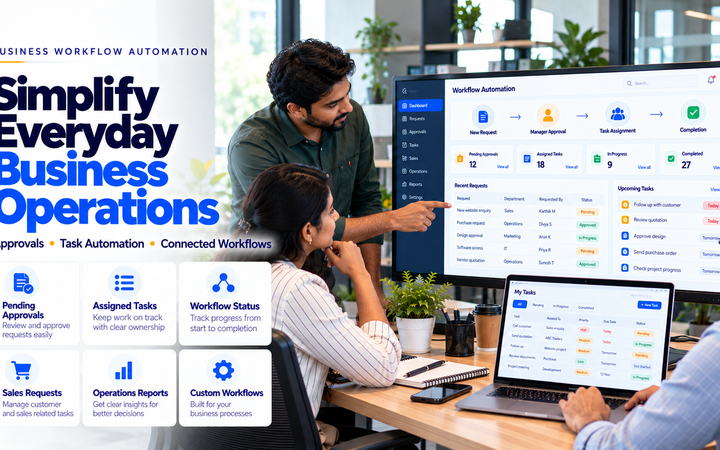
3. AI Business Process Automation
Businesses may have workflows involving multiple employees and software systems.
Automation can help coordinate repetitive steps such as:
- Lead assignment
- Task scheduling
- Document routing
- Approval requests
- Status notifications
- Scheduled reporting
AI may assist when the workflow requires interpretation of unstructured information.
Read AI Automation Services in Erode.
4. AI Document Processing Software
Businesses often receive invoices, purchase orders, quotations, forms, and other documents.
AI-assisted document processing may help extract information from supported document formats.
A possible workflow is:
Document Upload → Data Extraction → Validation → Human Review → System Entry
Important values such as invoice totals, tax details, and supplier information should be verified before final processing.
5. AI-Powered Inventory Management
Inventory management systems track stock movements, item quantities, and reorder requirements.
AI-assisted features may support:
- Demand forecasting
- Inventory trend analysis
- Stock movement summaries
- Unusual stock activity detection
- Reorder planning assistance
Forecast quality depends on the availability and reliability of historical data.
Purchasing decisions should follow approved business rules and human oversight.
6. AI Sales and Lead Management Software
Sales teams often manage customer enquiries, quotations, meetings, and follow-up activities.
Custom AI-assisted software may help:
- Organize leads
- Categorize customer requirements
- Summarize conversations
- Create follow-up reminders
- Track sales pipeline activity
- Generate management summaries
Lead scoring and AI-generated recommendations should be evaluated for accuracy and potential bias.
7. AI Customer Support Software
AI-assisted customer support systems may help employees find information and handle routine requests.
Potential features include:
- Support ticket classification
- Knowledge base search
- Suggested responses
- Conversation summaries
- Support routing
- Escalation management
Customers should have access to human assistance for complex or sensitive issues.
8. AI-Powered Business Reporting
Businesses often spend time collecting information from multiple departments to prepare reports.
Custom reporting software may help consolidate approved business data.
AI-assisted features may include:
- Natural-language data queries
- Report summaries
- Trend explanations
- Operational alerts
- Data exploration assistance
AI-generated summaries should be checked against underlying records before important decisions are made.
9. AI Software for Textile Businesses
Textile businesses may manage yarn, fabric, production orders, inventory, job work, and dispatch operations.
Potential custom software features include:
- Textile order management
- Production tracking
- Material requirement planning
- Inventory monitoring
- Dispatch coordination
- Business reporting
AI may support demand forecasting or document interpretation where suitable data is available.
Read Textile ERP Software Development in Erode.
10. AI Software for Manufacturing Companies
Manufacturing businesses may need custom systems that connect orders, materials, production activities, quality processes, and dispatch.
Possible applications include:
- Production planning assistance
- Manufacturing workflow tracking
- Inventory forecasting
- Operational reporting
- Document processing
- Maintenance planning support
AI should not independently control safety-critical machinery without appropriate engineering safeguards and validated control systems.
11. AI Software for Wholesale and Distribution
Wholesale businesses often coordinate dealer orders, stock, quotations, dispatch, and payments.
Custom software may support:
- Dealer order management
- Quotation workflows
- Inventory integration
- Dispatch tracking
- Sales reporting
- Customer enquiry organization
AI may assist with summaries or forecasting, while financial approvals remain controlled by defined business rules.
12. AI Software for Retail Businesses
Retail businesses may use AI-assisted software to support inventory planning and customer service.
Potential applications include:
- Sales trend analysis
- Stock planning assistance
- Customer enquiry support
- Product information search
- Operational reporting
13. AI Software for Ecommerce Businesses
Ecommerce businesses may need integrations across product catalogues, orders, customer support, shipping, and inventory.
Potential AI-assisted applications include:
- Product information assistance
- Customer support chatbots
- Order enquiry classification
- Demand forecasting
- Product data organization
- Business reporting
AI-generated product descriptions and recommendations should be checked for accuracy.
14. AI Software for Logistics Businesses
Transport and logistics companies may need systems for shipment tracking, delivery coordination, and operational reporting.
AI-assisted applications may include:
- Delivery demand forecasting
- Shipment exception classification
- Document processing
- Operational summaries
- Route planning assistance
Actual routing and delivery commitments should use reliable operational data.
15. AI Software for Healthcare Administration
Healthcare organizations may use custom software for administrative activities.
Potential applications include:
- Appointment management
- Administrative enquiry routing
- Document organization
- Staff scheduling support
- Operational reporting
Healthcare information requires additional privacy, security, and professional oversight.
AI systems should not independently make clinical decisions without appropriate validation and qualified supervision.
16. AI Software for Educational Institutions
Schools and colleges may use custom software to organize administrative workflows.
Possible applications include:
- Admission enquiry management
- Administrative document processing
- Student support routing
- Schedule management
- Reporting assistance
Student data must be handled with suitable privacy and access controls.
17. AI Software for Real Estate Businesses
Real estate companies may use custom software for property enquiries and customer management.
Potential features include:
- Lead capture
- Property enquiry categorization
- Agent assignment
- Site visit scheduling
- CRM integration
- Sales activity reporting
18. AI Software for Professional Service Companies
Professional service businesses may need systems for enquiries, projects, documents, and customer communication.
AI-assisted software may support:
- Document search
- Enquiry classification
- Task management
- Draft preparation
- Internal reporting
Professional judgments and regulated advice should remain subject to qualified human review.
19. AI Integration With Existing ERP Software
Businesses may already use ERP systems to manage operations.
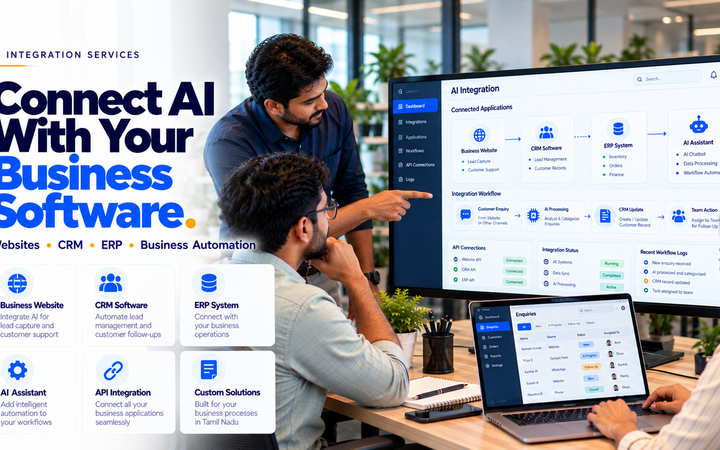
AI capabilities can sometimes be integrated with existing ERP software through supported APIs and approved access methods.
Possible applications include:
- Business reporting assistance
- Inventory forecasting
- Document extraction
- Workflow alerts
- Natural-language information retrieval
Integration feasibility depends on the ERP platform and available technical access.
20. AI Integration With CRM Software
AI-assisted CRM integration may help employees organize and interpret customer information.
Potential features include:
- Conversation summaries
- Lead categorization
- Follow-up suggestions
- Customer information search
- Sales reporting
Access controls should prevent users from viewing customer information outside their authorized permissions.
21. AI Integration With WhatsApp Business
Businesses may connect approved WhatsApp Business Platform workflows with custom software.
Possible applications include:
- Customer enquiry routing
- CRM lead creation
- Approved notifications
- Support ticket creation
- AI-assisted customer responses
Messaging must follow applicable WhatsApp Business Platform policies, customer consent requirements, and technical limitations.
Read WhatsApp Business Automation Services in Erode.
22. AI Integration With Business Websites
AI functionality can sometimes be integrated into existing websites.
Examples include:
- AI customer support chatbots
- Product information assistants
- Enquiry categorization
- Business knowledge search
- Internal content management assistance
AI features should not significantly harm website usability, accessibility, or loading performance.
23. What Is Retrieval-Augmented Generation?
Retrieval-Augmented Generation, or RAG, is an approach that retrieves relevant information from approved sources and provides it to an AI model when generating responses.
For example:
Employee Question → Search Approved Documents → Retrieve Information → AI Response → Verification
RAG can be useful for business knowledge assistants, but it does not eliminate inaccurate responses.
Access permissions, source quality, and evaluation remain important.
24. Custom AI Knowledge Base Development
Businesses may want employees to search internal documents and approved knowledge sources using natural-language questions.
A knowledge base may include:
- Product catalogues
- Internal process documents
- Support documentation
- Approved policies
- Training materials
The system should respect document permissions and avoid exposing restricted information.
25. AI Agents vs Traditional Workflow Automation
Some AI systems can plan or perform multiple steps using connected tools.
These are often described as AI agents.
However, more autonomous behavior can introduce additional risks.
For predictable business processes, rule-based workflows may be more reliable.
AI agents should have clearly defined permissions, action limits, monitoring, and approval requirements.
26. Should Every Business Build Its Own AI Model?
No.
Many business applications can use existing AI models through approved services or supported deployment options.
Training a model from scratch is often unnecessary for common business requirements.
The appropriate approach depends on:
- Business requirements
- Data sensitivity
- Performance needs
- Customization requirements
- Budget
- Maintenance capacity
27. Custom AI Software Architecture
A typical custom AI software system may include:
- Frontend web or mobile application
- Backend application services
- Database
- Authentication and authorization
- AI service integration
- Business rules and workflow engine
- API integrations
- Logging and monitoring
A simplified architecture is:
User Interface → Secure Backend → Business Logic → AI Service / Database / Integrations → Validated Response
API keys and sensitive credentials should be stored securely on the server rather than exposed in frontend code.
28. Security Requirements for Custom AI Software
Custom AI applications may process customer records, employee information, invoices, business documents, and operational data.
Important safeguards include:
- Role-based access controls
- Secure authentication
- Appropriate encryption
- API credential protection
- Input validation
- Audit logging
- Backup and recovery
- Data retention policies
- Prompt injection defenses
- Monitoring and incident response
Security requirements should be planned from the beginning of development.
29. Data Privacy in AI Software Development
Businesses should understand what information is sent to AI services and how that information is handled.
Before implementation, review:
- Data categories
- Customer permissions
- Vendor policies
- Data storage locations
- Retention periods
- Access permissions
- Applicable privacy laws
Only necessary data should be processed for the intended business purpose.
30. How to Reduce AI Errors
AI systems can generate inaccurate or incomplete information.
Businesses can reduce risk by:
- Using verified data sources
- Defining clear application boundaries
- Validating structured outputs
- Testing realistic scenarios
- Monitoring errors
- Maintaining human approval for important actions
- Providing fallback workflows
- Reviewing system performance regularly
No AI integration should be assumed to be error-free.
31. Human-in-the-Loop AI Workflows
Human-in-the-loop design allows employees to review important AI-generated outputs before actions are completed.
Example:
AI Extracts Invoice Data → Staff Reviews Values → System Creates Draft → Authorized Approval → Final Record
This approach can be useful for financial, contractual, operational, and other high-impact workflows.
32. Custom AI Software Development Process
- Business Requirement Analysis: Understand the current workflow and desired outcome.
- Feasibility Assessment: Evaluate data availability, integrations, and whether AI is appropriate.
- Solution Architecture: Plan application components, security, and integrations.
- UI/UX Design: Create user-friendly interfaces.
- Software Development: Build the application and business logic.
- AI Integration: Connect and configure suitable AI capabilities.
- Testing: Evaluate functionality, security, accuracy, and failure scenarios.
- Deployment: Release the application in the agreed environment.
- Training: Help users understand the system.
- Maintenance: Monitor errors, costs, and changing requirements.
33. Proof of Concept vs Full Development
Businesses considering complex AI applications may benefit from starting with a proof of concept.
A proof of concept can help evaluate whether the proposed AI capability works with realistic business data.
It can also reveal limitations before a larger development investment.
However, a successful prototype is not automatically ready for production use.
Production systems require additional security, testing, reliability, monitoring, and maintenance.
34. How to Measure AI Software Success
Businesses should define measurable goals before implementation.
Possible indicators include:
- Manual processing time
- Task completion rate
- Workflow error rate
- AI response accuracy
- Human review workload
- Customer response time
- Operational reporting time
- Software usage and adoption
- Total operating cost
Results should be compared with a documented baseline.
35. How Much Does Custom AI Software Development Cost in Tamil Nadu?
The cost depends on the project requirements and technical complexity.
Important factors include:
- Number of software modules
- Custom UI/UX requirements
- AI model or API usage
- Data processing complexity
- Existing software integrations
- User roles and permissions
- Security requirements
- Cloud infrastructure
- Testing and deployment
- Maintenance and support
Businesses should request a requirements-based quotation that separates initial development costs from recurring AI, hosting, and support expenses.
36. How Long Does Custom AI Software Development Take?
Development timelines depend on the scope and readiness of the business requirements.
A focused application with one AI-assisted workflow may require less development effort than a multi-department enterprise platform.
Timeline factors include:
- Requirement clarity
- Data preparation
- Integration availability
- AI evaluation requirements
- Security needs
- User acceptance testing
- Deployment complexity
37. How to Choose an AI Software Development Company in Tamil Nadu
Before selecting a development partner, evaluate:
- Understanding of your business process
- Custom software development capabilities
- AI integration approach
- Data security practices
- System integration experience
- Testing and evaluation process
- Documentation and training
- Maintenance arrangements
- Transparent cost structure
A suitable provider should explain when AI is beneficial and when simpler software automation is sufficient.
38. Custom AI Software Development Across Tamil Nadu
Businesses in different Tamil Nadu markets may have varying software requirements depending on their industries and operations.
Relevant business locations include:
- Erode
- Coimbatore
- Tiruppur
- Chennai
- Salem
- Namakkal
- Karur
- Madurai
- Trichy
- Hosur
- Krishnagiri
- Dharmapuri
- Dindigul
- Thanjavur
- Tirunelveli
- Thoothukudi
- Vellore
- Ranipet
- Tiruvannamalai
- Cuddalore
The right AI software solution depends on actual business requirements rather than location alone.
39. Common Custom AI Software Development Mistakes
- Adding AI without identifying a business problem
- Using unreliable source data
- Ignoring software integration limitations
- Skipping proof-of-concept testing
- Exposing sensitive API credentials
- Allowing unreviewed AI outputs to control important decisions
- Ignoring recurring AI usage costs
- Overlooking employee training
- Failing to define measurable outcomes
- Ignoring privacy requirements
- Launching without adequate monitoring
- Assuming AI guarantees business growth
40. Custom AI Software Development Checklist
- Define the business problem.
- Map the current workflow.
- Identify repetitive tasks.
- Evaluate whether AI is necessary.
- Review available business data.
- Identify integration requirements.
- Define user roles.
- Plan data privacy and security.
- Choose an appropriate architecture.
- Consider a proof of concept.
- Design user-friendly interfaces.
- Define AI accuracy requirements.
- Include human approval where needed.
- Test realistic business scenarios.
- Estimate recurring operating costs.
- Train employees.
- Monitor performance after launch.
- Maintain and improve the software.
41. How Greap Technologies Can Help
Greap Technologies can help businesses discuss custom software requirements and explore suitable AI integration opportunities.
Depending on the agreed project scope, work may include:
- Custom software requirement analysis
- AI application planning
- Web-based business software development
- CRM development and integration
- Workflow automation
- AI chatbot integration
- Document processing workflows
- Business reporting dashboards
- ERP integration
- WhatsApp Business Platform integration
- API development
- Security planning
- Testing and maintenance
Explore Greap Technologies for custom software development, business automation, and digital solutions.
Conclusion
Custom AI software development in Tamil Nadu can help businesses explore more efficient ways to manage information, automate selected processes, and support employees with intelligent software tools.
Potential applications include CRM systems, customer support, document processing, inventory planning, manufacturing workflows, ecommerce operations, and business reporting.
However, successful AI software development requires more than connecting an AI model to an application.
Businesses need clear requirements, reliable data, secure architecture, appropriate integrations, realistic testing, and ongoing maintenance.
A practical development approach is:
Identify Business Problem → Evaluate AI Feasibility → Design Solution → Build and Integrate → Test → Deploy → Monitor
For businesses in Erode and across Tamil Nadu, starting with a clearly defined operational problem can be a useful way to evaluate custom AI software before investing in a larger platform.
Planning Custom AI Software for Your Business?
Greap Technologies can help you discuss your business requirements, existing workflows, and suitable custom software or AI integration options.
Frequently Asked Questions
1. What is custom AI software development?
Custom AI software development involves building applications tailored to business requirements and integrating artificial intelligence where it provides practical value.
2. Which businesses can benefit from custom AI software?
Manufacturing, textiles, wholesale distribution, ecommerce, logistics, healthcare administration, education, and service businesses may have suitable AI software use cases.
3. Can AI be integrated into existing business software?
Yes, when the existing software provides suitable APIs, approved integrations, and necessary technical access.
4. Does every custom business software project need AI?
No. Many business requirements can be handled more reliably using conventional software development and rule-based automation.
5. Can AI software automate customer enquiries?
AI-assisted systems can help categorize enquiries, summarize messages, create CRM records, and support follow-up workflows.
6. Can AI software help manufacturing businesses?
AI may support selected forecasting, document processing, reporting, and operational planning activities when suitable data is available.
7. Is custom AI software secure?
Security depends on the architecture, access controls, data handling, vendor practices, testing, and maintenance.
8. Can custom AI software support Tamil and English?
Multilingual features may be implemented depending on the selected AI models, requirements, and evaluation results.
9. How much does custom AI software development cost in Tamil Nadu?
Cost depends on the software modules, AI capabilities, integrations, infrastructure, security, testing, and maintenance requirements.
10. How long does AI software development take?
The timeline depends on project scope, data readiness, integration complexity, testing, and deployment requirements.
11. Can AI software connect with WhatsApp and CRM?
Integration may be possible through authorized messaging platforms and supported CRM APIs.
12. Does Greap Technologies provide custom AI software development in Tamil Nadu?
Greap Technologies can help assess custom software and AI integration requirements and develop suitable solutions according to the agreed project scope.