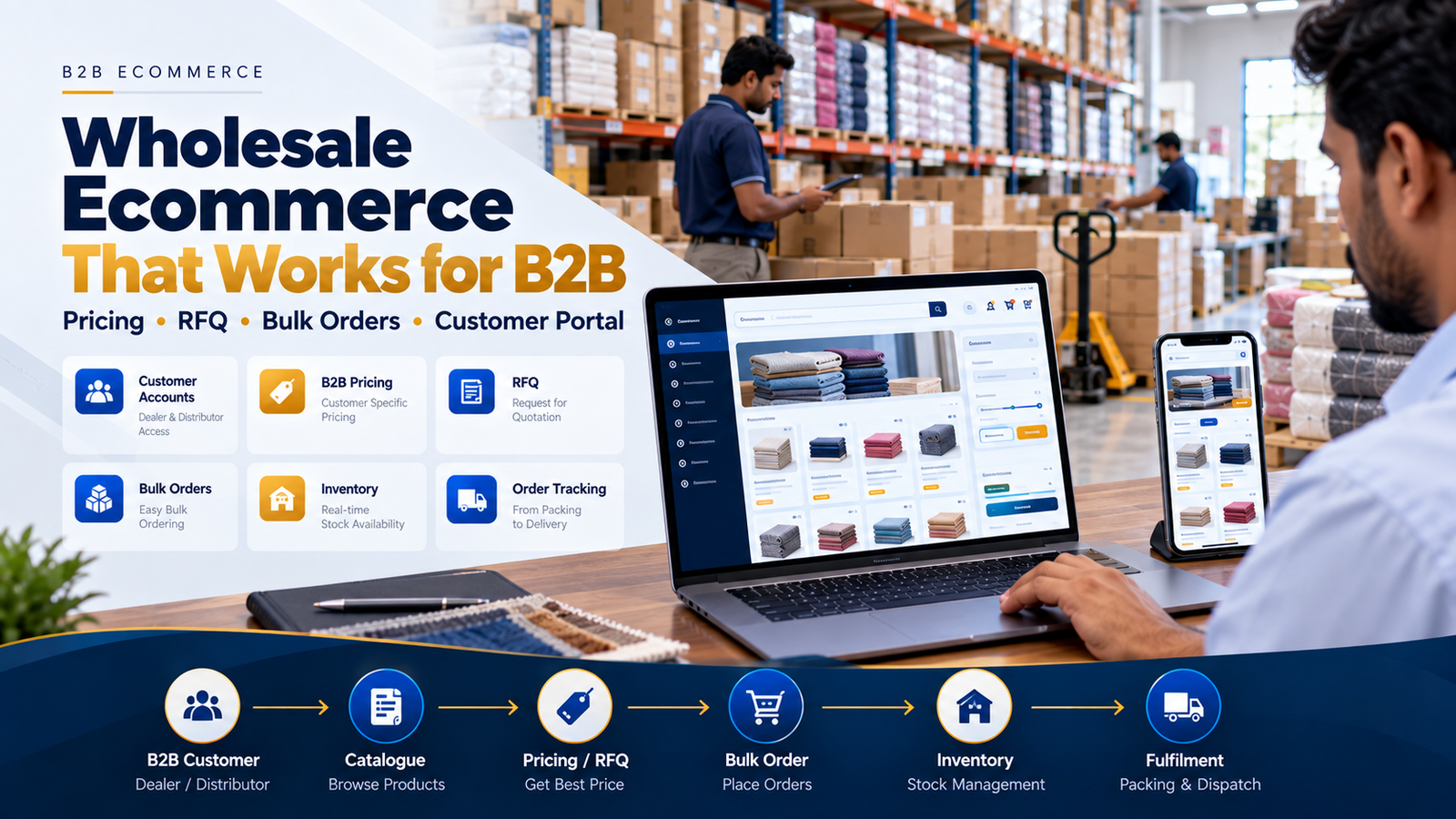
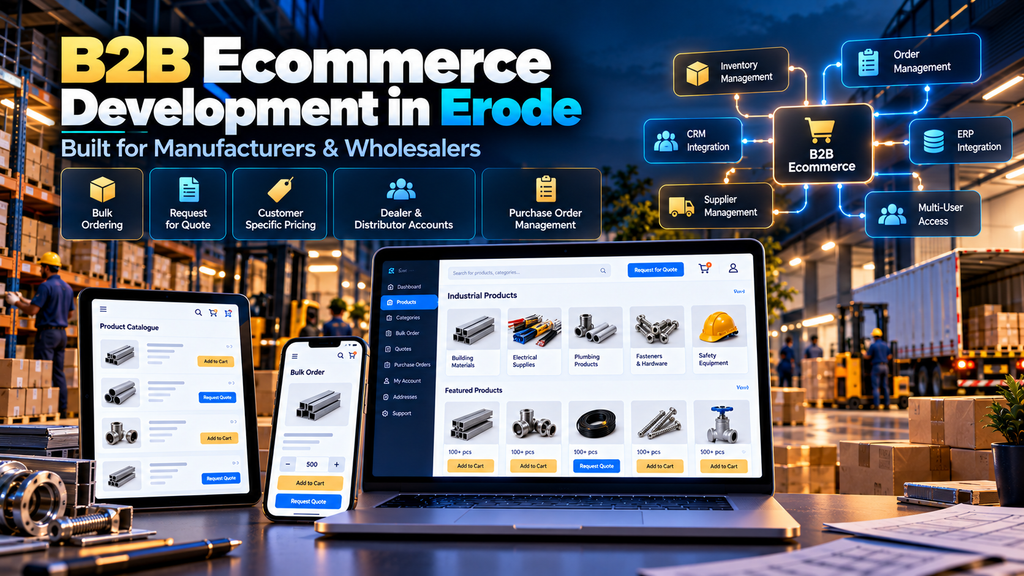
B2B Ecommerce Website Development for Wholesalers and Manufacturers in Erode can help businesses move beyond a basic product catalogue and create a digital system for enquiries, quotations, dealer relationships, bulk orders and repeat purchases.
B2B ecommerce is different from a typical consumer online store.
A retail customer may select one product, pay online and complete an order within minutes.
A manufacturer, distributor, dealer or wholesale buyer may need to compare specifications, order larger quantities, request a quotation, use negotiated pricing, submit a purchase order or reorder products they purchase regularly.
That means a B2B ecommerce website should be designed around the actual sales process of the business.
At Greap Technologies, we provide ecommerce development services, website development, custom business solutions and SEO services in Erode for manufacturers, wholesalers and other B2B businesses.
What Is B2B Ecommerce?
B2B ecommerce refers to online commercial transactions and digital sales processes between businesses.
Examples can include:
- Manufacturer to distributor
- Manufacturer to dealer
- Manufacturer to business customer
- Wholesaler to retailer
- Distributor to dealer
- Supplier to commercial buyer
A B2B ecommerce website may support direct online ordering, quotation requests or a combination of digital and sales-assisted purchasing.
How Is B2B Ecommerce Different from B2C Ecommerce?
| Area | B2B Ecommerce | B2C Ecommerce |
|---|---|---|
| Customer | Businesses, dealers, distributors or organizations | Individual consumers |
| Order Quantity | Often larger or recurring | Usually smaller individual purchases |
| Pricing | May be negotiated or customer-specific | Usually standard public pricing |
| Quotation | Often important | Less common |
| Purchase Orders | Can be part of the buying process | Less common |
| Customer Accounts | Can contain business-specific terms | Usually standard customer accounts |
| Product Information | Can require detailed technical specifications | Often focused on consumer buying information |
| Buying Decision | May involve multiple people | Often made by an individual |
Why B2B Ecommerce Matters for Erode Businesses
Erode and nearby industrial areas include manufacturers, wholesalers, distributors, textile businesses, engineering companies, suppliers and other businesses selling to commercial buyers.
Traditional B2B sales can depend heavily on:
- Phone calls
- WhatsApp messages
- Emails
- PDF catalogues
- Spreadsheets
- Sales representatives
- Manual quotations
These channels can remain useful, but a well-designed B2B ecommerce website can organize more of the buying journey into one digital experience.
1. Start with the Existing B2B Sales Process
Do not begin B2B ecommerce development by copying a normal retail store.
First document how customers currently buy from the business.
Ask:
- Who are our buyers?
- How do they discover products?
- Do we publish prices?
- Do customers have negotiated pricing?
- Do we use minimum order quantities?
- Do buyers request quotations?
- Do customers submit purchase orders?
- How are orders approved?
- How is inventory managed?
- How are repeat orders handled?
The ecommerce workflow should support the real business process.
2. Build a Professional B2B Product Catalogue
A B2B website should make the product catalogue easy to browse and understand.
Depending on the business, catalogue information may include:
- Product name
- Product code
- SKU
- Category
- Product images
- Technical specifications
- Dimensions
- Materials
- Available variants
- Packaging information
- Minimum order quantity
- Downloads
Good product information can help buyers evaluate products before contacting the sales team.
3. Create Clear Product Categories
Manufacturers and wholesalers can have large catalogues.
Products should be organized according to how customers actually search and purchase.
Category planning can improve:
- Navigation
- Product discovery
- Internal linking
- SEO
- Catalogue management
Avoid designing categories only around internal company terminology that customers may not understand.
4. Build Detailed B2B Product Pages
B2B buyers often need more technical information than ordinary retail shoppers.
A useful product page can include:
- Product title
- Product images
- Model or SKU
- Technical description
- Specifications
- Available variations
- MOQ information
- Packaging details
- Downloadable documents
- Request Quote button
- Bulk Order option
- Contact Sales option
The exact information should reflect the products being sold.
5. Add Request for Quote Functionality
Not every B2B product needs a fixed public online price.
A Request for Quote or RFQ workflow can allow a buyer to:
- Select products
- Specify quantities
- Add relevant requirements
- Enter business information
- Submit the quotation request
- Continue the sales process with the supplier
This can be useful when pricing depends on quantity, specifications, delivery location or commercial terms.
6. Support Multi-Product Quote Requests
A B2B buyer may need pricing for several products at the same time.
Instead of forcing the buyer to submit separate forms for every product, consider a quote-list workflow.
Customers could:
- Add products to a quote list
- Enter quantities
- Review selected products
- Add requirements
- Submit one enquiry
This can create a more practical purchasing experience for wholesale buyers.
7. Configure Minimum Order Quantities
Wholesalers and manufacturers may not sell every product as a single unit.
The website may need to support:
- Minimum order quantity
- Carton quantity
- Pack quantity
- Case quantity
- Minimum order value
These rules should be clearly communicated before checkout or quotation submission.
8. Support Bulk Ordering
Business buyers may need to order dozens or hundreds of units.
A B2B ecommerce system can provide more efficient bulk-ordering interfaces instead of forcing customers to repeatedly click the same controls.
Depending on requirements, bulk ordering can include:
- Quantity tables
- SKU-based ordering
- Quick-order forms
- Bulk product selection
- Repeat-order functionality
9. Customer-Specific Pricing
Some B2B businesses use different pricing for different customers.
Examples can include:
- Dealer pricing
- Distributor pricing
- Wholesale pricing
- Contract pricing
- Volume-based pricing
A B2B ecommerce system can be designed to show appropriate pricing after an approved customer signs in.
The exact pricing logic should match the company’s commercial policies.
10. Tiered and Quantity-Based Pricing
Some businesses offer different unit prices at different quantities.
For example, pricing may change when a buyer purchases a larger quantity.
A properly designed interface should make pricing rules easy to understand before the buyer places an order.
Complex pricing should be tested carefully to ensure calculations match the business’s intended rules.
11. Dealer and Distributor Accounts
A B2B ecommerce website can provide dedicated accounts for approved business customers.
Depending on requirements, an account may provide access to:
- Customer-specific pricing
- Order history
- Saved addresses
- Previous purchases
- Quick reorder
- Account documents
- Quotation information
- Approved payment terms
Account functionality should be designed around actual customer requirements rather than adding features that nobody uses.
12. Business Account Registration
B2B registration may require more information than a standard consumer account.
Depending on the business, registration can request relevant information such as:
- Company name
- Contact person
- Business email
- Phone number
- Billing information
- Shipping information
- Business type
If an approval process is required, the website can route registrations for internal review before providing restricted B2B functionality.
13. Account Approval Workflows
Some businesses may not want every visitor to immediately access wholesale pricing.
An approval workflow can follow a process such as:
Registration → Business Review → Account Approval → B2B Access
Approved customers can then receive the appropriate account permissions and commercial experience.
14. Quick Reordering
Repeat purchasing is an important part of many B2B relationships.
A returning customer may already know:
- Product codes
- Usual quantities
- Frequently ordered items
Quick reorder functionality can reduce unnecessary product browsing for established customers.
15. Order History
Business customers can benefit from viewing previous orders through their account.
This can make it easier to:
- Reference previous purchases
- Identify frequently ordered products
- Repeat relevant orders
- Review order information
The exact account information available should match the ecommerce and business systems being used.
16. Purchase Order Workflows
Some B2B buyers operate using purchase orders rather than standard consumer-style payment flows.
Where appropriate, a B2B ecommerce project can consider workflows involving:
- PO references
- Purchase-order information
- Internal approval
- Customer account terms
- Order processing
The technical workflow should be aligned with the company’s accounting and sales processes.
17. Payment Options for B2B Customers
Payment requirements vary between businesses.
Depending on the commercial model, a website may support appropriate combinations of:
- Online payment
- Bank-related payment workflows
- Approved account terms
- Sales-assisted payment processes
The implementation should reflect the company’s actual payment policies and the capabilities of its selected payment providers.
18. Shipping and Delivery Rules
B2B shipping can be more complicated than standard parcel delivery.
Requirements may depend on:
- Order quantity
- Product weight
- Dimensions
- Delivery location
- Transport method
- Minimum order value
Some orders may require shipping calculations or sales-team confirmation rather than a simple fixed rate.
19. Product Specification Tables
Industrial and manufacturing products often require structured specifications.
A product page can present information in a clear table.
| Specification | Example Information |
|---|---|
| Product Code | Model or SKU |
| Material | Relevant material information |
| Dimensions | Product dimensions |
| Weight | Product weight where relevant |
| Packaging | Pack or carton information |
| MOQ | Minimum order requirement |
Specifications should be based on accurate product data supplied by the business.
20. Product Document Downloads
Some buyers may need documents before making a purchasing decision.
Depending on the industry, useful downloads can include:
- Product catalogues
- Technical datasheets
- Product specifications
- Installation information
- Other relevant product documentation
Keep downloadable documents current and remove outdated versions when they are no longer valid.
21. Advanced Product Search
Large B2B catalogues need useful search functionality.
Customers may search using:
- Product name
- SKU
- Model number
- Category
- Technical term
Search should help experienced buyers quickly locate products they already know.
22. Product Filtering
Filters can help buyers narrow a large product catalogue.
Depending on the product type, filters can include:
- Category
- Brand
- Size
- Material
- Specification
- Application
- Other meaningful attributes
Avoid adding dozens of filters that provide little value.
23. ERP Integration
For some manufacturers and wholesalers, ecommerce cannot operate as an isolated system.
An ERP integration may be considered for relevant information such as:
- Products
- Inventory
- Pricing
- Customers
- Orders
- Order status
The exact integration depends on the ERP system and the APIs or integration methods it supports.
Integration requirements should be investigated before ecommerce development begins.
24. CRM Integration
A B2B website can also connect enquiries and customer information with a CRM.
For example:
Website Enquiry → CRM → Sales Representative → Follow-Up → Opportunity
This can help businesses organize digital leads rather than leaving important enquiries spread across individual email inboxes.
25. Inventory Integration
If inventory is managed in another system, the ecommerce website may need to receive relevant stock information.
Before development, clarify:
- Which system is the inventory source of truth?
- How frequently does information change?
- Should exact stock quantities be shown?
- What happens when stock is unavailable?
- How are orders synchronized?
Inventory architecture should be planned carefully to reduce conflicting information.
26. Accounting Integration
Some B2B ecommerce projects may require integration with accounting or finance workflows.
The requirements depend on the accounting platform and business processes.
Possible data flows can involve:
- Customer information
- Orders
- Invoices
- Payment status
- Product information
Integration feasibility should be confirmed with the systems involved before promising automation.
27. Sales Representative Workflows
B2B ecommerce does not necessarily replace the sales team.
It can support them.
A website can help sales representatives by giving customers access to:
- Updated products
- Specifications
- Quote requests
- Account information
- Ordering tools
This can allow sales conversations to focus on customer requirements rather than repeatedly sending basic product information.
28. Mobile-Friendly B2B Ecommerce
Business buyers can still access supplier websites from smartphones.
A B2B ecommerce website should therefore support mobile tasks such as:
- Searching products
- Reading specifications
- Viewing documents
- Requesting quotes
- Checking account information
- Reordering products
- Contacting sales
Do not design the B2B experience only for large desktop screens.
29. B2B Website Performance
Large catalogues, technical documents, product images and integrations can make B2B websites complex.
Performance optimization can involve:
- Image optimization
- Efficient code
- Caching
- Database optimization
- Search optimization
- Third-party script review
- Hosting or infrastructure optimization
Read our Website Speed Optimization Services in Erode guide for more information.
30. Core Web Vitals
Customer-facing B2B websites should also provide a stable and responsive experience.
Important Core Web Vitals include:
- LCP – loading performance
- INP – interaction responsiveness
- CLS – visual stability
Read our Core Web Vitals Optimization for Business Websites in Erode guide for a detailed explanation.
31. B2B Ecommerce SEO
A B2B ecommerce website can also support organic search visibility.
Potential search pages can include:
- Product categories
- Product pages
- Industry solutions
- Application pages
- Technical guides
- Blog articles
SEO should be built around the terms and questions real business buyers use.
32. Optimize Product Category Pages
Category pages can target meaningful groups of products while helping users browse the catalogue.
A useful category page can include:
- Clear H1
- Relevant product list
- Useful category description
- Filters where necessary
- Internal links
- Relevant metadata
Avoid creating hundreds of thin category pages solely to target keyword variations.
33. Optimize Individual Product Pages
Product pages should use accurate and useful information.
SEO elements can include:
- Descriptive product title
- Useful product description
- Specifications
- Images
- ALT text where appropriate
- Internal links
- Page title
- Meta description
- Relevant structured data
Do not copy identical generic descriptions across an entire product catalogue when useful product-specific information is available.
34. Create Industry and Application Pages
B2B buyers may search based on a problem, industry or application rather than a specific product name.
Depending on the business, useful pages could explain:
- Products for a particular industry
- Solutions for a particular application
- How products solve a business problem
- How different products compare
These pages should provide genuine information rather than simply repeating location and product keywords.
35. Build Internal Links Between Content and Products
Educational content can support product discovery when internal links are useful and relevant.
For example:
Technical Guide → Product Category → Product Page → RFQ
This creates a clearer journey from research to commercial enquiry.
36. Technical SEO for B2B Ecommerce
Large ecommerce websites require careful technical SEO.
Important areas can include:
- Crawlability
- Indexability
- XML sitemaps
- Canonical URLs
- Pagination
- Faceted navigation
- Redirects
- Broken links
- Structured data
- Core Web Vitals
Read our Technical SEO Checklist for Business Websites in Erode.
37. Analytics and B2B Conversion Tracking
A B2B website should measure meaningful commercial actions.
Depending on the business, these can include:
- RFQ submissions
- Product enquiries
- Account registrations
- Catalogue downloads
- Phone clicks
- WhatsApp clicks
- Orders
- Repeat orders
The objective is to understand whether the website is helping potential buyers move through the sales process.
38. User Roles and Permissions
B2B ecommerce systems may need different types of users.
Examples can include:
- Public visitors
- Approved customers
- Dealers
- Distributors
- Sales representatives
- Administrators
Each role should receive only the functionality and information appropriate to it.
39. Security
B2B ecommerce security should be considered throughout development and maintenance.
Important areas can include:
- User authentication
- Permissions
- Software updates
- HTTPS
- Secure development
- Backups
- Monitoring
- Integration security
The security approach should match the technology stack and sensitivity of the information handled by the system.
40. Ongoing Maintenance
A B2B ecommerce website is an ongoing business system, not a one-time design project.
Maintenance can involve:
- Software updates
- Security updates
- Product updates
- Pricing updates
- Integration monitoring
- Bug fixes
- Backups
- Performance optimization
- Technical SEO
Read our Website Maintenance Services in Erode guide for broader maintenance planning.
B2B Ecommerce Development Checklist
| Area | Requirement to Consider | Priority |
|---|---|---|
| Product Catalogue | Categories, products and specifications | High |
| RFQ | Single and multi-product quotations | High when required |
| Bulk Ordering | Efficient high-quantity purchasing | High |
| Pricing | Public, wholesale or customer-specific | High |
| Accounts | Dealer and business customer access | High |
| MOQ | Minimum order rules | High when applicable |
| Payments | Business-appropriate payment workflow | High |
| Shipping | Commercial delivery requirements | High |
| ERP/CRM | Business-system integrations | High when applicable |
| Mobile | Responsive B2B buying experience | High |
| SEO | Products, categories and technical SEO | High |
| Analytics | RFQs, enquiries and orders | High |
| Security | Accounts, permissions and integrations | High |
Common B2B Ecommerce Development Mistakes
- Copying a B2C ecommerce design without understanding B2B purchasing
- Not documenting the existing sales process
- Showing incorrect or oversimplified pricing
- Ignoring customer-specific pricing requirements
- Making bulk ordering difficult
- Ignoring repeat ordering
- Providing weak product specifications
- Ignoring ERP and CRM requirements until late in development
- Building poor product search
- Ignoring mobile users
- Ignoring website performance
- Ignoring technical SEO
- Failing to plan ongoing maintenance
B2B Ecommerce vs a Product Catalogue Website
| Product Catalogue Website | B2B Ecommerce Website |
|---|---|
| Displays products | Supports digital purchasing workflows |
| Basic enquiry forms | Can provide structured RFQ workflows |
| Usually public information | Can provide customer-specific information |
| Limited customer accounts | Can provide dealer or distributor accounts |
| Manual sales process | Can integrate parts of sales and ordering |
A catalogue website can still be the correct choice when customers do not need online purchasing functionality.
The project should match the sales process rather than adding ecommerce unnecessarily.
B2B Ecommerce vs B2C Ecommerce
The technology may overlap, but the customer journey can be significantly different.
B2B ecommerce can require:
- Business account approval
- Wholesale pricing
- MOQ
- Bulk ordering
- RFQ
- Purchase orders
- Repeat ordering
- Business integrations
These requirements should be defined before choosing the ecommerce architecture.
WooCommerce for B2B Ecommerce
WooCommerce can be considered for B2B projects that benefit from WordPress content management and require suitable ecommerce customization.
Depending on requirements, WooCommerce can be extended or custom-developed for workflows involving:
- Wholesale products
- Business accounts
- Bulk ordering
- RFQs
- Pricing rules
- Integrations
Read our WooCommerce Website Development for Businesses in Erode guide.
Custom Development for B2B Ecommerce
A custom ecommerce application can be considered when business requirements are highly specialized.
Examples can include:
- Complex pricing engines
- Special approval workflows
- Deep ERP integration
- Multi-level user permissions
- Unique ordering processes
- Custom dashboards
The additional flexibility should solve a genuine business requirement.
Read our Custom Website vs WordPress: Which Is Better for Your Business? comparison for more context on platform selection.
How Much Does B2B Ecommerce Website Development Cost in Erode?
There is no single price for every B2B ecommerce website.
Project cost can depend on:
- Number of products
- Catalogue complexity
- Design requirements
- Customer accounts
- RFQ functionality
- Pricing rules
- Bulk ordering
- Payment requirements
- Shipping requirements
- ERP integration
- CRM integration
- Custom development
- Data migration
- SEO requirements
A B2B catalogue with quotation forms requires a different scope from a fully integrated dealer ordering portal connected to ERP and CRM systems.
How Long Does B2B Ecommerce Development Take?
Development time depends on project complexity.
The timeline can be influenced by:
- Requirements gathering
- UI/UX design
- Product data readiness
- Pricing complexity
- Integrations
- Custom functionality
- Data migration
- Testing
A realistic timeline should be established after the business workflow and technical requirements are understood.
B2B Ecommerce for Manufacturers in Erode
Manufacturers can use B2B ecommerce to provide buyers with a structured digital product and ordering experience.
Useful capabilities may include:
- Technical product catalogues
- Product specifications
- RFQ
- MOQ
- Dealer accounts
- Bulk ordering
- Product documentation
- ERP integration
- CRM integration
The system should support the manufacturer’s existing sales model rather than attempting to replace important offline processes without a clear reason.
B2B Ecommerce for Wholesalers in Erode
Wholesalers may benefit from features focused on fast repeat purchasing.
These can include:
- Wholesale customer accounts
- Bulk quantities
- Tiered pricing
- Minimum orders
- Quick ordering
- Previous orders
- Reordering
- Inventory information
A wholesale website should reduce unnecessary friction for customers who already know what they need.
B2B Ecommerce for Distributors and Dealers
Distributor networks may require different account types and commercial rules.
The website can potentially support:
- Dealer login
- Distributor pricing
- Territory-related workflows
- Product access rules
- Order history
- Sales support
The exact implementation should follow the company’s distribution model.
B2B Ecommerce Development for Erode and Nearby Areas
Greap Technologies can support manufacturers, wholesalers, distributors and B2B suppliers in Erode, Perundurai, Bhavani, Gobichettipalayam, Sathyamangalam, Anthiyur, Chennimalai, Modakkurichi, Kavindapadi, Nambiyur, Kodumudi and nearby areas.
The ecommerce architecture should be based on the company’s sales process and technical requirements rather than changing the solution artificially for every nearby town.
Why Choose Greap Technologies for B2B Ecommerce Development in Erode?
Greap Technologies provides ecommerce development, custom website development, software solutions, performance optimization and SEO services for businesses in Erode and nearby areas.
Depending on project requirements, B2B ecommerce development can include:
- B2B requirement analysis
- Product catalogue development
- Product specification systems
- RFQ functionality
- Bulk ordering
- MOQ rules
- Customer accounts
- Dealer or distributor portals
- Customer-specific pricing
- Repeat-order workflows
- Payment integration
- Shipping configuration
- ERP integration
- CRM integration
- Responsive development
- Website performance optimization
- Technical SEO
- Analytics and conversion tracking
- Ongoing website support
The goal should be to build a digital sales system around how the business actually operates instead of copying a standard retail ecommerce template.
Explore our Ecommerce Development Services, Website Development Services, SEO Services in Erode and Digital Marketing Services.
Conclusion
B2B ecommerce website development can help Erode manufacturers and wholesalers create a more structured digital buying experience for business customers.
The most effective solution is rarely a normal retail store with a few wholesale features added later.
Start with the actual B2B sales process and plan the website around:
- Product catalogue
- Technical specifications
- RFQs
- Bulk orders
- MOQ
- Customer-specific pricing
- Dealer accounts
- Purchase workflows
- Repeat orders
- ERP and CRM integrations
- SEO
- Performance
- Ongoing maintenance
The objective is not simply to put products online.
It is to make it easier for the right business customers to discover products, evaluate them, request pricing and place or repeat orders.
Need a B2B Ecommerce Website in Erode?
If your manufacturing or wholesale business currently manages product enquiries, quotations and repeat orders through a combination of calls, WhatsApp, emails, spreadsheets and PDF catalogues, a B2B ecommerce system may help organize more of that workflow digitally.
Greap Technologies provides B2B ecommerce development, ecommerce website development, custom web development, business integrations, technical SEO and ongoing website support for businesses in Erode and nearby areas.
Discuss Your B2B Ecommerce Project on WhatsApp
Frequently Asked Questions
1. What is a B2B ecommerce website?
A B2B ecommerce website is designed for transactions and sales interactions between businesses. Depending on requirements, it can include product catalogues, business accounts, bulk ordering, quotation requests, wholesale pricing and integrations with other business systems.
2. How is B2B ecommerce different from a normal online store?
B2B ecommerce can involve larger quantities, negotiated pricing, RFQs, purchase orders, business accounts, repeat ordering and more complex integrations than a typical consumer ecommerce store.
3. Can a B2B website show different prices to different customers?
Yes, a suitable B2B ecommerce system can be designed to support customer groups or customer-specific pricing when that matches the business’s commercial model.
4. Can customers request quotations online?
Yes. RFQ functionality can allow customers to select products, quantities and requirements before submitting a structured quotation request.
5. Can a B2B ecommerce website support minimum order quantities?
Yes. MOQ, pack quantities, minimum order values and other purchasing rules can be implemented depending on the selected ecommerce architecture and business requirements.
6. Can B2B ecommerce integrate with ERP software?
Integration may be possible when the ERP system provides suitable APIs or other supported integration methods. The exact scope should be assessed before development.
7. Can a B2B ecommerce website connect to a CRM?
Yes, suitable integrations can send relevant enquiries or customer information into a CRM when supported by the systems involved.
8. Is WooCommerce suitable for B2B ecommerce?
WooCommerce can support B2B projects through appropriate extensions and custom development. Suitability depends on catalogue size, pricing rules, integrations, workflows, performance requirements and other project needs.
9. Do manufacturers need online payment for B2B ecommerce?
Not necessarily. Some B2B websites use online payment, while others focus on quotation, purchase-order or account-based workflows. The website should follow the company’s actual sales process.
10. How much does B2B ecommerce development cost in Erode?
Cost depends on catalogue size, customer accounts, pricing rules, RFQ functionality, bulk ordering, integrations, design, data migration, SEO and custom-development requirements.
11. Can existing product data be migrated to a new B2B website?
Often yes, but the migration approach depends on the quality, format and structure of the existing product data and the architecture of the new website.
12. Does Greap Technologies provide B2B ecommerce development in Erode?
Yes. Greap Technologies provides ecommerce development, custom website development, business-system integrations, performance optimization, technical SEO and ongoing website support for manufacturers, wholesalers and other businesses in Erode and nearby areas.