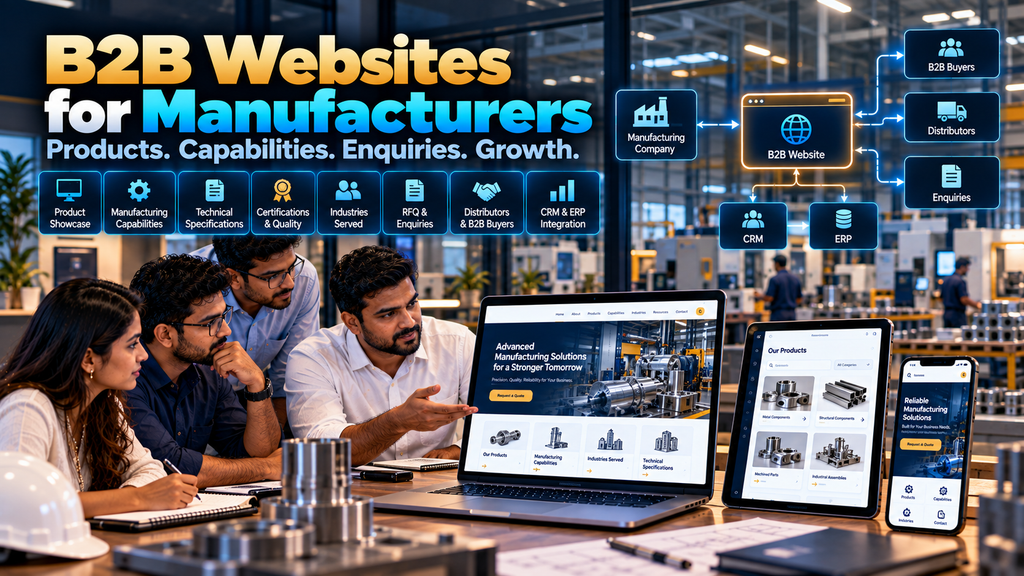
A manufacturing website should do more than display a company name, factory photograph and contact number.
For many manufacturers, the website is one of the first places a potential buyer, distributor, dealer, sourcing team or business partner will visit before starting a conversation.
Professional B2B website development for manufacturers in Erode should therefore focus on communicating what the company manufactures, its capabilities, the industries it serves, technical product information and how an interested buyer can make an enquiry.
The website may also need to support product catalogues, downloadable documents, Request for Quotation (RFQ) workflows, dealer enquiries, SEO, CRM connections and other business systems.
This guide explains how manufacturers can plan a B2B website around real buyer requirements instead of building a generic corporate website.
At Greap Technologies, we develop websites, ecommerce platforms and custom software solutions for businesses and manufacturers in Erode and nearby industrial areas.
What Is a B2B Manufacturing Website?
A B2B manufacturing website is designed primarily to communicate with other businesses rather than only individual retail consumers.
Potential visitors can include:
- Procurement teams
- Business owners
- Wholesalers
- Distributors
- Dealers
- Importers
- Export buyers
- Project contractors
- OEM customers
- Industrial buyers
- Engineers and technical evaluators
These visitors may require significantly more information than a consumer browsing a simple promotional website.
Why Manufacturers in Erode Need a Professional B2B Website
Erode and surrounding areas include businesses operating across manufacturing, textiles, construction materials, engineering, food products, machinery, agricultural products, industrial supplies and distribution.
A website can help a manufacturer clearly present its business to potential buyers who discover the company through search, referrals, advertisements, exhibitions, sales outreach or other channels.
A typical B2B journey might be:
Search / Referral / Sales Outreach → Website → Product or Capability → Technical Evaluation → RFQ / Enquiry → Sales Follow-Up → Quotation
The website should support this journey.
1. Start With the Manufacturer’s Business Model
Before designing pages, understand how the company sells.
For example:
- Direct to businesses
- Through dealers
- Through distributors
- Wholesale
- OEM manufacturing
- Contract manufacturing
- Project-based supply
- Export
- A combination of these models
The website structure should reflect the actual sales model.
2. Identify the Target B2B Buyer
Manufacturers should define who they want the website to attract.
Possible audiences include:
- Local buyers
- Indian businesses
- International buyers
- Dealers
- Distributors
- Architects
- Contractors
- Procurement departments
- Industrial buyers
- OEM partners
A website attempting to speak to everybody can become too generic to communicate effectively with anyone.
3. Understand What B2B Buyers Want to Know
A potential buyer may want answers to questions such as:
- What does the company manufacture?
- Which product categories are available?
- What manufacturing capabilities are available?
- Which industries are served?
- Are custom requirements supported?
- What technical specifications are available?
- Where does the company supply?
- How can a quotation be requested?
Your website should make important answers easy to find.
4. Build the Website Around Buyer Intent
Do not structure the website only around internal company departments.
Think about how a potential customer searches.
A buyer may search for:
- A specific product
- A product specification
- A manufacturer
- A supplier
- A manufacturing capability
- An OEM partner
- A wholesale supplier
- A solution for an industry
5. Create a Clear Homepage
The homepage should quickly communicate:
- What the company manufactures
- Who it serves
- Important product categories
- Manufacturing capabilities
- Industries served
- Relevant business information
- How to make an enquiry
A visitor should not need to search through multiple sections just to understand what the company does.
6. Product Category Pages
Manufacturers with multiple product groups should organize products into logical categories.
For example:
Products → Category → Product → Technical Information → Request Quote
This is usually easier to navigate than placing every product on a single page.
7. Individual Product Pages
Important products can have dedicated pages containing useful buyer information.
Depending on the product, a page may include:
- Product name
- Product images
- Description
- Applications
- Materials
- Dimensions
- Specifications
- Variants
- Technical information
- Downloads
- RFQ or enquiry CTA
Only information genuinely applicable to the product should be displayed.
8. Avoid Thin Product Pages
Creating hundreds of pages containing only a product name and one sentence may provide little value to potential buyers.
Prioritize useful product information wherever it is available.
9. Manufacturing Capabilities Pages
Some buyers search for manufacturing capabilities rather than finished products.
A capabilities section can explain processes the company genuinely provides.
Depending on the manufacturer, this could include information about:
- Production processes
- Machinery
- Materials handled
- Custom manufacturing
- Quality-control processes
- Production capacity where the business chooses to publish verified information
10. Industries Served Pages
If products serve multiple industries, relevant industry pages can help explain how the company’s capabilities apply to each market.
For example:
Manufacturing Capability → Automotive Application
Manufacturing Capability → Construction Application
Manufacturing Capability → Industrial Application
Create separate industry pages only when there is meaningful information to provide.
11. OEM Manufacturing Information
If the company genuinely supports OEM manufacturing, the website can explain:
- Supported product categories
- Customization process
- Development workflow
- Production considerations
- Quality process
- How buyers can submit requirements
Avoid making capability claims the business cannot verify.
12. Contract Manufacturing Pages
Contract manufacturers can use the website to explain the type of manufacturing work they accept and the process used to evaluate new projects.
A typical enquiry journey could be:
Requirement → Technical Discussion → Feasibility Review → Quotation → Approval → Production Process
13. Custom Manufacturing Enquiries
Custom projects often require more information than a standard contact form.
An enquiry workflow might request relevant details such as:
- Company name
- Contact person
- Product requirement
- Quantity
- Material
- Specifications
- Required timeline
- Drawing or document where appropriate
Forms should request only information genuinely needed at that stage.
14. Request for Quotation Functionality
RFQ functionality can be useful when products cannot be purchased at a fixed public price.
A simple flow could be:
Product → Request Quote → Requirement Details → Sales Team → Quotation
The workflow should match the company’s actual sales process.
15. Multi-Product RFQ
Manufacturers and wholesalers with large catalogues may allow buyers to add several products to an enquiry list before submitting one quotation request.
This can be more convenient than submitting a separate form for every product.
16. Quantity-Based Enquiries
Where relevant, RFQ forms can allow buyers to specify required quantities.
This helps the sales team understand the request before responding.
17. Drawing and Document Uploads
Custom manufacturing enquiries may require buyers to provide technical files.
If file uploads are supported, the website should consider:
- Allowed formats
- File-size limits
- Secure storage
- Access controls
- Validation
- Retention
18. Technical Specification Tables
Industrial buyers often need structured technical information.
Specifications may include relevant:
- Dimensions
- Materials
- Grades
- Models
- Performance characteristics
- Compatibility information
Technical values should come from verified manufacturer information.
19. Downloadable Technical Documents
Where appropriate, product pages can provide approved resources such as:
- Product datasheets
- Technical specifications
- Brochures
- Installation documents
- Approved drawings
Documents should be maintained so visitors are not relying on obsolete technical information.
20. Product Search
A manufacturer with a large catalogue may benefit from internal product search.
Search can potentially use:
- Product names
- Model numbers
- SKUs
- Categories
- Applications
21. Product Filtering
Filters can help buyers narrow large product catalogues.
Relevant filters depend on the product and may include:
- Category
- Material
- Size
- Application
- Product type
- Other meaningful attributes
22. Mobile-Friendly B2B Website Design
B2B buyers do not research only from desktop computers.
The website should work properly on smartphones and tablets.
Check:
- Navigation
- Product pages
- Tables
- Images
- Forms
- Downloads
- RFQ buttons
23. Responsive Technical Tables
Large specification tables can be difficult to use on mobile devices.
Responsive layouts should prevent technical information from breaking the page or becoming unreadable.
24. B2B Website UI/UX
A manufacturing website does not need excessive animation to appear professional.
Good B2B design should prioritize:
- Clear hierarchy
- Professional presentation
- Easy navigation
- Readable technical information
- Strong product imagery
- Useful calls to action
25. Industrial Website Photography
Authentic photography can help buyers understand the company.
Useful photography may include:
- Factory exterior
- Production environment
- Machinery
- Products
- Quality processes
- Packaging
- Warehouse
Images should represent the actual business where presented as company photography.
26. Avoid Fake Factory Images
Do not present unrelated stock factories as if they were your own facilities.
If stock imagery is used decoratively, it should not misrepresent the company’s real capabilities.
27. Company Profile Section
A useful company page can explain:
- Business background
- Manufacturing focus
- Markets served
- Facilities
- Processes
- Company approach
Avoid filling the page with generic statements that could describe almost any company.
28. Certifications and Standards
If the manufacturer holds relevant certifications, verified information can be presented clearly.
Never display certifications, badges or standards that the company does not actually hold or meet.
29. Quality Assurance Information
B2B buyers may want to understand how product quality is managed.
The website can explain genuine quality processes without publishing confidential operational information.
30. Client Logos and Customer Names
Customer logos should be displayed only when the business has appropriate permission.
Do not create fictional client logos or imply commercial relationships that do not exist.
31. Manufacturing Case Studies
Case studies can help explain how the manufacturer handles real requirements when appropriate customer permissions are available.
A case study can cover:
- Requirement
- Challenge
- Approach
- Solution
- Relevant outcome
Confidential customer information should not be published without authorization.
32. Testimonials
Only genuine customer testimonials should be published.
Avoid fabricated quotes, ratings or customer identities.
33. B2B Website SEO
A manufacturing website should be built with search visibility in mind where organic discovery is important.
SEO can involve:
- Keyword research
- Search intent
- Website architecture
- Product-page optimization
- Capability-page optimization
- Technical SEO
- Content
- Internal linking
- Performance
Explore SEO Services.
34. Manufacturing Keyword Research
B2B keyword research should prioritize relevance over search volume alone.
Searches may involve:
- Product + manufacturer
- Product + supplier
- Product + exporter
- Product + wholesale
- Capability + manufacturer
- Material + product
- Industry + product
- Custom manufacturing requirements
35. B2B Search Intent
Manufacturing searches can be highly specific.
A low-volume technical search may be commercially important if it closely matches the manufacturer’s capabilities.
SEO strategy should therefore consider buyer intent rather than targeting only broad high-volume keywords.
36. Product SEO
Important product pages should clearly communicate what the product is and provide useful information.
Optimization can include:
- Descriptive title
- Clear H1
- Useful product description
- Specifications
- Applications
- Relevant images
- Internal links
- RFQ CTA
37. Capability SEO
Manufacturers should not focus only on product names.
If buyers search for manufacturing processes or capabilities the company genuinely provides, dedicated capability pages can potentially address that search intent.
38. Industry-Specific SEO
Industry pages can be useful when the manufacturer genuinely serves a particular industry and has meaningful information to explain.
Avoid creating thin pages for every imaginable industry simply to target keywords.
39. Technical SEO for Manufacturing Websites
Technical SEO can include:
- Crawlability
- Indexability
- Canonical URLs
- XML sitemap
- Robots directives
- HTTPS
- Redirects
- Broken links
- Mobile usability
- Performance
- Structured data where relevant
Read Technical SEO Checklist for Business Websites in Erode.
40. Website Speed
Manufacturing websites often contain large product and factory images.
Images should be prepared appropriately for web use.
Performance work can involve:
- Image compression
- Modern image formats where appropriate
- Correct image dimensions
- Lazy loading where suitable
- Script optimization
- Caching
- Hosting review
Read Website Speed Optimization Services in Erode.
41. Core Web Vitals
Core Web Vitals provide measurements related to loading performance, responsiveness and visual stability.
Manufacturers should treat them as part of the broader website experience rather than chasing a perfect test score without considering actual users.
Read Core Web Vitals Optimization for Business Websites in Erode.
42. Manufacturing Content Marketing
Manufacturers can publish useful content around questions buyers genuinely ask.
Examples include:
- Product selection guides
- Material comparisons
- Application guides
- Technical explanations
- Maintenance information
- Manufacturing-process explanations
- Buyer guides
Technical content should be reviewed by people who understand the company’s products and processes.
43. Build Topical Content Clusters
Content can support important product and capability pages.
For example:
Main Product Category → Product Pages → Technical Guides → Application Guides → RFQ
This creates a useful information journey for potential buyers.
44. International B2B SEO
Manufacturers targeting buyers outside India may require a broader SEO strategy.
Considerations can include:
- Target countries
- Search terminology
- Language
- Product demand
- International website structure
- Shipping or export information
International SEO should be planned according to the actual markets being targeted.
45. Export-Focused Manufacturing Websites
Manufacturers targeting export enquiries can provide relevant information about:
- Products
- Manufacturing capabilities
- Markets served
- Packaging where relevant
- Export enquiry process
- Business contact information
Do not make unsupported export or compliance claims.
46. Multi-Language Websites
Businesses targeting users who genuinely need different languages may consider multilingual content.
Translations should preserve technical accuracy and should not be created only to generate additional pages.
47. Lead Generation Website Design
A B2B website should make the next step clear.
Potential calls to action include:
- Request a Quote
- Send Your Requirement
- Download Product Information
- Contact Sales
- Enquire About This Product
The CTA should match the sales process.
48. Do Not Use the Same CTA Everywhere Without Thinking
A first-time visitor reading a technical article may not be ready to request a quotation immediately.
A product page visitor with a specific requirement may have much stronger commercial intent.
CTA placement should consider page intent.
49. B2B Contact Forms
Contact forms should collect enough information to help sales teams understand an enquiry without creating unnecessary friction.
A general B2B form might include:
- Name
- Company
- Business email
- Phone
- Product or service
- Requirement
50. Phone and Business Messaging
Some buyers may prefer to call or use a supported business messaging channel.
Important contact options should be easy to find, particularly on mobile devices.
51. CRM Integration
Website enquiries can potentially be sent into a CRM or lead-management system.
A possible workflow is:
Website → RFQ → CRM → Sales Assignment → Follow-Up → Quotation → Outcome
Integration depends on the systems, APIs and business requirements involved.
Read WhatsApp CRM and Lead Follow-Up Software for Businesses in Erode.
52. Quotation Software Integration
Where suitable, qualified website enquiries can connect with an internal quotation workflow.
For example:
RFQ → Requirement Review → Quotation → Revision → Approval → Order
Read Quotation and Invoice Management Software Development in Erode.
53. ERP Integration
A B2B website may need to exchange approved information with an ERP or other business system.
Possible integration areas can include:
- Products
- Customers
- Inventory
- Orders
- Order status
Integration feasibility depends on available APIs, permissions and system architecture.
54. Inventory Integration
If stock information is displayed, businesses should clearly define whether inventory is:
- Real-time
- Periodically synchronized
- Manually maintained
Do not describe periodically updated stock as live inventory.
55. Dealer Portal Integration
Manufacturers working through dealer networks may require secure dealer functionality.
Features could include:
- Dealer login
- Product catalogue
- Authorized pricing
- Order placement
- Order history
- Documents
Read Dealer and Distributor Management Software Development in Erode.
56. B2B Ecommerce
Some manufacturers need more than an enquiry website.
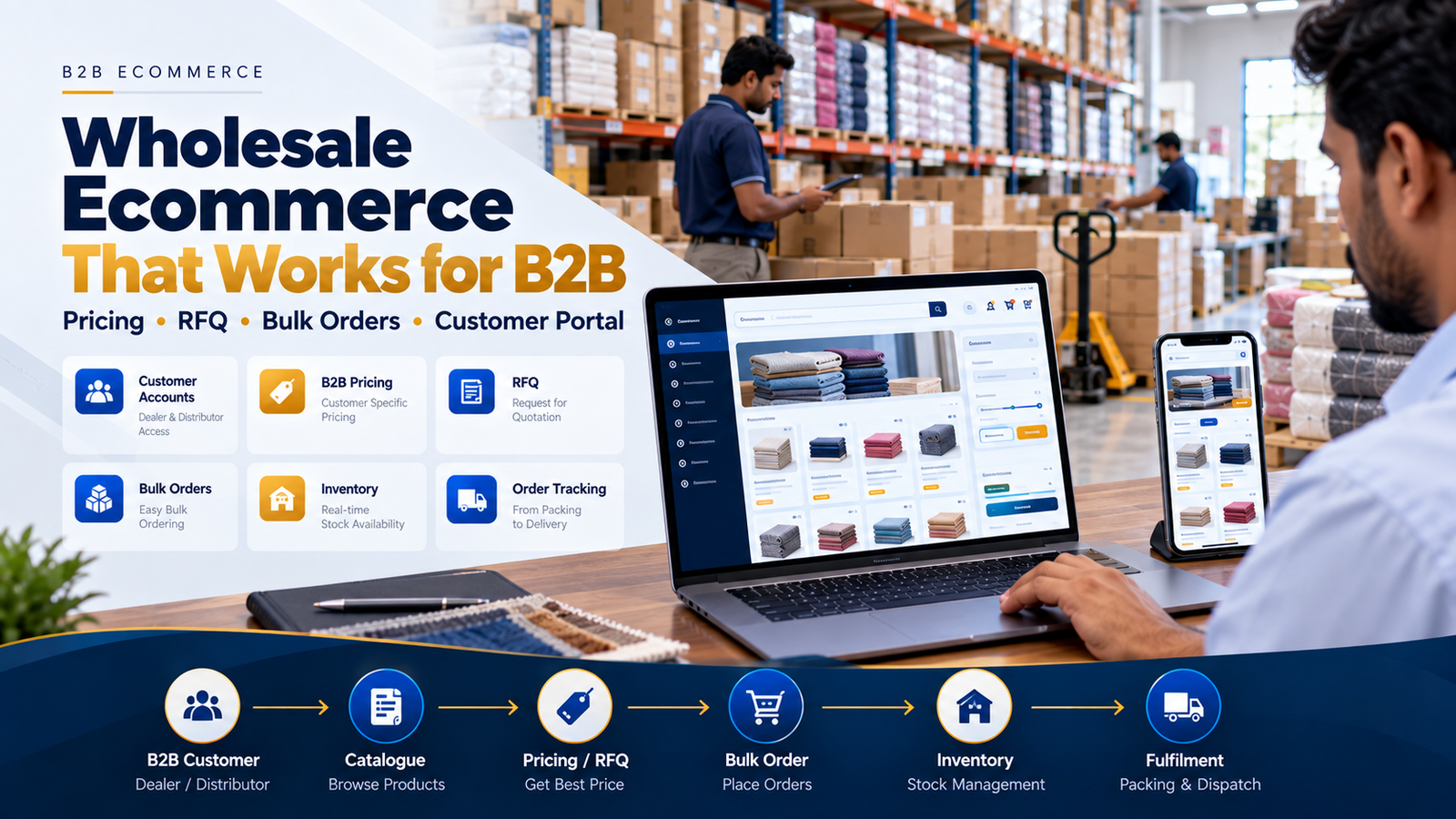
A B2B ecommerce platform can potentially support:
- Business accounts
- Customer-specific pricing
- Minimum order quantities
- Bulk ordering
- Quick reorder
- Quotation workflows
- Purchase orders
- Dealer ordering
Read B2B Ecommerce Website Development for Wholesalers and Manufacturers in Erode.
57. Website vs B2B Ecommerce Platform
| B2B Website | B2B Ecommerce Platform |
|---|---|
| Product and capability information | Product catalogue plus transactional workflows |
| RFQ and enquiries | Orders, quotations or account purchasing |
| Public information focus | Can include customer-specific functionality |
| Suitable for enquiry-led sales | Suitable when digital ordering is required |
The correct approach depends on how the manufacturer sells.
58. Website Security
A professional manufacturing website should include appropriate security practices.
Depending on the platform, this can involve:
- HTTPS
- Secure administration
- Strong authentication
- Software updates
- Backups
- Form validation
- File-upload controls
- Access permissions
59. Website Backups
Backup procedures should be appropriate to the website and its rate of change.
Businesses should understand:
- What is backed up
- How frequently
- Where backups are stored
- How restoration works
60. Analytics
Website analytics can help manufacturers understand how visitors interact with the website.
Useful information can include:
- Traffic sources
- Important landing pages
- Product-page usage
- RFQ submissions
- Other defined conversions
61. Measure Enquiries, Not Only Traffic
Website traffic can be useful, but a B2B manufacturer should also understand whether relevant visitors are reaching important products and generating genuine business enquiries.
More traffic does not automatically mean more qualified opportunities.
62. Connect Website Leads With Sales Outcomes
Where practical, the manufacturer can track what happens after an enquiry.
For example:
Website Lead → Qualified / Not Qualified → Quotation → Negotiation → Order / Closed
This can provide more useful feedback than evaluating website sessions alone.
63. Website Maintenance
Manufacturing websites require ongoing maintenance.
Work may include:
- Security updates
- Backups
- Bug fixes
- Product updates
- Content changes
- Technical SEO monitoring
- Performance improvements
Read Website Maintenance Services in Erode: What Businesses Need.
64. Keep Product Information Updated
A technically perfect website can still create problems if its product information is outdated.
Create an internal process for updating:
- Products
- Specifications
- Documents
- Contact information
- Business capabilities
65. Plan for Future Expansion
A website should be capable of supporting reasonable future requirements.
Potential expansion might include:
- New products
- New product categories
- Additional industries
- New markets
- Dealer functionality
- Customer accounts
- B2B ecommerce
- CRM or ERP integrations
This does not mean every possible feature needs to be built during version one.
66. Custom Website vs WordPress for Manufacturers
Both WordPress and custom development can be suitable for manufacturing websites.
The choice depends on requirements.
WordPress may suit many content-focused corporate and product websites, while custom development may become relevant when specialized workflows, integrations or application-like functionality are required.
Read Custom Website vs WordPress: Which Is Better for Your Business?.
67. How Much Does a Manufacturing Website Cost in Erode?
There is no single price for B2B manufacturing website development.
Cost can depend on:
- Number of pages
- Number of products
- Custom UI/UX
- Product catalogue complexity
- Technical specification data
- RFQ functionality
- File uploads
- Search and filtering
- Multilingual requirements
- SEO scope
- CRM integration
- ERP integration
- Dealer functionality
- B2B ecommerce
- Content requirements
A simple company website and a large industrial catalogue connected to business software are very different projects.
68. Compare Website Scope, Not Just Price
Two quotations for a “manufacturing website” can include very different deliverables.
One might include only a template and several basic pages.
Another might include:
- Requirement analysis
- Custom UI/UX
- Product architecture
- RFQ functionality
- SEO foundations
- Performance optimization
- CRM integration
- Testing
- Post-launch support
Compare the actual scope before comparing the final amount.
69. How Long Does Manufacturing Website Development Take?
Timeline depends on factors such as:
- Website size
- Product catalogue
- UI/UX requirements
- Content availability
- Technical specifications
- Integrations
- Feedback
- Testing
A realistic timeline should be estimated after requirements are understood.
70. Manufacturing Website Development Process
A structured project can follow:
Business Discovery → Buyer Research → Website Architecture → Content Planning → UI/UX → Development → Product Setup → SEO → Integrations → Testing → Launch → Maintenance
71. Business Discovery
The development company should first understand:
- What the company manufactures
- Who buys the products
- How sales currently happen
- Which markets are important
- Which products need priority
- What systems are already used
72. Website Architecture Planning
Before visual design, define the site’s hierarchy.
For example:
Home
Products → Categories → Products
Capabilities → Individual Capabilities
Industries → Industry Pages
Resources → Technical Guides
About → Company / Quality
Contact → RFQ
73. Content Collection
Manufacturing projects often slow down because product information is scattered across spreadsheets, catalogues, PDFs and employee knowledge.
Collect important information early, including:
- Product names
- Descriptions
- Specifications
- Images
- Documents
- Capabilities
- Industry information
- Verified company information
74. Development
After structure and designs are approved, the website can be developed with the required content-management, catalogue, RFQ and integration functionality.
75. Testing
Before launch, test:
- Desktop layouts
- Mobile layouts
- Navigation
- Product pages
- Search
- Filters
- Forms
- RFQ workflows
- File uploads
- Downloads
- Integrations
- Important SEO configurations
76. Post-Launch Review
After launch, verify that:
- Important pages are accessible
- Forms work
- RFQs reach the correct team
- Analytics records intended events
- Redirects work where required
- Sitemap configuration is correct
- No important production errors are present
How to Choose a B2B Website Development Company in Erode
Manufacturers should look beyond visual design alone.
Evaluate whether the development company understands:
- B2B customer journeys
- Manufacturing websites
- Product architecture
- Technical information
- RFQ workflows
- Responsive design
- SEO
- Performance
- CRM and ERP integration
- Website maintenance
Read Web Development Company in Erode: How to Choose the Right Development Partner.
Questions Manufacturers Should Ask a Website Development Company
- How will you understand our products and customers?
- How should our product catalogue be structured?
- Do important products need individual pages?
- How will technical specifications be presented?
- Can buyers request quotations from product pages?
- Can several products be added to one RFQ?
- Can buyers upload requirement documents?
- How will the website work on mobile?
- What SEO foundations are included?
- How will product pages be optimized?
- Can enquiries connect to our CRM?
- Can the website integrate with our ERP?
- Who will own the domain, website and data?
- How will the website be maintained?
- How will future products be added?
- What support is available after launch?
B2B Manufacturing Website Checklist
| Area | What to Check |
|---|---|
| Business Positioning | Can visitors quickly understand what the company manufactures? |
| Products | Are product categories and pages logically structured? |
| Technical Information | Can buyers find relevant specifications? |
| Capabilities | Are genuine manufacturing capabilities explained? |
| RFQ | Can interested buyers submit useful requirements? |
| Mobile | Do catalogue and technical pages work properly on mobile? |
| SEO | Can important pages be crawled and understood? |
| Performance | Are heavy industrial images appropriately optimized? |
| Integrations | Can required CRM or ERP connections be supported? |
| Maintenance | Can products, documents and software be kept current? |
Common Manufacturing Website Mistakes
- Using only a generic company profile
- Hiding products inside downloadable PDFs
- Providing almost no technical product information
- Using poor-quality or misleading factory imagery
- Creating thin product pages
- Ignoring mobile users
- Using difficult RFQ forms
- Ignoring website speed
- Ignoring technical SEO
- Publishing outdated specifications
- Using fake certifications or customer logos
- Not tracking enquiries
- Not connecting website leads with sales follow-up
- Not planning website maintenance
B2B Website Development in Erode and Nearby Industrial Areas
Greap Technologies provides website, ecommerce and custom software development services for manufacturers and businesses in Erode and nearby areas including Perundurai, Bhavani, Chennimalai, Gobichettipalayam, Sathyamangalam, Anthiyur, Modakkurichi, Kavindapadi, Kodumudi, Nambiyur and surrounding locations.
Local targeting should reflect genuine service coverage and useful business information rather than repeating town names unnaturally throughout the website.
Why Consider Greap Technologies for a Manufacturing Website?
Greap Technologies develops business websites and custom digital systems based on the company’s products, customers and sales process.
Depending on project requirements, a manufacturing website can include:
- Custom website design
- Responsive development
- Product catalogues
- Product detail pages
- Technical specifications
- Manufacturing capability pages
- Industry pages
- RFQ functionality
- File uploads
- Product search and filtering
- SEO foundations
- Website performance optimization
- CRM integration
- ERP integration
- Dealer functionality
- B2B ecommerce
- Analytics
- Maintenance and support
The appropriate website architecture should be selected after understanding the manufacturer’s products, buyers, sales process and technical requirements.
Explore Website Development Services, SEO Services, Ecommerce Development Services, Digital Marketing Services and Greap Technologies.
Final Checklist Before Developing a Manufacturing Website
Before development begins, confirm:
- Target buyers
- Target markets
- Product categories
- Priority products
- Manufacturing capabilities
- Industries served
- Technical information
- Product images
- Downloadable documents
- RFQ requirements
- SEO requirements
- CRM requirements
- ERP requirements
- Dealer requirements
- Analytics
- Website ownership
- Maintenance responsibilities
Conclusion
Effective B2B website development for manufacturers in Erode is not simply about creating an attractive company website.
The website should connect the manufacturer’s capabilities with the information potential buyers need to evaluate the business.
A strong B2B journey can look like:
Search / Referral → Product or Capability → Technical Information → Trust → RFQ → Sales Follow-Up → Quotation
For manufacturers with more advanced digital operations, it may extend further:
Website → RFQ → CRM → Quotation System → ERP → Sales Process
The appropriate solution depends on how the manufacturer sells, the complexity of its catalogue, its target markets and the systems already used by the business.
Instead of beginning with visual design alone, manufacturers should first define their buyers, products, capabilities, technical information and enquiry process. The website can then be designed around that commercial journey.
Looking for B2B Website Development for Your Manufacturing Company in Erode?
If your manufacturing business needs a professional product website, industrial catalogue, RFQ system, dealer portal or B2B ecommerce platform, Greap Technologies can discuss your requirements and plan an appropriate website architecture.
Discuss Your Manufacturing Website on WhatsApp
Frequently Asked Questions
1. What is B2B website development for manufacturers?
B2B website development for manufacturers involves creating a website around business buyers, products, manufacturing capabilities, technical information, RFQ workflows and the manufacturer’s sales process rather than building only a basic company-profile website.
2. What pages should a manufacturing website have?
The appropriate structure depends on the business, but common sections can include products, product categories, manufacturing capabilities, industries served, company information, technical resources, RFQ and contact pages.
3. How much does a manufacturing website cost in Erode?
Cost depends on the number of pages and products, custom design, product catalogue complexity, RFQ functionality, technical data, SEO, multilingual requirements, CRM or ERP integrations and other custom functionality.
4. Can a manufacturing website generate B2B leads?
A website can support B2B lead generation by helping relevant buyers discover and evaluate products or capabilities and providing clear enquiry paths. Lead volume or sales cannot be guaranteed because results also depend on demand, visibility, competition, offer and sales follow-up.
5. Should every manufacturing product have its own page?
Not necessarily. Important products can benefit from dedicated pages when enough useful information exists. Closely related variants may sometimes be better organized within a product family rather than creating many thin pages.
6. Can buyers request quotations through the website?
Yes. RFQ functionality can allow buyers to submit product requirements, quantities and other relevant information. The workflow should match the manufacturer’s actual quotation process.
7. Can a manufacturing website integrate with ERP software?
Potentially. Integration feasibility depends on the ERP system, available APIs or supported integration methods, permissions and the information that needs to be exchanged.
8. Can a B2B website connect with a CRM?
Yes, where the CRM provides suitable integration capabilities. Website enquiries can potentially be captured, assigned and followed through a CRM workflow.
9. Is SEO important for manufacturing websites?
SEO can be important when potential buyers search online for products, suppliers, manufacturers or capabilities. The strategy should prioritize relevant buyer searches rather than search volume alone.
10. Do manufacturing websites need ecommerce?
Not always. Many manufacturers operate through RFQs and quotations. B2B ecommerce becomes relevant when customers need functionality such as online ordering, business accounts, customer-specific pricing, bulk quantities or quick reordering.
11. Should a manufacturing website be mobile-friendly?
Yes. Product pages, technical information, navigation, RFQ forms and contact options should work properly across supported mobile, tablet and desktop screen sizes.
12. Does Greap Technologies develop B2B manufacturing websites in Erode?
Yes. Greap Technologies provides website, ecommerce and custom software development solutions for manufacturers and other businesses in Erode and nearby areas.