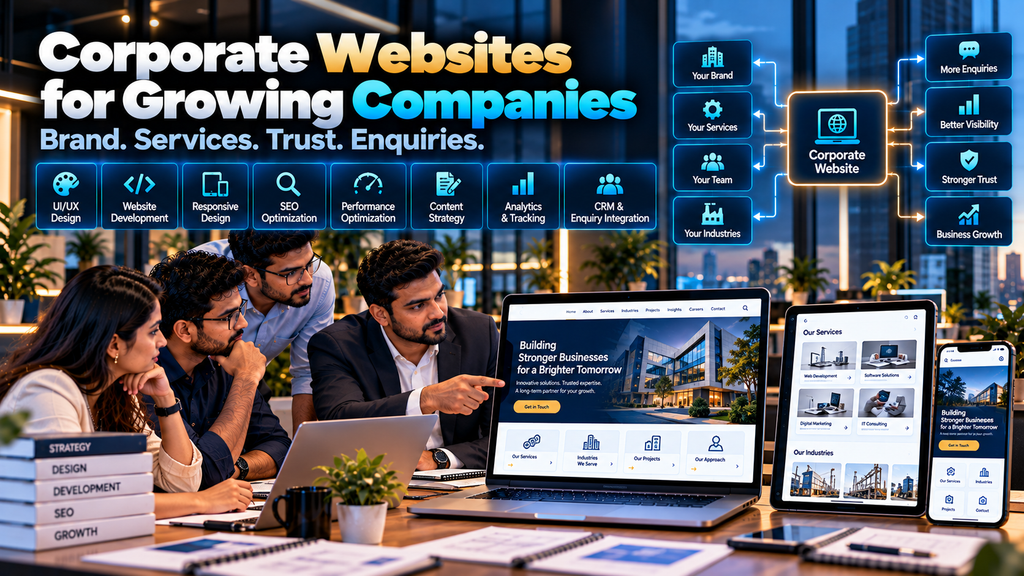
A corporate website is often one of the first places customers, suppliers, business partners, job candidates and other stakeholders visit when they want to understand a company.
For growing businesses, a website should therefore do more than display a company name, a few services and a contact form.
Professional corporate website development in Erode should communicate what the company does, who it serves, its capabilities, services, experience and how an interested visitor can take the next step.
The website should also work properly across mobile, tablet and desktop devices while providing a solid foundation for SEO, website performance, security, analytics and future expansion.
This guide explains what companies should consider when planning a corporate website, which pages and features may be required, what affects development cost and how to choose a suitable website development company.
At Greap Technologies, we develop corporate websites, business websites, ecommerce platforms and custom digital solutions for companies in Erode and surrounding areas.
What Is a Corporate Website?
A corporate website is the official digital presence of a company.
It can communicate information about:
- The company
- Products and services
- Capabilities
- Industries served
- Locations
- Projects or work
- Resources
- Careers
- Business enquiries
The exact structure depends on the company and the audiences it needs to serve.
Corporate Website vs Basic Business Website
A small business website may require only a few pages covering services, company information and contact details.
A corporate website can require a broader information architecture involving multiple services, business divisions, industries, locations, resources, recruitment information, integrations and content-management workflows.
The distinction is based more on business requirements than the number of employees.
Why Companies in Erode Need a Professional Corporate Website
Companies in Erode operate across manufacturing, textiles, construction, technology, retail, distribution, professional services, education, healthcare and many other sectors.
A potential customer may discover a company through search, a referral, sales outreach, advertising, social media, an exhibition or an offline business interaction.
In many of these situations, the next step is visiting the company’s website.
A typical journey may look like:
Discovery → Website → Company / Service Evaluation → Trust → Enquiry → Sales Follow-Up
The corporate website should support this evaluation process.
1. Define the Purpose of the Corporate Website
Before discussing colours, animations or layouts, determine what the website needs to accomplish.
Possible objectives include:
- Present the company professionally
- Explain services
- Show products or capabilities
- Generate business enquiries
- Support B2B sales
- Attract distributors or partners
- Support recruitment
- Publish company information
- Build organic search visibility
- Support multiple business divisions
The website architecture should follow these objectives.
2. Identify the Website’s Audiences
A corporate website can serve several audiences.
These may include:
- Potential customers
- Existing customers
- Suppliers
- Dealers and distributors
- Business partners
- Job applicants
- Investors or other stakeholders where applicable
Not every visitor needs the same information.
3. Define the Main Customer Journey
For a lead-generation corporate website, an important journey might be:
Search → Service Page → Company Evaluation → Relevant Evidence → Contact → Sales Follow-Up
For a manufacturer, the journey might instead be:
Product Search → Product / Capability → Technical Information → RFQ → Sales Team
Website design should support the company’s real buying process.
4. Plan the Website Architecture Before Designing It
Website architecture determines how pages and information are organized.
A corporate structure might look like:
Home
About
Services → Individual Service Pages
Industries → Individual Industry Pages
Projects / Case Studies
Insights / Blog
Careers
Contact
Product-based businesses may require additional product and category sections.
5. Design a Clear Corporate Homepage
The homepage should help visitors quickly understand the business.
Important sections can include:
- Clear company positioning
- Primary services or products
- Industries served
- Important capabilities
- Relevant company information
- Projects or case studies where appropriate
- Useful resources
- Contact CTA
A visitor should not need to interpret vague marketing language to determine what the company actually provides.
6. Write a Clear Hero Section
The hero section is usually one of the first elements visitors see.
It should clearly communicate:
- What the company provides
- Who it serves where relevant
- The primary next action
Clarity is generally more useful than complicated slogans that provide little information about the business.
7. Create a Useful About Page
A corporate About page should help visitors understand the organization rather than simply stating that it provides excellent quality and customer satisfaction.
Depending on the company, it may cover:
- Company background
- What the business does
- Markets served
- Capabilities
- Company approach
- Leadership information where appropriate
- Locations
8. Build Dedicated Service Pages
If a company provides several important services, each major service can have its own useful page.
A service page might explain:
- What the service is
- Who it is for
- Problems it addresses
- Scope
- Process
- Relevant capabilities
- Related services
- How to enquire
9. Avoid Putting Every Service on One Page
A single page containing a few sentences about ten different services may not provide enough information for users evaluating a particular service.
Important services can be developed into dedicated pages when enough meaningful information exists.
10. Product-Based Corporate Websites
Companies selling or manufacturing products may need:
- Product categories
- Individual product pages
- Specifications
- Applications
- Downloads
- Product search
- Filtering
- Enquiry or RFQ functionality
Read B2B Website Development for Manufacturers in Erode.
11. Industry Pages
Companies serving multiple industries may use dedicated industry pages to explain how relevant services or products apply to those sectors.
However, each page should contain useful industry-specific information.
Avoid creating near-identical pages simply to increase the number of URLs.
12. Capability Pages
Companies with specialist capabilities can explain them separately from general services.
This is particularly useful for manufacturing, engineering, technology and B2B businesses where buyers evaluate technical capability before contacting a supplier.
13. Corporate Projects and Portfolio
Where appropriate, a projects or portfolio section can help potential customers understand the type of work a company performs.
Each project can include information such as:
- Project context
- Requirement
- Scope
- Approach
- Relevant deliverables
Publish only information the company is authorized to share.
14. Case Studies
Case studies can provide more context than a simple project gallery.
A useful structure can be:
Business Requirement → Challenge → Approach → Solution → Supported Outcome
Any performance or business-result claims should be based on information the company can substantiate.
15. Client Logos
Client logos can provide context about the organizations a company has worked with, but they should only be displayed when appropriate permission exists.
Do not use fabricated logos or imply relationships that do not exist.
16. Testimonials
Customer testimonials should be genuine and presented accurately.
Avoid fabricated testimonials, invented customer names or misleading ratings.
17. Certifications
Companies with genuine certifications or relevant accreditations may present them on the website where appropriate.
Only current and verifiable information should be displayed.
18. Leadership and Team Information
Depending on the company, leadership or team information can help visitors understand who is behind the organization.
The level of information published should follow the company’s communication and privacy preferences.
19. Careers Section
Growing companies may need a dedicated careers area.
It can include:
- Company work environment
- Open positions
- Job descriptions
- Application process
- Application forms
Recruitment forms should request only information reasonably needed for the hiring process.
20. Contact Page
The contact page should make legitimate business contact information easy to find.
Depending on the company, this can include:
- Phone
- Business email
- Office address
- Contact form
- Business hours
- Map where useful
21. Corporate Enquiry Forms
Forms should collect enough information for the company to understand the enquiry without creating unnecessary friction.
A general corporate enquiry form might request:
- Name
- Company
- Business email
- Phone
- Service or requirement
- Message
22. Create Relevant Calls to Action
Calls to action should match the purpose of the page.
Examples can include:
- Discuss Your Requirement
- Request a Quote
- Contact Our Team
- View Our Services
- Explore Products
- Send an Enquiry
23. Do Not Overload Every Section With CTAs
Calls to action should be visible without making the website feel aggressive or difficult to read.
Use stronger CTAs at natural decision points.
24. Corporate UI/UX Design
A professional corporate website should balance brand identity with usability.
Important considerations include:
- Clear visual hierarchy
- Consistent typography
- Brand colours
- Readable layouts
- Logical navigation
- Professional imagery
- Consistent components
- Accessible interaction patterns
25. Avoid Designing Only for Appearance
A visually impressive website can still perform poorly as a business tool if visitors cannot find services, understand the company or contact the right team.
Design decisions should support communication and usability.
26. Use the Company’s Existing Brand System
If the company already has defined branding, website design should use it consistently.
This can include:
- Logo
- Colours
- Typography
- Photography direction
- Graphic style
- Tone of communication
27. Responsive Website Development
A corporate website should adapt properly across supported screen sizes.
Test:
- Desktop
- Laptop
- Tablet
- Mobile
Responsive development should consider more than simply shrinking the desktop layout.
28. Mobile Navigation
Mobile visitors should be able to find important information without navigating through a confusing menu.
Prioritize key services, products, contact information and important calls to action.
29. Mobile Forms
Corporate enquiry forms should be comfortable to complete on mobile devices.
Use appropriate field types, clear labels and reasonable form length.
30. Website Accessibility
Accessibility should be considered during design and development.
Useful practices can include:
- Semantic page structure
- Keyboard-friendly interactions
- Clear form labels
- Readable contrast
- Descriptive link text
- Alternative text for meaningful images
31. Corporate Website SEO
A corporate website should be developed with a search-friendly foundation when organic visibility matters to the business.
SEO can involve:
- Website architecture
- Keyword research
- Search intent
- Service-page optimization
- Technical SEO
- Internal linking
- Content strategy
- Website performance
Explore SEO Services in Erode.
32. Keyword Research Before Building Pages
SEO research can help identify how potential customers describe services and problems.
This information can support decisions about:
- Website structure
- Service pages
- Page terminology
- Supporting content
Keyword research should not turn the website into repetitive search-engine copy.
33. Search Intent
Different searches indicate different needs.
For example:
“What is ERP software?” is primarily informational.
“Software development company in Erode” has stronger commercial intent.
The website should provide suitable pages for important customer intentions.
34. Service Page SEO
Important services should have enough information to help both potential customers and search systems understand the page.
Relevant elements can include:
- Descriptive title
- Clear H1
- Service explanation
- Scope
- Process
- Relevant internal links
- Useful CTA
35. Technical SEO
Technical SEO considerations can include:
- Crawlability
- Indexability
- Canonical URLs
- XML sitemap
- Robots directives
- HTTPS
- Redirects
- Broken links
- Mobile usability
- Structured data where appropriate
- Website performance
Read Technical SEO Checklist for Business Websites in Erode.
36. Internal Linking
Internal links should connect related information naturally.
For example:
Homepage → Service → Related Case Study → Supporting Blog → Contact
This helps visitors continue researching without repeatedly returning to the main navigation.
37. Content Marketing
A corporate website can use articles, guides and resources to answer questions potential customers ask before contacting a provider.
Topics can include:
- Buyer guides
- Service comparisons
- Industry explanations
- Technical guides
- Implementation considerations
- Frequently asked questions
38. Avoid Publishing Blogs Without a Strategy
Publishing large numbers of unrelated articles is not automatically useful.
Content should support topics relevant to the company’s products, services, customers and expertise.
39. Local SEO for Erode Companies
Companies serving customers within Erode and nearby areas may also need local SEO.
This can involve:
- Accurate business information
- Relevant local service content
- Business profile management
- Genuine customer reviews
- Relevant citations
- Local website relevance
Read How to Improve Google Rankings for a Local Business in Erode.
40. Avoid Location Keyword Stuffing
Repeating “Erode” in every paragraph does not make a page more useful.
Local relevance should be communicated naturally through genuine company, service and location information.
41. Website Speed
Corporate websites often contain large hero images, videos, animations and third-party scripts.
These elements should be implemented carefully so they do not unnecessarily reduce performance.
Read Website Speed Optimization Services in Erode.
42. Image Optimization
Images can be optimized through techniques such as:
- Appropriate dimensions
- Compression
- Modern formats where suitable
- Responsive image delivery
- Lazy loading where appropriate
43. Core Web Vitals
Core Web Vitals measure aspects of loading performance, responsiveness and visual stability.
They should be considered alongside the overall website experience rather than treated as the only performance objective.
Read Core Web Vitals Optimization for Business Websites in Erode.
44. Website Security
Security requirements depend on the platform and functionality.
Common considerations include:
- HTTPS
- Secure administration
- Strong authentication
- Software updates
- Access permissions
- Input validation
- Backups
- Dependency management
45. Website Backups
A company should understand:
- What is backed up
- How often backups are created
- Where backups are stored
- How restoration is performed
Backup strategy should reflect how frequently the website changes.
46. Content Management System
A CMS can allow authorized company staff to manage selected website content.
Depending on requirements, this can include:
- Pages
- Blogs
- Projects
- Careers
- Products
- Downloads
Editing permissions should be assigned appropriately.
47. WordPress Corporate Websites
WordPress can be suitable for many corporate websites, particularly where content management is an important requirement.
Its suitability depends on the website’s functionality, integrations, security requirements and long-term maintenance plan.
48. Custom Corporate Website Development
Custom development may be considered when a company requires specialized functionality, workflows or integrations that are not well served by a standard content-management setup.
Read Custom Website vs WordPress: Which Is Better for Your Business?.
49. Corporate Website Integrations
A corporate website can sometimes connect with other business systems.
Potential integrations include:
- CRM
- ERP
- Lead management
- Recruitment systems
- Marketing platforms
- Quotation systems
- Customer portals
Feasibility depends on available APIs, supported integration methods, permissions and the systems involved.
50. CRM Integration
Website enquiries can potentially be transferred to a CRM for assignment and follow-up.
A workflow might look like:
Website → Enquiry → CRM → Salesperson → Follow-Up → Outcome
Read WhatsApp CRM and Lead Follow-Up Software for Businesses in Erode.
51. Quotation Workflow Integration
B2B companies may want qualified enquiries to move into a quotation process.
For example:
Website Enquiry → Requirement Review → Quotation → Revision → Approval
Read Quotation and Invoice Management Software Development in Erode.
52. Business Messaging Integration
A website can provide convenient links to supported business messaging channels where appropriate.
Advanced automated messaging should use official supported technologies and follow applicable platform requirements.
53. Analytics
Analytics can help a company understand how visitors reach and use the website.
Useful measurements may include:
- Traffic sources
- Landing pages
- Service-page engagement
- Contact-form submissions
- Other defined business conversions
54. Measure Business Actions, Not Only Visitors
A corporate website should not be evaluated only by total traffic.
Where appropriate, measure actions that connect more closely with business objectives.
For example:
Organic Search → Service Page → Enquiry → Qualified Lead → Sales Outcome
55. Corporate Website Redesign
An older corporate website may require redesign when it no longer accurately represents the business or creates usability and technical problems.
Possible reasons include:
- Outdated company information
- Poor mobile usability
- Confusing navigation
- Slow performance
- Difficult content management
- Outdated design
- Missing service information
- Technical SEO problems
56. Protect SEO During a Redesign
Replacing a website without reviewing existing URLs can affect organic search visibility.
Before migration, review:
- Existing valuable pages
- URLs
- Page content
- Metadata
- Internal links
- Redirect requirements
- Canonical URLs
- Sitemap configuration
57. Corporate Website Maintenance
A website continues to require attention after launch.
Maintenance can include:
- Updates
- Security checks
- Backups
- Bug fixes
- Content changes
- Performance monitoring
- Technical SEO checks
Read Website Maintenance Services in Erode: What Businesses Need.
58. Website AMC
Companies that need structured ongoing website support may consider an annual maintenance arrangement.
The scope should clearly define what is included and what is treated as new development.
Read Website AMC Services in Erode: Cost, Scope and Benefits.
59. Website Ownership
Before beginning a project, clarify ownership and access arrangements for important assets.
These may include:
- Domain
- Hosting
- Website administration
- Source code where applicable
- Content
- Analytics
- Other integrated accounts
60. Hosting
Hosting requirements depend on factors such as:
- Technology stack
- Traffic
- Website functionality
- Storage
- Security
- Performance requirements
The hosting solution should match the project rather than being selected only by the cheapest available plan.
61. Scalability
A corporate website should support reasonable future expansion.
Potential additions may include:
- New services
- New products
- New industries
- New locations
- Additional languages
- Customer portals
- CRM integrations
- Other business systems
However, version one does not need every feature the company might possibly use years later.
62. Multi-Location Corporate Websites
Companies operating genuine offices or branches in multiple locations may need location information or dedicated pages.
Each location page should provide useful and accurate information rather than simply duplicating the same content with a different city name.
63. Multilingual Corporate Websites
A multilingual website may be appropriate when important audiences genuinely use different languages.
Translation should preserve business and technical accuracy.
64. Corporate Website Content
Website copy should clearly explain the business rather than relying entirely on generic phrases such as “world-class solutions” or “customer-centric excellence.”
Useful content answers real questions about:
- What the company provides
- Who it serves
- How services work
- Relevant capabilities
- Why the service may fit a particular requirement
- How to contact the company
65. Company Photography
Where possible, genuine business photography can help represent the company accurately.
Potential subjects include:
- Office
- Facility
- Team
- Products
- Projects
- Work environment
66. Avoid Misleading Stock Imagery
Stock imagery can be useful as a supporting design element, but it should not imply that an unrelated office, factory, employee or project belongs to the company.
67. Corporate Website Development Cost in Erode
There is no single fixed cost suitable for every corporate website.
Development cost can depend on:
- Number of pages
- Custom UI/UX
- Content requirements
- Product catalogue
- Project or case-study functionality
- Careers functionality
- Multilingual requirements
- SEO scope
- CRM or ERP integration
- Custom functionality
- Hosting requirements
- Maintenance and support
A small corporate website and a large multi-division website with integrations should not be expected to have the same scope or cost.
68. Why Corporate Website Quotations Differ
Two proposals labelled “corporate website development” may contain very different deliverables.
One may use an existing template with basic content entry.
Another may include:
- Business discovery
- Information architecture
- Custom UI/UX
- Responsive development
- Content support
- SEO foundations
- Performance optimization
- Analytics
- Integrations
- Testing
- Post-launch support
Compare scope before comparing only the final price.
69. Corporate Website Development Timeline
Development time depends on factors such as:
- Website size
- Design complexity
- Content readiness
- Number of stakeholders
- Custom functionality
- Integrations
- Feedback and approvals
- Testing
A realistic schedule should be determined after the requirements and approval process are understood.
70. Corporate Website Development Process
A structured process can follow:
Business Discovery → Requirements → Website Architecture → Content Planning → UI/UX → Development → SEO Foundations → Integrations → Testing → Launch → Support
71. Business Discovery
The development team should understand:
- The company
- Services or products
- Target customers
- Markets
- Business objectives
- Current website problems
- Required integrations
- Future requirements
72. Wireframing and Information Architecture
For larger corporate websites, planning page structure and important user journeys before detailed visual design can reduce confusion later in the project.
73. UI/UX Design
Once the structure is defined, the visual system can be designed around the company’s brand and content requirements.
Important templates may include:
- Homepage
- Service page
- Industry page
- Project page
- Blog article
- Careers page
- Contact page
74. Development
The approved designs can then be implemented using a technology stack suitable for the website’s requirements.
The technology should be chosen based on the project rather than because one platform is universally best.
75. Content Integration
Content should be reviewed during development to ensure headings, images, tables, downloads, links and calls to action work correctly within the layouts.
76. Website Testing
Before launch, test important areas including:
- Responsive layouts
- Navigation
- Links
- Forms
- Buttons
- Downloads
- Content
- Integrations
- Browser behaviour
- Important SEO configurations
77. Launch
Launch should include appropriate production configuration and verification.
If an existing website is being replaced, redirects and migration requirements should be implemented carefully.
78. Post-Launch Checks
After launch, verify important functionality such as:
- Forms
- Analytics
- Conversion events
- Redirects
- Indexing configuration
- Sitemap
- HTTPS
- Mobile pages
How to Choose a Corporate Website Development Company in Erode
Choosing a website partner should involve more than comparing design screenshots.
Evaluate whether the company understands:
- Business requirements
- Information architecture
- Corporate UI/UX
- Responsive development
- SEO
- Performance
- Security
- Integrations
- Analytics
- Website maintenance
Read Web Development Company in Erode: How to Choose the Right Development Partner.
Questions to Ask Before Hiring a Corporate Website Developer
- How will you understand our business and customers?
- How will you plan the website structure?
- Will important services have dedicated pages?
- Is the UI/UX custom or template-based?
- How will the website work on mobile?
- What SEO foundations are included?
- How will performance be considered?
- What security practices are included?
- Can the website integrate with our CRM or other systems?
- How will analytics be configured?
- Who owns the website and accounts?
- How will content updates work?
- What maintenance is available?
- What is excluded from the quotation?
- What happens after launch?
Corporate Website Evaluation Checklist
| Area | What to Check |
|---|---|
| Positioning | Can visitors quickly understand the company? |
| Architecture | Are services and information logically organized? |
| UI/UX | Is the website professional and easy to navigate? |
| Mobile | Does important functionality work across screen sizes? |
| Content | Does the website provide useful company and service information? |
| SEO | Is there a sound technical and content foundation? |
| Performance | Are images, scripts and other resources implemented carefully? |
| Security | Are appropriate security practices considered? |
| Conversions | Can visitors easily take appropriate next actions? |
| Maintenance | Is there a plan for updates and ongoing support? |
Common Corporate Website Development Mistakes
- Starting with visual design before defining requirements
- Using vague homepage messaging
- Putting every service on one short page
- Creating confusing navigation
- Using excessive animations
- Ignoring mobile users
- Using misleading stock imagery
- Publishing fake testimonials or client logos
- Ignoring technical SEO
- Ignoring website performance
- Not tracking enquiries
- Not planning redirects during redesigns
- Not clarifying website ownership
- Not planning post-launch maintenance
Corporate Website Development in Erode and Nearby Areas
Greap Technologies provides corporate and business website development services for companies in Erode and nearby areas including Perundurai, Bhavani, Gobichettipalayam, Sathyamangalam, Anthiyur, Chennimalai, Modakkurichi, Kavindapadi, Kodumudi, Nambiyur and surrounding locations.
Geographic targeting should reflect genuine business operations and service coverage rather than relying on repetitive location keywords.
Why Consider Greap Technologies for Corporate Website Development?
Greap Technologies combines website development with SEO, ecommerce, software development and digital marketing capabilities.
Depending on your company’s requirements, a corporate website project can include:
- Business requirement analysis
- Website architecture
- Custom UI/UX
- Responsive website development
- Service and product pages
- Corporate content sections
- Projects and case studies
- Careers functionality
- CMS development
- SEO foundations
- Website performance optimization
- Analytics
- CRM integration
- Custom software integration
- Website maintenance
The appropriate solution should be selected after understanding the company’s objectives, users, content, workflows and future requirements.
Explore Website Development Services, SEO Services, Digital Marketing Services and Greap Technologies.
Final Checklist Before Starting a Corporate Website
- Define the website objective
- Identify target audiences
- List important services and products
- Plan website architecture
- Collect existing brand assets
- Prepare company information
- Prepare service content
- Collect genuine images
- Identify SEO requirements
- Define enquiry workflows
- Identify required integrations
- Define analytics requirements
- Clarify ownership
- Plan website maintenance
- Define approval responsibilities
Conclusion
Professional corporate website development for companies in Erode should begin with the business rather than with a website template.
The development team needs to understand what the company provides, who its customers are, what information visitors require and what should happen after a visitor becomes interested.
A strong corporate website journey can look like:
Discovery → Website → Service / Product → Company Evaluation → Trust → Enquiry → Sales Follow-Up
SEO, performance, mobile usability, security, content and analytics should support this journey rather than exist as disconnected additions.
For companies with more complex operations, the website can also become an entry point into CRM, quotation, dealer, ecommerce or other digital business workflows.
The objective is not simply to launch a visually attractive website. It is to create a professional digital platform that accurately represents the company and supports its customers and business processes.
Looking for Corporate Website Development in Erode?
If your company needs a new corporate website or wants to redesign an existing business website, Greap Technologies can review your requirements and plan the appropriate website structure, design, technology and integrations.
Discuss Your Corporate Website on WhatsApp
Frequently Asked Questions
1. What is corporate website development?
Corporate website development involves planning, designing and developing an official company website around the organization’s services, products, audiences, brand, content and business objectives.
2. What pages should a corporate website include?
The structure depends on the company, but common sections include Home, About, Services, Products or Capabilities, Industries, Projects or Case Studies, Insights, Careers and Contact.
3. How much does corporate website development cost in Erode?
Cost depends on website size, custom design, content, functionality, integrations, SEO requirements, multilingual requirements and ongoing support. The project scope should be defined before estimating cost.
4. How long does it take to develop a corporate website?
Timeline depends on the number of pages, design complexity, content readiness, functionality, integrations, stakeholder approvals and testing requirements.
5. Should a corporate website use WordPress or custom development?
Either can be suitable. WordPress can work well for many content-driven corporate websites, while custom development may be appropriate for specialized functionality and workflows. The choice should follow the requirements.
6. Does a corporate website need SEO?
SEO can be important when a company wants its services, products or information to be discovered through organic search. SEO should ideally be considered during website architecture, content and development.
7. Can a corporate website integrate with CRM software?
Potentially. Website enquiries can connect with CRM systems when suitable APIs or other supported integration methods are available.
8. Can an old corporate website be redesigned without losing existing SEO?
A redesign can preserve important SEO signals more effectively when existing URLs, content, internal links, metadata, redirects, canonical configurations and other migration requirements are reviewed before launch.
9. Should a corporate website have a blog?
A blog or resources section can be useful when the company has relevant questions, insights and topics to address. Content should support customers and business topics rather than being published simply to increase article count.
10. Does a corporate website need ongoing maintenance?
Most websites require ongoing attention for software updates, backups, security, content changes, technical issues and performance depending on the platform and functionality.
11. Can a corporate website generate business enquiries?
A well-planned website can support enquiry generation by helping relevant visitors understand the company and providing clear conversion paths. The number and quality of enquiries also depend on factors such as market demand, traffic sources, positioning and sales follow-up.
12. Does Greap Technologies develop corporate websites in Erode?
Yes. Greap Technologies provides corporate website development, SEO, ecommerce, digital marketing and custom software solutions for companies in Erode and nearby areas.