How to Build a High-Converting Business Website in Erode
A business website should do more than display your company name, services, and contact information.
It should help potential customers understand what your business offers, why your services may be suitable for them, and how to take the next step.
Many businesses invest in website development but overlook an important question:
What should visitors do after opening the website?
For some businesses, the answer is submitting an enquiry form. For others, it may be calling the company, requesting a quotation, booking an appointment, or starting a WhatsApp conversation.
This is why building a high-converting business website in Erode requires more than attractive design.
It involves understanding your customers, planning the right website structure, presenting useful information, creating clear calls to action, and reducing unnecessary friction.
In this guide, we explain how businesses in Erode and across Tamil Nadu can plan conversion-focused websites that combine professional design, responsive development, technical SEO, website speed, and lead-generation features.
What Is a High-Converting Business Website?
A high-converting business website is designed to help relevant visitors complete meaningful actions aligned with the company’s goals.
These actions are called conversions.
Depending on the business, conversions may include:
- Submitting a contact form
- Requesting a quotation
- Making a phone call
- Starting a WhatsApp conversation
- Booking an appointment
- Requesting a product catalogue
- Scheduling a consultation
- Purchasing a product
- Requesting a software demonstration
The most valuable conversion action depends on the business model and customer journey.
What Is Website Conversion Rate?
Conversion rate measures the proportion of website visits or users that complete a defined action.
A common session-based calculation is:
Conversion Rate = (Converting Sessions ÷ Total Sessions) × 100
For example, suppose a website receives 1,000 sessions and 30 of those sessions result in an enquiry.
The session conversion rate would be 3%.
This is an illustrative calculation, not a claim about typical business website performance.
Businesses should define their conversion events and measurement method consistently.
Why Business Websites Fail to Generate Enquiries
A website may look modern but still make it difficult for visitors to take action.
Common problems include:
- Unclear service descriptions
- Confusing navigation
- Slow page loading
- Poor mobile layouts
- Weak calls to action
- Long enquiry forms
- Missing contact information
- Unverified business claims
- Insufficient trust information
- Irrelevant traffic
- Broken forms
- Unclear next steps
Conversion optimization starts by identifying which obstacles are affecting real users.
1. Define Your Website’s Business Goal
Before designing the website, decide what the website should achieve.
Examples include:
- Generate enquiries for a service company
- Receive wholesale quotation requests
- Book appointments for a clinic
- Generate leads for software development
- Sell products through an ecommerce store
- Showcase a manufacturer’s capabilities
A website can support several goals, but important conversion actions should be prioritized.
2. Understand Your Target Customers
Different customers look for different information.
For example, a textile manufacturer looking for software may need technical details, implementation information, and examples of relevant workflows.
A local customer looking for a professional service may prioritize availability, location, service details, and contact options.
Research:
- Customer type
- Industry
- Common problems
- Buying concerns
- Required information
- Preferred contact methods
- Decision-making process
3. Plan the Website Structure
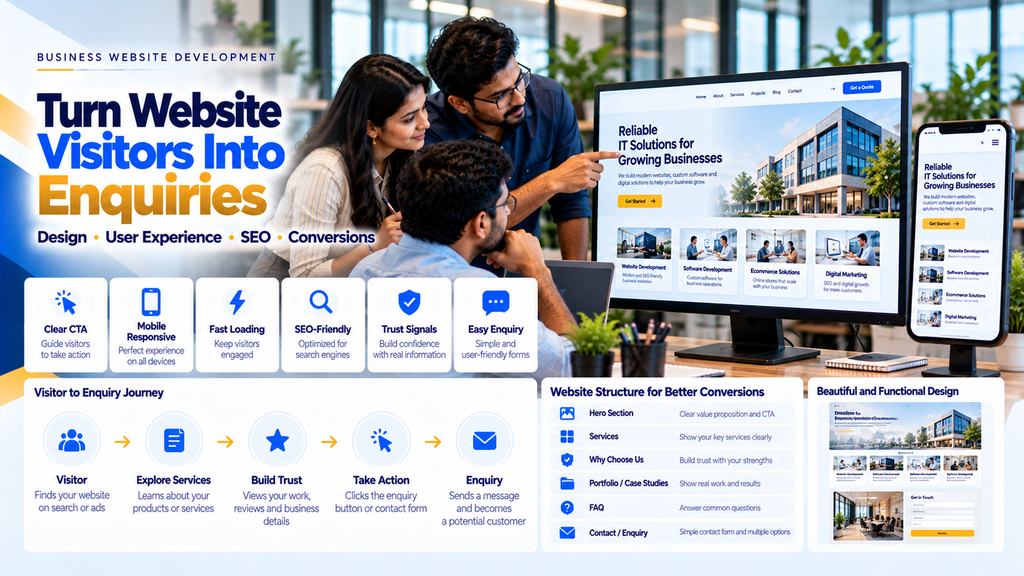
A conversion-focused website needs a clear information architecture.
A typical business website may include:
- Homepage
- About Us
- Services
- Individual Service Pages
- Industries Served
- Portfolio or Projects
- Case Studies
- Blog or Resources
- Frequently Asked Questions
- Contact
Not every business needs every page. The structure should reflect actual services and customer needs.
4. Design a Clear Homepage Hero Section
The hero section is often one of the first areas visitors see.
It should quickly communicate:
- What the business offers
- Who the service is for
- Why the visitor should continue
- What action is available next
Example Hero Content
Professional Business Website Development in Erode
Responsive business websites designed to present your services clearly and make customer enquiries easier.
CTA: Discuss Your Website Requirements
This is clearer than a generic heading such as “Welcome to Our Website.”
5. Use a Strong Value Proposition
A value proposition explains why a service is relevant to the customer.
It should focus on real capabilities and customer needs.
For example:
We develop responsive business websites with clear service pages, enquiry forms, and SEO-friendly technical foundations.
Avoid unsupported claims such as guaranteed sales increases or guaranteed first-page rankings.
6. Make Navigation Simple
Visitors should be able to find important information without unnecessary effort.
Useful navigation principles include:
- Clear menu labels
- Logical page hierarchy
- Easy access to services
- Visible contact options
- Consistent mobile navigation
- Descriptive internal links
Avoid complicated menus that hide important services behind unclear labels.
7. Build Mobile-Responsive Pages
Business websites should work across different screen sizes.
Important responsive design requirements include:
- Readable text
- Flexible layouts
- Responsive images
- Touch-friendly controls
- Accessible navigation
- Forms that fit mobile screens
- No unnecessary horizontal scrolling
Test actual mobile interactions rather than checking only how the homepage looks in a desktop browser.
8. Improve Website Loading Speed
Slow-loading pages can interrupt the visitor journey.
Important performance areas include:
- Optimized images
- Efficient JavaScript
- Appropriate caching
- Reliable hosting
- Reduced unnecessary third-party scripts
- Stable page layouts
Read How to Improve Website Page Speed for Better SEO and Conversions.
9. Understand Core Web Vitals
Core Web Vitals measure important aspects of real-world website experience.
| Metric | What It Measures |
|---|---|
| LCP | Loading performance |
| INP | Interaction responsiveness |
| CLS | Visual stability |
Good Core Web Vitals can support user experience, but they do not guarantee better rankings or more enquiries.
10. Create Dedicated Service Pages
Businesses offering multiple services should consider creating useful individual service pages.
For example, a technology company may provide:
- Website Development
- Ecommerce Development
- Software Development
- Mobile App Development
- SEO Services
- Digital Marketing
Each page should explain the specific service rather than repeat the same generic content.
11. Structure Service Pages for Conversions
A useful service page can follow this structure:
- Clear service heading
- Short explanation of the service
- Customer problems addressed
- Features or deliverables
- Relevant industries or use cases
- Development or service process
- Real examples where available
- Frequently asked questions
- Clear enquiry CTA
The exact structure should depend on the service and audience.
12. Use Clear Calls to Action
A call to action tells visitors what they can do next.
Examples include:
- Request a Quotation
- Discuss Your Requirements
- Book an Appointment
- View Our Services
- Contact Our Team
- Request a Demo
Choose CTA wording that accurately describes the action.
13. Place CTAs at Relevant Points
A CTA does not need to appear after every paragraph.
Useful placements may include:
- Homepage hero section
- After a service explanation
- After relevant portfolio examples
- Near pricing information
- At the end of a detailed service page
CTAs should be noticeable without interrupting the reading experience.
14. Make Contact Forms Easy to Complete
Long forms can create unnecessary friction.
For an initial enquiry, businesses may only need:
- Name
- Contact method
- Service required
- Brief requirement
Collect additional information only when it is necessary for the service or workflow.
Provide clear error messages, accessible labels, and confirmation after successful submission.
15. Integrate WhatsApp Appropriately
WhatsApp can be a convenient contact option for businesses whose customers prefer messaging.
A website can provide a direct WhatsApp contact link.
For example:
<a href="https://wa.me/917092330168">
  Chat on WhatsApp
</a>
Make sure the contact number is correct and the business is prepared to respond.
A WhatsApp button does not replace the need for accessible contact information or suitable enquiry forms.
16. Make Phone Contact Easy
Businesses that depend on phone enquiries should provide a clear contact number.
On mobile devices, a clickable phone link can reduce friction.
<a href="tel:+917092330168">
  Call +91 70923 30168
</a>
Display contact details consistently across relevant pages.
17. Build Trust With Genuine Business Information
Visitors may want evidence that a business is legitimate and capable of delivering its services.
Useful trust information can include:
- Clear company identity
- Real team information where appropriate
- Accurate business contact details
- Genuine portfolio projects
- Real customer testimonials with permission
- Relevant qualifications
- Transparent service information
- Clearly explained processes
Never invent customer reviews, client logos, certifications, awards, or project outcomes.
18. Add a Professional Portfolio
A portfolio can help potential customers understand the type of work a business performs.
Depending on the business, a portfolio may include:
- Website projects
- Software interfaces
- Ecommerce stores
- Manufacturing capabilities
- Product catalogues
- Completed installations
Only publish work that the business is authorized to display.
19. Use Case Studies to Explain Your Process
Case studies can provide useful context about real projects.
A simple structure is:
Client Requirement → Challenge → Approach → Implementation → Verified Outcome
If measurable results are unavailable, explain the completed work without inventing performance statistics.
20. Explain the Business Process
Customers often want to know what happens after they make an enquiry.
A website development process might include:
- Requirement discussion
- Project scope and quotation
- Design planning
- Development
- Testing
- Launch
- Support according to agreement
Clear process information can help customers understand expectations.
21. Use SEO-Friendly Website Architecture
A high-converting website also needs to attract relevant visitors.
SEO-friendly architecture can include:
- Descriptive URLs
- Logical heading structure
- Relevant page titles
- Useful content
- Internal linking
- Mobile accessibility
- Technical indexability
- Appropriate structured data
Read Technical SEO Services in Erode.
22. Research Keywords Based on Customer Intent
Keyword research helps identify how potential customers search for products and services.
Examples include:
- Website development company in Erode
- Business website development Erode
- Ecommerce website development Erode
- Custom software development Erode
- SEO services in Erode
Each keyword should be mapped to the most suitable page rather than inserted repeatedly throughout the website.
Read Local Keyword Research for Erode Businesses.
23. Optimize Website Content for Real Customers
Good website content should answer relevant customer questions.
For a business website, useful information may include:
- What the business offers
- Who the service is for
- What problems it addresses
- Important features
- Service process
- Pricing factors
- How to contact the business
Avoid keyword stuffing and generic statements that do not help customers make decisions.
24. Add Frequently Asked Questions
FAQ sections can address concerns that prevent visitors from taking action.
For example:
- What is included in the service?
- How does the process work?
- What information is required?
- What affects the project cost?
- Is ongoing support available?
Use accurate answers based on the business’s actual policies and capabilities.
25. Use Internal Links to Guide Visitors
Internal links help visitors move between related pages.
For example:
Homepage → Website Development → Business Website Service → Portfolio → Contact
Another journey may be:
SEO Blog → Related Service Page → Service Details → Enquiry
Internal linking should help users discover relevant information naturally.
26. Add Appropriate Schema Markup
Structured data can help search engines interpret certain information about a website.
Relevant schema types may include:
- Organization
- LocalBusiness where appropriate
- Service
- BreadcrumbList
- BlogPosting
Schema markup does not guarantee rich results or higher rankings.
Read Schema Markup SEO for Local Business Websites.
27. Make the Website Accessible
Accessibility improves usability for people with different abilities and assistive technologies.
Important practices include:
- Semantic HTML
- Accessible form labels
- Keyboard navigation
- Visible focus indicators
- Appropriate text contrast
- Descriptive image alternatives
- Clear error messages
- Usable interactive controls
Accessibility should be considered during design and development, not only after launch.
28. Use HTTPS and Secure Forms
Business websites often collect personal contact information through enquiry forms.
Security considerations include:
- HTTPS
- Server-side input validation
- Appropriate spam protection
- Secure data handling
- Software updates
- Access controls
- Privacy information
A professional website should protect submitted information and avoid collecting unnecessary personal data.
29. Improve Conversion Tracking
Businesses need to understand which website actions are useful.
Depending on the website, measurable events may include:
- Form submissions
- Phone-link clicks
- WhatsApp-link clicks
- Appointment bookings
- Quotation requests
- Purchases
Configure analytics and consent handling according to applicable privacy requirements.
Do not treat every button click as a confirmed qualified lead.
30. Use Google Analytics and Search Console
Google Analytics can help businesses understand website activity and configured conversion events.
Google Search Console provides information about search visibility, indexing, and search performance.
Together, these tools can support website improvement decisions.
They do not automatically explain every reason why a visitor did or did not convert.
31. Test the Website Before Launch
A business website should be tested across devices and important user journeys.
Useful tests include:
- Mobile navigation
- Desktop navigation
- Tablet layouts
- Contact forms
- Phone links
- WhatsApp links
- Page loading
- Image rendering
- Keyboard accessibility
- Broken links
- Indexability
- Security configuration
32. Use A/B Testing When Appropriate
A/B testing compares different versions of a page or element to understand how changes affect a defined outcome.
Potential tests include:
- CTA wording
- Form layout
- Hero content
- Service-page structure
- Contact placement
Testing requires appropriate traffic, reliable measurement, and careful interpretation.
For low-traffic websites, usability research and targeted improvements may be more practical than formal A/B testing.
33. Website Conversion Optimization for Different Industries
| Business Type | Important Website Features |
|---|---|
| Local Service Business | Service pages, contact details, enquiry forms |
| Manufacturer | Capabilities, product catalogue, quotation requests |
| Textile Business | Product categories, specifications, wholesale enquiries |
| Software Company | Solution pages, workflows, demo requests |
| Clinic | Services, doctor information, appointment booking |
| Ecommerce Store | Product pages, cart, checkout, support information |
34. High-Converting Websites for Manufacturers in Erode
Manufacturing websites often need to support B2B enquiries.
Useful elements may include:
- Manufacturing capabilities
- Product specifications
- Industry applications
- Real facility information
- Quality processes
- Downloadable catalogues
- Quotation request forms
The website should help potential buyers determine whether the manufacturer can meet their requirements.
35. High-Converting Websites for Textile Businesses
Textile businesses may need websites that explain product ranges and simplify wholesale enquiries.
Depending on the business, useful features may include:
- Fabric or yarn categories
- Product photographs
- Material specifications
- Wholesale enquiry options
- Product catalogue downloads
- Business contact information
36. High-Converting Websites for Software Companies
Software buyers may need detailed information before requesting a quotation or demonstration.
Useful content can include:
- Software features
- Industry-specific use cases
- Workflow explanations
- Integration information
- Implementation process
- Support scope
- Demo request options
37. High-Converting Websites for Local Service Providers
Service businesses may benefit from a simple customer journey:
Find Service → Understand Scope → Review Trust Information → Contact Business
Important features can include:
- Clear service descriptions
- Relevant local information
- Visible phone number
- Easy enquiry form
- Accurate business hours
- Genuine reviews
38. Local SEO for Erode Business Websites
Businesses targeting Erode and nearby areas should build location relevance naturally.
Potential service areas include:
- Erode
- Perundurai
- Bhavani
- Anthiyur
- Gobichettipalayam
- Sathyamangalam
- Chennimalai
- Modakkurichi
- Kodumudi
- Nambiyur
- Kavindapadi
- Ammapettai
- Arachalur
- Sivagiri
- Punjai Puliampatti
- Thalavadi
Businesses should only describe locations they genuinely serve.
Do not create dozens of near-identical location pages simply by replacing town names.
39. Common Website Conversion Mistakes
- Using vague homepage headlines
- Hiding important services
- Adding too many competing CTAs
- Using complicated enquiry forms
- Ignoring mobile visitors
- Publishing generic service content
- Using fake testimonials
- Making unsupported guarantees
- Ignoring website speed
- Using inaccessible forms
- Failing to test contact buttons
- Ignoring technical SEO
- Measuring traffic without meaningful conversion events
- Never reviewing website performance
40. Complete High-Converting Business Website Checklist
- Define the website’s primary business goal.
- Understand target customers.
- Research customer search intent.
- Plan the page structure.
- Create a clear homepage hero.
- Explain the business value proposition.
- Build dedicated service pages.
- Use responsive layouts.
- Optimize page speed.
- Use clear calls to action.
- Simplify enquiry forms.
- Make phone and WhatsApp contact accessible.
- Publish genuine trust information.
- Add relevant portfolio content.
- Explain the service process.
- Implement SEO fundamentals.
- Use relevant internal links.
- Apply appropriate schema markup.
- Review website accessibility.
- Secure customer information.
- Configure meaningful analytics events.
- Test important user journeys.
- Monitor results after launch.
- Improve based on evidence.
41. How Greap Technologies Can Help
Greap Technologies can support businesses planning professional, conversion-focused websites.
Depending on the agreed project scope, website development work can include:
- Business requirement analysis
- Website planning
- UI/UX design
- Responsive development
- Service-page architecture
- Contact and enquiry forms
- WhatsApp integration
- SEO-friendly development
- Website speed optimization
- Technical SEO setup
- Analytics event planning
- Website testing
- Maintenance and support
Explore Website Development Services, SEO Services, and Greap Technologies.
42. How Much Does a High-Converting Business Website Cost in Erode?
The development cost depends on the website’s requirements.
Factors may include:
- Number of pages
- Custom UI/UX design
- Content requirements
- Enquiry forms
- CMS integration
- Appointment booking
- Custom functionality
- SEO requirements
- Third-party integrations
- Hosting and maintenance
A basic service website and a custom B2B lead-generation platform may require different development scopes and budgets.
43. How Long Does It Take to Build a Business Website?
The timeline depends on the scope, design requirements, content readiness, integrations, feedback cycles, and testing.
A simple informational website may require less development work than a custom website with multiple forms, dashboards, or integrations.
Businesses should confirm deliverables and milestones before development begins.
Conclusion
Building a high-converting business website in Erode requires more than attractive colours, animations, and modern layouts.
A useful business website should make it easy for customers to understand the business, explore relevant services, evaluate genuine information, and take the next step.
A practical website strategy is:
Understand Customers → Plan Content → Design Experience → Develop Website → Optimize SEO → Simplify Enquiries → Measure → Improve
For businesses in Erode and across Tamil Nadu, combining professional website development with clear service content, mobile responsiveness, performance, and meaningful conversion tracking can support a stronger digital presence.
However, no website design can guarantee a particular number of enquiries, sales, or Google rankings.
Planning a Business Website in Erode?
Greap Technologies can help you plan a professional business website with responsive design, clear service pages, SEO-friendly development, and enquiry-focused features.
Frequently Asked Questions
1. What is a high-converting business website?
A high-converting business website helps relevant visitors complete useful actions such as enquiries, calls, appointments, quotation requests, or purchases.
2. How can I increase website enquiries?
Start by improving service clarity, navigation, calls to action, mobile usability, forms, trust information, and website performance. Measure results to identify effective improvements.
3. Does website design affect conversions?
Website design can influence how easily visitors understand information and complete actions, but visual design alone does not guarantee more conversions.
4. Why is mobile responsiveness important?
Responsive design helps websites remain usable across mobile phones, tablets, and desktop devices.
5. Does website speed affect lead generation?
Slow pages can create friction in the enquiry journey. Improving performance can support usability, but additional leads are not guaranteed.
6. What should a business website homepage include?
A homepage should clearly explain the business, highlight important services, provide relevant trust information, and make the next action easy to find.
7. Should every service have a separate page?
Distinct services may benefit from dedicated pages when each page provides meaningful information for a different customer need.
8. Is WhatsApp integration useful for business websites?
WhatsApp can be a convenient enquiry option when it matches customer preferences and the business can respond appropriately.
9. How do I measure website conversion rate?
Define a meaningful conversion event and calculate the percentage of sessions or users completing it, using a consistent measurement method.
10. Can SEO and conversion optimization work together?
Yes. SEO helps relevant visitors discover website content, while conversion optimization improves the experience and actions available after they arrive.
11. How much does a business website cost in Erode?
Cost depends on the number of pages, design requirements, features, integrations, content, SEO scope, and maintenance requirements.
12. Does Greap Technologies develop conversion-focused websites in Erode?
Greap Technologies can provide responsive website development, UI/UX planning, service-page design, enquiry features, and SEO-friendly implementation according to the agreed project requirements.