A business website can look professional and still struggle to communicate clearly with search engines and potential customers.
The problem is not always the design.
Sometimes the individual pages have unclear titles, weak headings, thin content, overlapping keywords, poor internal links, unoptimized images or content that does not properly match what customers are searching for.
This is where on-page SEO services in Erode can help.
On-page SEO focuses on improving the elements within a website and its individual pages so that the content, structure and purpose are easier for both users and search engines to understand.
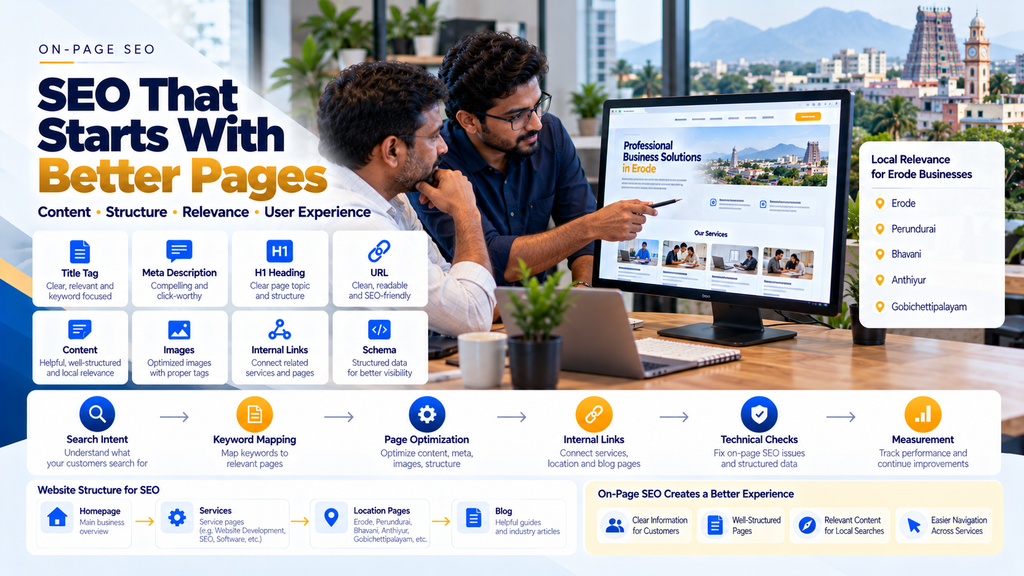
A practical process looks like:
Search Intent → Keyword Mapping → Page Optimization → Internal Linking → Technical Checks → Measurement → Continuous Improvement
This guide explains how on-page SEO works, what businesses in Erode should optimize, common mistakes to avoid and what to check before choosing an SEO company.
What Is On-Page SEO?
On-page SEO is the process of improving individual website pages to make their purpose, content and structure clearer for users and search engines.
Depending on the website, on-page optimization can include:
- Search-intent analysis
- Keyword research
- Keyword-to-page mapping
- Title tag optimization
- Meta description optimization
- Heading structure
- Page content
- URL structure
- Internal linking
- Image optimization
- ALT text
- Breadcrumbs
- Structured data where appropriate
- Content duplication review
- Basic crawlability and indexability checks
- Mobile usability
- Page experience
- Conversion-focused page improvements
Why Is On-Page SEO Important for Businesses in Erode?
Customers increasingly research businesses, services and products online before contacting a company.
A business may offer an excellent service in Erode, but its website still needs to explain that service clearly.
For example, a page simply titled:
Our Services
provides less context than a properly structured page dedicated to the actual service the business provides.
On-page SEO helps connect:
What Customers Search → What Your Business Offers → The Most Relevant Website Page
On-Page SEO Is Not Just Adding Keywords
One of the biggest misunderstandings about SEO is that optimization means repeating a keyword throughout a page.
That is not a good on-page SEO strategy.
A stronger approach considers:
Search Intent + Page Purpose + Helpful Content + Clear Structure + Internal Links + Technical Accessibility + User Experience
The objective is to create the best possible page for the intended topic and audience rather than forcing keywords into every paragraph.
What Is Search Intent?
Search intent is the underlying reason someone performs a search.
Understanding it is one of the first steps in on-page optimization.
Informational Intent
The user wants to learn something.
Example:
How does local SEO work?
Commercial Investigation
The user is researching possible providers or solutions.
Example:
best SEO company for small business
Service Intent
The user is looking for a service provider.
Example:
SEO services in Erode
Local Intent
The search has a geographic requirement.
Example:
on-page SEO services in Erode
Step 1: Audit Existing Website Pages
Before rewriting content, understand what already exists.
A website audit can identify:
- Existing service pages
- Existing location pages
- Blog articles
- Duplicate pages
- Missing titles
- Duplicate titles
- Missing H1 headings
- Multiple competing pages
- Weak internal links
- Broken links
- Redirected URLs
- Pages receiving organic impressions
- Pages receiving little search visibility
Step 2: Research Relevant Keywords
Keyword research helps understand how potential customers describe products, services and problems.
For a business in Erode, keyword research can include several levels.
Primary Service Keywords
These represent the main service.
For example:
website development
Local Service Keywords
These combine genuine service demand with location intent.
For example:
website development company in Erode
Specific Service Keywords
These represent narrower requirements.
For example:
ecommerce website development in Erode
Problem-Based Keywords
These describe a problem potential customers want to solve.
Informational Keywords
These can support blog and educational content.
Step 3: Map Keywords to the Correct Pages
Keyword mapping determines which page should primarily address each important search intent.
For example:
Website Development → Website Development Service Page
Ecommerce Development → Ecommerce Development Page
SEO Services → SEO Service Page
Google Maps SEO → Dedicated Service or Supporting Guide
Website Speed → Speed Optimization Page / Supporting Content
This prevents the entire website from trying to rank every page for the same broad keyword.
Why Keyword Mapping Matters
Without a keyword map, businesses may accidentally create several pages targeting almost identical intent.
For example:
/seo-services-erode/
/best-seo-company-erode/
/seo-agency-erode/
/seo-experts-erode/
If all four pages provide substantially the same content and purpose, they may create unnecessary duplication instead of building a clear website structure.
Step 4: Optimize the Title Tag
The title element is an important page-level SEO signal and can also influence how a search result is presented.
Describe the Page Accurately
The title should communicate the page’s primary topic.
Use the Primary Topic Naturally
Do not repeat the same phrase several times.
Include Location When It Is Genuinely Relevant
A local service page can naturally reference Erode when the business serves customers there.
Differentiate Important Pages
Each important page should have a title appropriate to its own purpose.
Example of an Over-Optimized Title
SEO Erode | Best SEO Erode | SEO Company Erode | SEO Services Erode
This is unnecessarily repetitive.
Example of a Clearer Title
SEO Services in Erode | Greap Technologies
The goal is clarity, not maximum repetition.
Step 5: Optimize the Meta Description
A meta description can summarize what the page offers to potential search visitors.
Explain the Page Clearly
Tell users what they can expect after clicking.
Include Relevant Context
The main service and location can be mentioned naturally where appropriate.
Write for Humans
A meta description should read like useful search-result copy rather than a list of keywords.
Avoid Fake Claims
Do not write claims such as “Guaranteed #1 Google Ranking” unless they can genuinely be supported—which, for rankings, cannot responsibly be guaranteed.
Step 6: Optimize the H1 Heading
The main H1 should make the primary topic of the page immediately clear.
Use a Clear Main Heading
For example:
Website Development Services in Erode
Avoid Vague Headings
A heading such as:
Transform Your Digital Future
may sound attractive but does not clearly explain the service.
A creative supporting line can still be used, but the primary heading should communicate the page purpose.
Step 7: Build a Logical Heading Structure
Headings make longer pages easier to scan and understand.
A simple structure can be:
H1 → Main Page Topic
H2 → Major Sections
H3 → Supporting Subsections
Do Not Choose Headings Only for Font Size
Heading tags should represent content hierarchy rather than being used purely for visual styling.
Step 8: Improve the Main Page Content
Content should answer the questions a potential customer is likely to have before contacting the business.
Explain the Service
What does the business actually provide?
Explain Who It Is For
Which types of businesses or customers is the service designed for?
Explain the Process
How does the project or service normally work?
Explain Important Features
What is included?
Explain Relevant Limitations
Avoid creating unrealistic expectations.
Answer Common Questions
Useful FAQs can reduce uncertainty for potential customers.
Step 9: Improve Content Quality
Strong on-page SEO content should be written primarily to help the intended audience.
Avoid Generic AI-Looking Content
Do not publish hundreds of pages containing the same generic introduction, benefits and conclusion with only a keyword changed.
Add Business-Specific Information
Include actual services, processes, industries, capabilities and relevant local context.
Use Examples Where Useful
Examples can make technical services easier to understand.
Remove Filler
Longer content is not automatically better content.
Step 10: Avoid Keyword Stuffing
A page does not need to repeat “SEO company in Erode” in every paragraph.
Use the primary topic naturally and include related terminology where it genuinely helps explain the service.
Step 11: Optimize the URL
URLs should be stable and understandable.
For example:
/seo-services/
or a carefully planned local service URL where the site architecture requires it.
Avoid Unnecessarily Long URLs
Do not insert every possible keyword into the slug.
Avoid Changing Established URLs Without a Reason
If a URL must change, use an appropriate redirect to the relevant replacement.
Step 12: Improve Internal Linking
Internal links help users discover related pages and help search engines understand relationships across the website.
A useful business website architecture can look like:
Homepage → Main Services → Specific Services → Supporting Blog Content
Homepage to Important Services
Core services should be accessible through logical navigation or relevant homepage sections.
Service Page to Related Service
Connect genuinely related offerings.
Blog to Service Page
Informational articles can direct users to a relevant commercial service when appropriate.
Service Page to Useful Guide
A potential customer who needs more information can continue researching.
Example SEO Content Cluster
For an SEO service business:
SEO Services
↓
On-Page SEO
Technical SEO
Local SEO
Google Maps SEO
Website Speed Optimization
↓
Supporting SEO Guides and Blog Articles
Step 13: Use Descriptive Internal-Link Anchor Text
Link text should help users understand the destination.
For example:
Read our Technical SEO Checklist for Business Websites in Erode.
This provides more context than repeatedly using generic text such as “click here.”
Step 14: Find and Fix Orphan Pages
An orphan page has little or no useful internal-link connection from the rest of the website.
Important service pages should be integrated into the site’s navigation and content structure rather than existing only in a sitemap.
Step 15: Optimize Images
Images can improve page communication, but poorly optimized assets can make pages unnecessarily heavy.
Use Appropriate Dimensions
Do not serve a massive image when it is displayed as a small card.
Compress Images
Reduce unnecessary file size while preserving suitable quality.
Use Modern Formats Where Appropriate
Formats such as WebP or AVIF can be considered depending on the website’s technical requirements.
Add Useful ALT Text
Alternative text should describe meaningful images appropriately.
Avoid ALT Keyword Stuffing
ALT text is not a place to repeat every SEO keyword.
Step 16: Improve Page Speed
On-page optimization should not ignore how the page performs for real users.
Common performance problems can include:
- Oversized images
- Too many scripts
- Unused CSS or JavaScript
- Heavy third-party widgets
- Slow hosting
- Unoptimized fonts
- Excessive page-builder components
Read Website Speed Optimization Services in Erode.
Step 17: Review Core Web Vitals
Performance and user experience should be evaluated as part of the wider SEO process.
Important considerations include loading performance, interaction responsiveness and layout stability.
Read Core Web Vitals Optimization for Business Websites in Erode.
Step 18: Optimize for Mobile Users
Business websites should provide a strong experience on smartphones as well as desktop devices.
Readable Text
Users should not need to zoom to read basic content.
Usable Navigation
Important pages should be easy to access.
Touch-Friendly Buttons
Calls to action should be practical to use on mobile.
No Horizontal Overflow
Tables, images and page sections should remain within the viewport.
Fast Mobile Loading
A visually attractive website should not become unnecessarily heavy on mobile connections.
Step 19: Review Crawlability
An optimized page has limited search value if search engines cannot access it as intended.
Review factors such as:
- Robots directives
- Internal links
- HTTP status
- Canonical configuration
- JavaScript rendering where relevant
Step 20: Review Indexability
Important pages intended for search visibility should not accidentally contain directives or configurations preventing indexing.
Check Noindex Directives
Ensure important pages are not unintentionally excluded.
Check Canonical Tags
A service page should not accidentally canonicalize to an unrelated page.
Check Redirects
An intended landing page should not unexpectedly redirect elsewhere.
Step 21: Optimize Canonical Tags
Canonical tags can help communicate a preferred URL when duplicate or substantially similar URLs exist.
They should be configured based on the actual site architecture rather than applied blindly.
Step 22: Use XML Sitemaps Correctly
XML sitemaps can help search engines discover important canonical URLs.
A sitemap should generally focus on URLs the business actually intends to have processed for search.
Avoid Redirected URLs
Old URLs that permanently redirect should not unnecessarily remain in the active sitemap.
Avoid Unwanted URLs
Do not fill the sitemap with internal search pages, test pages or other URLs the business does not want treated as search landing pages.
Step 23: Add Structured Data Where Appropriate
Structured data can provide machine-readable information about supported page entities.
Depending on the website and visible content, relevant types may include:
- Organization
- LocalBusiness
- BreadcrumbList
- Product
- Article
- Service-related information where supported by the chosen vocabulary and implementation
Markup should accurately represent visible or legitimate page information.
Do Not Add Fake Reviews
Never create review markup for testimonials or ratings that do not genuinely exist.
Do Not Add Fake Business Information
Structured data should not be used to create misleading locations, services or business details.
Schema Does Not Guarantee Rankings
Structured data can improve machine readability and may enable eligible search features, but it is not a guaranteed ranking method.
Step 24: Optimize Breadcrumbs
Breadcrumbs can help users understand where a page sits within the website.
For example:
Home → SEO Services → On-Page SEO
This can also strengthen logical internal linking.
Step 25: Improve Local Relevance
For businesses genuinely serving Erode, local relevance should come from real business context rather than repeating the word “Erode” throughout every paragraph.
Explain the Service Area Naturally
Tell potential customers where the business operates.
Add Genuine Local Business Information
Use accurate business details where relevant.
Discuss Local Industries Where Appropriate
If the business has genuine experience serving industries common in the region, explain that experience accurately.
Use Local Case Studies When Available
Real project examples can provide stronger local context than simply inserting town names into generic content.
Step 26: Avoid Creating Near-Duplicate Location Pages
A common local SEO mistake is duplicating one service page dozens of times and changing only the town name.
For example:
SEO Services in Erode
SEO Services in Perundurai
SEO Services in Bhavani
SEO Services in Anthiyur
If every page contains essentially identical content, the website is not providing much unique value.
Create Location Pages Only When Useful
A dedicated location page should have a genuine reason to exist.
Add Location-Specific Information
Where applicable, include meaningful service-area information, relevant work, business context and useful local content.
Do Not Mass-Generate Town Pages
More pages do not automatically create stronger local rankings.
Step 27: Connect On-Page SEO With Google Maps SEO
A local business website and its business listing should communicate consistent information about the company and its services.
Website content can support customers who discover the business through local search by giving them detailed service information after they visit the site.
Read Google Maps SEO for Service Businesses in Erode.
Step 28: Improve Calls to Action
SEO should attract relevant visitors, but the website also needs to help those visitors take the next step.
Depending on the business, calls to action can include:
- Request a quote
- Call the business
- Send a WhatsApp enquiry
- Book a consultation
- Submit a contact form
- View relevant services
- View a portfolio or case study
Step 29: Place CTAs at Useful Points
A visitor should not need to reach the final line of a very long page before finding a way to contact the business.
Useful CTA locations can include:
Introduction → Relevant Service Explanation → Decision Section → Conclusion
Step 30: Connect SEO With Conversion Optimization
Ranking is not the final business objective.
A more useful journey is:
Relevant Search → Useful Landing Page → Trust → Service Understanding → Enquiry
On-page SEO and conversion-focused design should therefore support each other.
Step 31: Review Existing Search Performance
Before making major changes to an established page, review its current search performance.
A page may already receive impressions or clicks for valuable searches.
Blindly replacing its URL, title and content can create unnecessary risk.
Step 32: Use Google Search Console Data
Search performance data can help identify opportunities and problems.
Review:
- Queries
- Pages
- Clicks
- Impressions
- Click-through trends
- Indexing information
Step 33: Use Analytics Data Carefully
Website analytics can help show what happens after visitors arrive.
Depending on the website’s measurement setup, useful actions can include:
- Contact form submissions
- Phone interactions
- WhatsApp interactions
- Quote requests
- Bookings
- Product purchases
The measurement setup should be tested so that business decisions are not based on broken tracking.
Step 34: Measure SEO Leads, Not Just Traffic
A page receiving more traffic is not automatically producing more business.
A more useful measurement model is:
Organic Visibility → Relevant Visit → Engagement → Enquiry → Qualified Lead → Business Outcome
Step 35: Update Important Pages Over Time
On-page SEO is not necessarily a one-time task.
Businesses change.
Services change.
Customer questions change.
Websites change.
Important pages should be reviewed periodically when there is a genuine reason to update them.
On-Page SEO for Service Businesses in Erode
Service businesses often need pages that clearly explain individual offerings.
A useful structure can be:
Homepage → Service Category → Individual Service → Supporting Guides → Contact
Each important service page should answer the questions potential customers are likely to have before making an enquiry.
On-Page SEO for Manufacturers in Erode
Manufacturing websites often require a different SEO structure from a local service website.
Important page types can include:
- Product categories
- Product catalogue pages
- Individual products
- Capabilities
- Industries served
- Applications
- Infrastructure
- Quality information
- Enquiry pages
Read Product Catalogue Website Development for Manufacturers in Erode.
On-Page SEO for B2B Businesses
B2B buyers may search differently from consumer customers.
Pages may need to address:
- Product specifications
- Bulk requirements
- Business applications
- Industries served
- RFQ process
- Dealer/distributor information
- Technical documentation
- Business enquiries
On-Page SEO for Ecommerce Websites
Ecommerce SEO needs to scale across potentially hundreds or thousands of URLs.
Important page types include:
Homepage → Category → Subcategory → Product
with supporting buying guides and informational content.
Read Ecommerce Category Page SEO: Complete Optimization Guide and Ecommerce Product Page SEO: How to Rank Products on Google.
On-Page SEO for Local Businesses
Local businesses should connect website SEO with their broader local presence.
This can include:
- Clear business information
- Relevant service pages
- Accurate service areas
- Useful location information
- Google Business Profile
- Consistent contact details
- Customer reviews
- Local citations
Read Local Citation Building for Erode Businesses: Complete Guide.
Technical SEO vs On-Page SEO
These areas overlap, but they are not identical.
| On-Page SEO | Technical SEO |
|---|---|
| Search intent | Crawlability |
| Keyword mapping | Indexability |
| Titles and headings | HTTP status codes |
| Page content | Canonical implementation |
| Internal linking | XML sitemaps |
| Image context | Robots directives |
| Page relevance | Rendering and architecture |
| User-focused content structure | Performance and technical implementation |
A strong SEO strategy usually considers both rather than treating them as isolated activities.
Read Technical SEO Checklist for Business Websites in Erode.
On-Page SEO vs Off-Page SEO
| On-Page SEO | Off-Page SEO |
|---|---|
| Website content | External mentions and links |
| Titles | Digital PR |
| Headings | Relevant citations |
| Internal links | Brand visibility outside the website |
| Page structure | External authority signals |
| Images | Third-party references |
Improving off-page signals cannot fully compensate for a website whose pages are confusing, thin or technically inaccessible.
Local SEO vs On-Page SEO
Local SEO has a wider geographic focus and can involve the website, business profile, reviews, citations and local prominence.
On-page SEO contributes by ensuring the website clearly communicates:
- What the business does
- Which services it provides
- Where it genuinely operates
- How customers can contact it
- Why each page exists
How Long Does On-Page SEO Take?
The implementation time depends on the size and condition of the website.
A small business website with a limited number of pages may require a different amount of work from an ecommerce or manufacturing website with thousands of URLs.
Factors include:
- Number of pages
- Existing content quality
- Website platform
- Keyword research requirements
- Duplicate content
- Technical problems
- Internal-link structure
- Approval workflow
- Developer involvement
Implementation time should not be confused with ranking time. Search visibility changes cannot be promised on a fixed schedule.
How Much Do On-Page SEO Services Cost in Erode?
The cost depends on the actual scope of work rather than the number of times a keyword can be inserted into a website.
Pricing can be influenced by:
- Website size
- Number of priority pages
- Keyword research
- Competitor/search landscape research
- Content rewriting requirements
- New content requirements
- Technical SEO issues
- Internal-link restructuring
- Schema implementation
- Analytics and measurement setup
- Ongoing optimization requirements
A proper SEO audit should help define the scope before a business compares quotations.
What Should an On-Page SEO Audit Include?
- Website architecture
- Priority URLs
- Keyword mapping
- Search intent
- Title tags
- Meta descriptions
- H1 and heading structure
- Content quality
- Duplicate content
- URLs
- Internal links
- Orphan pages
- Images
- ALT text
- Broken links
- Redirects
- Canonicals
- Indexability
- XML sitemap
- Structured data
- Mobile experience
- Performance
- Conversion paths
Complete On-Page SEO Checklist
- One clear purpose for each important page
- Correct search intent
- Primary topic mapped to the correct URL
- Descriptive title
- Useful meta description
- Clear H1
- Logical H2/H3 structure
- Helpful original content
- Natural keyword usage
- Clean URL
- Relevant internal links
- No important orphan pages
- Optimized images
- Useful ALT text
- Mobile-friendly layout
- Fast page experience
- Correct HTTP status
- Correct indexability
- Appropriate canonical
- Updated XML sitemap
- Accurate structured data where appropriate
- Useful breadcrumbs
- Clear calls to action
- Search performance monitored
- Conversions measured where appropriate
Common On-Page SEO Mistakes
- Keyword stuffing
- Targeting every keyword on the homepage
- Creating multiple pages for the same intent
- Duplicating location pages
- Using the same title on many pages
- Using vague H1 headings
- Publishing thin generic content
- Writing only for search engines
- Creating content only to reach a word count
- Ignoring internal links
- Leaving important pages orphaned
- Using oversized images
- Ignoring mobile users
- Ignoring page speed
- Incorrect canonical tags
- Accidental noindex directives
- Broken links
- Unnecessary redirects
- Fake review schema
- Changing high-performing URLs without planning
- Tracking traffic but not enquiries
- Expecting instant ranking changes
- Guaranteeing first-position rankings
How to Choose an On-Page SEO Company in Erode
Before choosing a provider, ask how they approach the website rather than simply asking how many keywords they will optimize.
1. Do They Audit the Website First?
Recommendations should be based on the current website.
2. Do They Understand Search Intent?
Keyword volume alone is not enough.
3. Do They Create a Keyword Map?
Important topics should be assigned to appropriate pages.
4. Do They Review Technical Problems?
Content changes cannot solve every crawlability or indexability issue.
5. Do They Review Internal Linking?
A website should function as a connected structure rather than a collection of isolated pages.
6. Do They Understand Your Business?
The content should accurately represent your services, products and customers.
7. Do They Measure Business Actions?
SEO reporting should go beyond a screenshot of several keyword positions.
8. Do They Promise Guaranteed Rankings?
Be cautious of guaranteed first-position claims. Search rankings depend on many factors outside an SEO provider’s direct control.
On-Page SEO Services Across Erode District
Greap Technologies works with businesses in Erode and surrounding areas, including:
- Erode
- Perundurai
- Bhavani
- Anthiyur
- Gobichettipalayam
- Sathyamangalam
- Modakkurichi
- Kodumudi
- Nambiyur
- Chennimalai
- Kavindapadi
- Ammapettai
- Arachalur
- Sivagiri
- Punjai Puliampatti
- Thalavadi
- Nasiyanur
- Surampatti
- Veerappanchatram
The objective should not be to repeat all of these locations across every website page. Location targeting should be planned according to actual service areas, customer intent and the site’s overall architecture.
How Greap Technologies Approaches On-Page SEO
Greap Technologies can review on-page SEO as part of the complete website and digital growth structure.
Depending on the business and website, the work can include:
- SEO website audit
- Keyword research
- Search-intent analysis
- Keyword mapping
- Service-page optimization
- Title and meta optimization
- Heading optimization
- Content improvement
- Local content optimization
- Internal-link strategy
- Image optimization
- URL review
- Canonical review
- Indexability review
- XML sitemap review
- Structured-data implementation where appropriate
- Mobile usability review
- Website speed optimization
- Core Web Vitals improvements
- Google Search Console review
- Analytics and conversion measurement review
- Ongoing SEO content planning
Explore Greap Technologies SEO Services, Website Development Services, Digital Marketing Services or visit Greap Technologies.
Recommended SEO Architecture for an Erode Business Website
A scalable structure can look like:
Homepage
↓
Main Service Pages
↓
Specific Service Pages
↓
Relevant Location Pages Where They Provide Genuine Value
+
Supporting Blog Content
↓
Case Studies / Portfolio / Proof
↓
Contact / Enquiry
On-Page SEO Should Be Part of a Wider SEO Strategy
On-page SEO alone is not the entire SEO process.
A broader strategy can connect:
Technical SEO
+
On-Page SEO
+
Content Strategy
+
Internal Linking
+
Local SEO
+
Relevant Off-Page Signals
+
Website Experience & Conversion Optimization
↓
Relevant Search Visibility → Qualified Website Visits → Enquiries
Conclusion
On-page SEO services in Erode should involve much more than adding keywords to an existing website.
A strong process connects:
Business Goals → Search Intent → Keyword Mapping → Page Structure → Useful Content → Internal Links → Technical Validation → Measurement
Each important website page should have a clear purpose.
The title should describe it.
The H1 should make the topic clear.
The content should answer relevant customer questions.
Internal links should connect it to the wider website.
Images and page assets should be optimized.
The page should work properly on mobile devices.
Search engines should be able to crawl and index it as intended.
And visitors should have a clear next step when they are interested in the service.
For local businesses, Erode relevance should come from genuine business and service-area context rather than excessive location-keyword repetition.
No on-page SEO company can responsibly guarantee a particular Google position. The objective is to improve relevance, content quality, site structure, technical accessibility and user experience so that the website has a stronger foundation for organic search growth.
Looking for On-Page SEO Services in Erode?
If your website has service pages but you are unsure whether the titles, content, keywords, internal links and technical SEO are structured correctly, Greap Technologies can review the existing website and identify priority on-page improvements.
Discuss Your On-Page SEO Requirements
Frequently Asked Questions
1. What are on-page SEO services?
On-page SEO services improve individual website pages through areas such as search-intent analysis, keyword mapping, titles, headings, content, URLs, internal links, images and other page-level SEO elements.
2. What is included in on-page SEO?
The exact scope depends on the website, but it can include keyword research, page mapping, title and meta optimization, headings, content improvements, internal linking, image optimization, URL review, structured data where appropriate and related technical checks.
3. Is on-page SEO important for local businesses in Erode?
Yes. A local business website needs to clearly explain its services, business context and genuine service areas. On-page SEO can help organize this information around relevant pages without relying on excessive location-keyword repetition.
4. Is adding keywords enough for on-page SEO?
No. Keywords are only one part of the process. Search intent, useful content, page structure, internal links, crawlability, mobile usability and the overall customer experience also matter.
5. How many keywords should one page target?
There is no universal number. A page should primarily satisfy a coherent search intent and can naturally cover closely related terms and questions. Unrelated intents are often better served by separate pages.
6. How long should an SEO service page be?
There is no required SEO word count. The page should contain enough useful information to explain the service and answer important customer questions without adding unnecessary filler purely to increase length.
7. Can I create separate SEO pages for every location in Erode district?
Dedicated location pages can make sense when they provide genuine location-specific value. Mass-producing near-identical pages and changing only the town name is not a strong long-term local SEO strategy.
8. What is the difference between on-page SEO and technical SEO?
On-page SEO focuses heavily on page purpose, content, headings, metadata and internal relationships. Technical SEO focuses more on areas such as crawling, indexing, status codes, canonicals, sitemaps, rendering and technical performance. The two areas often overlap.
9. Does on-page SEO include website speed?
Page speed is commonly treated as part of technical SEO and page experience, but it should be considered alongside on-page optimization because a slow page can create a poor user experience.
10. How long does on-page SEO take to improve rankings?
There is no fixed ranking timeline. Implementation time depends on the website, while changes in search visibility depend on many additional factors such as competition, existing site quality, crawling, indexing, content quality and wider search signals.
11. How much do on-page SEO services cost in Erode?
Cost depends on the number of pages, current website condition, research requirements, content work, technical problems, internal-link restructuring and whether ongoing optimization is required. A website audit can help define the actual scope before pricing.
12. Can on-page SEO guarantee first-page Google rankings?
No. On-page SEO can improve a website’s relevance, structure, content and technical foundation, but no provider can responsibly guarantee a specific Google ranking.